
Introduction
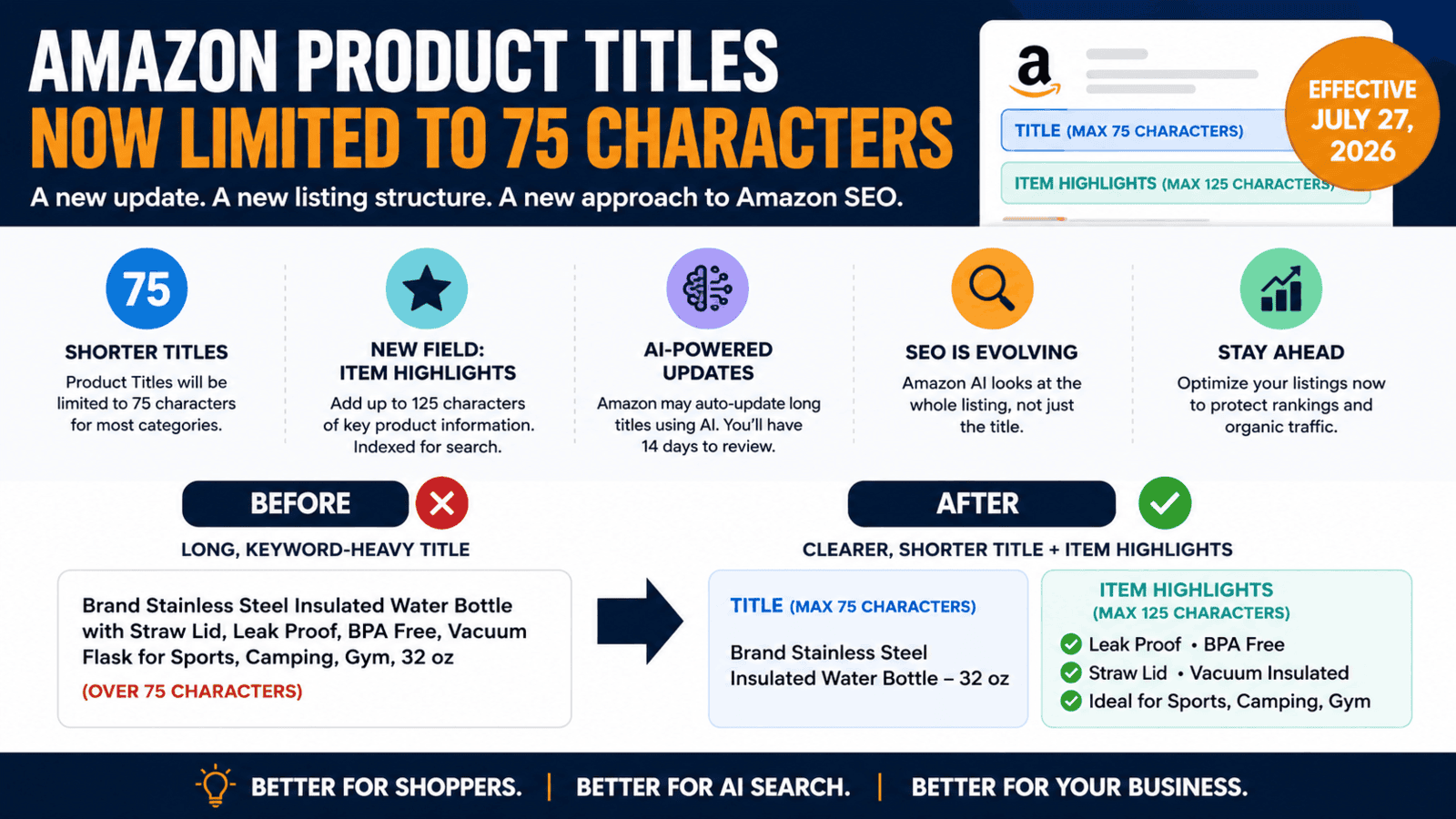
Starting July 27, 2026, Amazon is making one of the biggest listing updates in years. Product Titles for most categories will be limited to 75 characters (excluding Media), while a new field called Item Highlights will become part of the listing structure.
At first glance, this looks like a simple character limit. In reality, it signals a much broader shift. Amazon is redesigning product listings to improve the shopping experience while making them easier for AI-powered search and recommendation systems to understand.
What's Changing?
According to Amazon Seller Central, beginning July 27, 2026, Product Titles in most categories will be capped at 75 characters. At the same time, Amazon is introducing Item Highlights, a new field that allows sellers to add up to 125 characters of structured product information.
Amazon has also confirmed that listings with longer titles that aren't updated manually may be rewritten automatically using AI. Sellers will have 14 days to review and edit AI-generated titles before they're applied.
Why Is Amazon Shortening Product Titles?
Officially, Amazon says the change is intended to improve readability, especially on mobile devices.
However, there's a much bigger trend behind it.
Over the past year, Amazon has invested heavily in AI-driven shopping experiences, including Alexa for Shopping (formerly Rufus), AI-powered recommendations, and generative content tools. These systems perform better when product information is organized into dedicated fields instead of being packed into a single keyword-heavy title.
Rather than relying primarily on Product Titles to describe a product, Amazon is moving toward a structured listing where each element serves a specific purpose.
Modern Amazon AI doesn't just scan keywords. It analyzes product attributes, materials, compatibility, use cases, customer intent, and shopping behavior to determine which products are most relevant for each shopper.
The New Amazon Listing Structure
This update doesn't make Product Titles less important—it changes what belongs inside them.
Instead of cramming every keyword and feature into the title, sellers should focus on the essentials: the product type and the most important search terms that clearly identify the item.
Additional information that previously appeared at the end of long titles—materials, compatibility, key benefits, sizes, or product features—should move into Item Highlights.
Amazon has confirmed that Item Highlights are indexed for search and displayed both in search results and on the product detail page. That makes this field an important part of future Amazon listing optimization.
Item Highlights are also the ideal place to describe product benefits, compatibility, materials, and common use cases in a way that's easier for both shoppers and AI systems to understand.
Getting your listings ready for Amazon's new requirements?
We optimize Product Titles, Item Highlights, and entire Amazon listings for the latest platform updates.
Our SEO- and AI-optimized content helps protect organic rankings and improve product visibility.
What We Know About Indexing
This update has sparked plenty of discussion among Amazon sellers, especially around search visibility.
So far, Amazon has officially confirmed two things:
Product Titles remain indexed.
Item Highlights are also indexed for search.
That makes Item Highlights a legitimate SEO field rather than just another product attribute.
What Amazon hasn't disclosed is how much ranking weight each listing element carries or whether the importance of Bullet Points, Product Descriptions, or Backend Search Terms will change.
How Amazon SEO Is Changing
The biggest shift isn't the 75-character limit itself—it's how Amazon evaluates listings.
Instead of relying heavily on keyword-rich titles, Amazon is moving toward a system that analyzes the entire product page.
AI now looks beyond keywords. It considers who the product is for, how it's used, what problems it solves, what it's compatible with, and which product attributes matter most to shoppers. That additional context helps Amazon deliver more relevant and personalized recommendations.
For sellers, this means the old strategy of squeezing as many keywords as possible into the Product Title is becoming less effective.
Primary keywords should still remain in the title, but supporting information should be distributed across Item Highlights, Bullet Points, Product Description, and Backend Search Terms.
For example, instead of using a title like this:
Brand Stainless Steel Insulated Water Bottle with Straw Lid, Leak Proof, BPA Free, Vacuum Flask for Sports, Camping, Gym, 32 oz
a listing may now look like this:
Brand Stainless Steel Insulated Water Bottle – 32 oz
Features such as Leak Proof, BPA Free, Straw Lid, compatibility, and common use cases can move into Item Highlights and other listing fields.
The goal isn't to remove information—it's to organize it more effectively.What Sellers Should Do Now
Don't wait for Amazon to rewrite your titles automatically.
Review every listing with a Product Title longer than 75 characters and identify which search terms are essential. Keep only the most important keywords in the title, then move supporting details into Item Highlights, Bullet Points, and the Product Description.
Give special attention to Item Highlights. Since Amazon has confirmed this field is indexed, it's best used for meaningful product information—materials, dimensions, compatibility, key benefits, and common use cases—instead of promotional copy.
Conclusion
The new 75-character Product Title limit is only the most visible part of Amazon's latest update. The bigger change is a shift toward structured product data designed for both shoppers and AI-powered search.
For sellers, this means moving beyond optimizing a single field. Successful Amazon listing optimization will increasingly depend on how well information is distributed across Product Title, Item Highlights, Bullet Points, Product Description, and Backend Search Terms.
As Amazon expands the role of AI in search and product recommendations, listings need to be understandable not only to customers but also to algorithms. Rather than relying on keyword density alone, Amazon AI evaluates the overall context of a product—its attributes, benefits, compatibility, intended use, and the shopper's likely intent.
Frequently Asked Questions
Should I shorten my Product Titles now?
Yes. If your Product Titles exceed 75 characters, it's better to update them yourself. Otherwise, Amazon may generate a replacement using AI, and you'll have only 14 days to review or edit it.
What should move from the Product Title to Item Highlights?
Use Item Highlights for product materials, dimensions, compatibility, major benefits, and common use cases. Keep your Product Title focused on the product type and the most important search terms.
Will Bullet Points and Product Descriptions still matter for SEO?
Will shorter Product Titles hurt my rankings?
Why is Amazon introducing Item Highlights?
Item Highlights help create a cleaner listing structure, improve the mobile shopping experience, and provide Amazon's AI systems with more organized product data for search and recommendations.
Book a call now…
Book a call now…
Up to 45-min duration video-call
Topics we'll discuss:
| The next steps — there are two options
|