Introduction
Getting stuck during Amazon Seller Identity Verification (SIV) is one of the most common reasons new sellers never reach their first sale. Existing sellers may also be asked to verify their account again after updating their business address, banking details, or other key account information. In most cases, verification issues aren't caused by major business or compliance problems. Small inconsistencies—such as a mismatched name, an outdated bank statement, or a cropped document—are enough to delay approval. Understanding Amazon's requirements before you apply can help you avoid these mistakes.
This guide explains Amazon Seller Identity Verification based on Amazon's official requirements. You'll learn which documents to prepare, how to avoid common verification errors, and what to do if Amazon requests additional information. Successfully completing verification activates your Amazon Seller Account and allows you to start selling on the Amazon Marketplace.
What Is Amazon Seller Identity Verification?
Seller Identity Verification (SIV) is a mandatory review for all new Amazon sellers. During this process, Amazon verifies your identity, confirms your residential or business address, and validates your business information. Without completing verification, your seller account can't be activated.
Why Amazon Requires Verification
Amazon uses Seller Identity Verification to protect customers and maintain the integrity of its marketplace. Whether you're creating a new account or updating an existing one, Amazon verifies three key elements:
your identity;
your address;
your business.
Who Can Register to Sell on Amazon?
You don't need to be a U.S. resident to sell on Amazon.
Amazon accepts seller registrations from more than 180 countries and territories. As long as your country is supported, you can register an Amazon Seller Account with:
residency in a supported country;
a valid phone number;
a credit card that supports international transactions.
Why Many International Sellers Form a U.S. Company
Although Seller Identity Verification doesn't require a U.S. business entity, many international entrepreneurs choose to register an LLC or Corporation because it simplifies the overall process.
A U.S. company can make it easier to:
open a business bank account;
complete business verification;
register on Amazon;
manage taxes;
access additional Amazon services and product categories;
separate business and personal liability.
What You Need to Register an Amazon Seller Account
Besides the documents required for Seller Identity Verification, Amazon typically asks for:
a valid credit card;
a business or personal bank account (depending on your account type);
a phone number;
tax information.
Every seller must also complete the Tax Interview, an online questionnaire that determines which tax form applies:
Form W-9 for U.S. taxpayers.
Form W-8BEN (or another applicable W-8 form) for most international sellers.
Amazon may also request supporting documents such as:
a passport or government-issued ID;
a bank or credit card statement;
additional identity documents.
Some of these overlap with the documents required for Seller Identity Verification, but they're requested separately during the registration process.
Once your account is verified, all submitted information becomes part of your Amazon Seller Account. Any significant changes—such as updating your legal entity, address, or banking information—may trigger another verification.Phone Verification
A valid phone number is required during registration. Enter it in international format, including the "+" sign and country code (for example, +1 5551234567).
If SMS verification fails, Amazon recommends trying another mobile carrier or a different phone number before contacting Seller Support.What Documents Do You Need for Amazon Seller Identity Verification?
To complete Amazon Seller Identity Verification, Amazon must confirm your identity, address, and—if you're registering a business account—the legitimacy of your company.
While document requirements vary slightly by country and account type, the goal is always the same: verify that the seller is real, the business is legitimate, and the information provided is accurate.
Below are Amazon's core document requirements.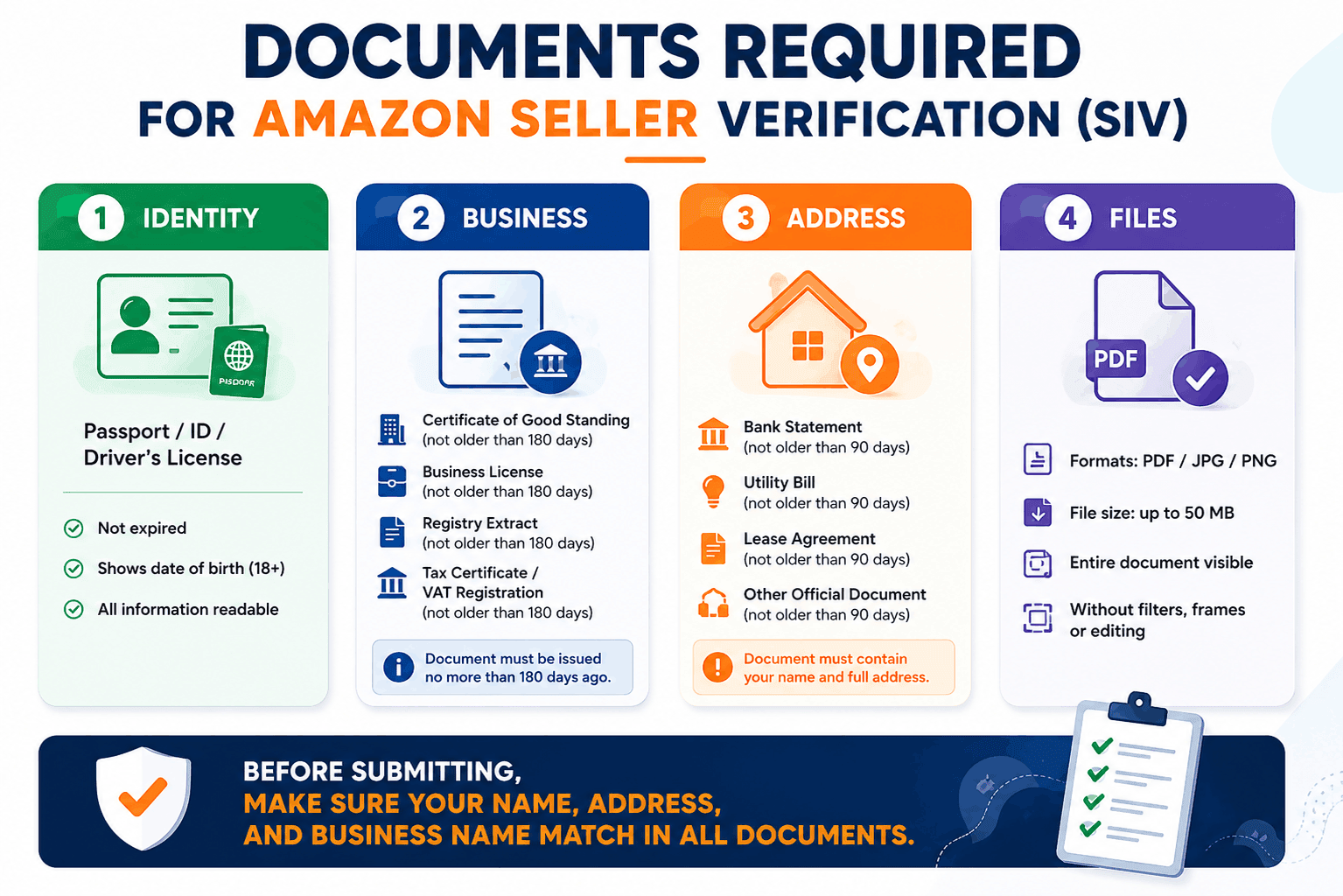
Identity Documents
Amazon accepts a government-issued photo ID, including:
Passport
National ID card
Driver's license
Your ID must:
match the document selected during registration;
show your date of birth (18+);
include a unique identification number;
be valid and unexpired.
If important information appears on the back of the document (such as a signature, barcode, or expiration date), upload both sides as a single file.
Travel documents such as NEXUS, SENTRI, or Global Entry cards aren't accepted for identity verification.Business Verification Documents
For business accounts, Amazon generally requires documents issued within the last 180 days.
Accepted documents include:
Certificate of Good Standing or Certificate of Existence
Business License
Tax Clearance or VAT Registration Certificate
Government business registry extract
Chamber of Commerce certificate (where applicable)
The document should display:
issuing authority;
registered business name;
registration or license number;
issue date;
expiration date (if applicable).
Amazon may also request proof that the person managing the account is authorized to represent the company. In most countries, acceptable documents include:
Letter of Authorization;
Articles of Incorporation or Organization;
Proof of Address
Proof of address documents must usually be no older than 90 days.
Amazon commonly accepts:
bank or credit card statements;
statements from supported payment providers (Payoneer, Hyperwallet, World First, Alipay);
certified bank letters;
utility bills;
lease agreements;
mortgage statements;
tax documents showing your address.
Business accounts may also use a Business Registration Certificate or Business License.
Your document must clearly show:
your full legal name or company name;
complete address;
provider or issuing authority;
issue date.
Technical File Requirements
Many verification delays occur because uploaded files don't meet Amazon's technical standards.
Before uploading, make sure your documents are:
in PDF, JPG, JPEG, PNG, TIF, or TIFF format;
no larger than 50 MB;
high resolution and fully readable;
uncropped and photographed straight on;
original and unedited;
not password protected.
If a document contains important information on both sides, include both sides in one file.
Amazon accepts documents in several major languages, including English, French, German, Spanish, Italian, Portuguese, Dutch, Polish, Japanese, Turkish, Arabic, Simplified Chinese, Swedish, Thai, Tamil, Hindi, and Vietnamese.
Documents issued in other languages should be accompanied by a certified or notarized translation.
Depending on your business location or the marketplace where you register, Amazon may request additional supporting documents.Letter of Authorization
A Letter of Authorization is required when the individual managing the seller account isn't the company's legal owner.
The letter must:
be signed by a legal representative, director, or beneficial owner;
appear on company letterhead;
include the signing date.
[Letterhead of the company]
POWER TO ACT ON BEHALF OF THE COMPANY
The undersigned [Enter Company name here] (hereinafter, the "Company"), duly represented by (name, date of birth, and function) [add full name, date of birth, and function of the signatory here], confirms that [add full name of the Person of Contact here] is authorized to open a Selling on Amazon account with Amazon Payments, accept the User Agreement and other Policies, have access to the Selling on Amazon account, initiate transactions in the name and on behalf of the Company and approve new Secondary users added to the account and, if required, grant them access to update listings, respond to buyers, and initiate refunds.
Dated this:
[Enter date]
Signed By:
[Sign here]
If you're submitting a Letter of Authorization or Power of Attorney, Amazon recommends combining it with your business registration or identity document into a single PDF before uploading.
Banking Requirements
Your banking information must match the details in your Amazon Seller Account, as Amazon issues seller payouts through Amazon Payments.
For North American marketplaces, your bank account must be located in a country supported by Amazon Currency Converter, and your account must include a valid business address.
Although Amazon doesn't explicitly require a U.S. bank account, having one often simplifies verification and payout processing.
For international sellers, Payoneer and Wise Business remain two of the most widely used solutions, providing multi-currency banking details, including U.S. receiving accounts.
If you operate through a U.S. company with an EIN, services such as Mercury and Relay may also be suitable, although Mercury now requires a verifiable physical U.S. business address rather than a registered agent or virtual office.Beneficial Owner Requirements
For business accounts, Amazon requires disclosure of every beneficial owner who directly or indirectly owns 25% or more of the company's shares or voting rights.
Common Reasons Verification Is Delayed
Most verification delays result from inconsistencies rather than missing documents.
Before submitting your application, confirm that:
✅ Your name, business name, and address exactly match your Amazon Seller Account.
✅ Bank and credit card statements were issued within the last 90 days.
✅ Your passport or government-issued ID is valid.
✅ Documents are complete, readable, and not cropped.
✅ Files meet Amazon's format requirements (PDF, JPG, JPEG, PNG, TIF, TIFF; up to 50 MB).
✅ Documents in unsupported languages include a certified translation.
How to Submit Your Documents
To upload your documents, sign in to Amazon Seller Central and go to:
Settings → Account Info → Identity Verification
This is where Amazon Seller Identity Verification (SIV) takes place. Amazon will display the document requirements based on your country, business type, and account settings.
After uploading your documents, you'll receive a confirmation that your submission has been received. In most cases, Amazon reviews applications within two business days.
If additional information is needed, you'll receive:
a notification in Seller Central;
an email sent to the address linked to your seller account.
While your verification is under review, avoid submitting duplicate documents or opening multiple support cases, as this may delay the process.
If Amazon requests another submission, you'll usually have 30 days to provide updated documents. Missing this deadline may prevent your seller account from being activated.
Verification decisions are based entirely on the documents provided. Amazon doesn't offer a formal appeals process for Seller Identity Verification.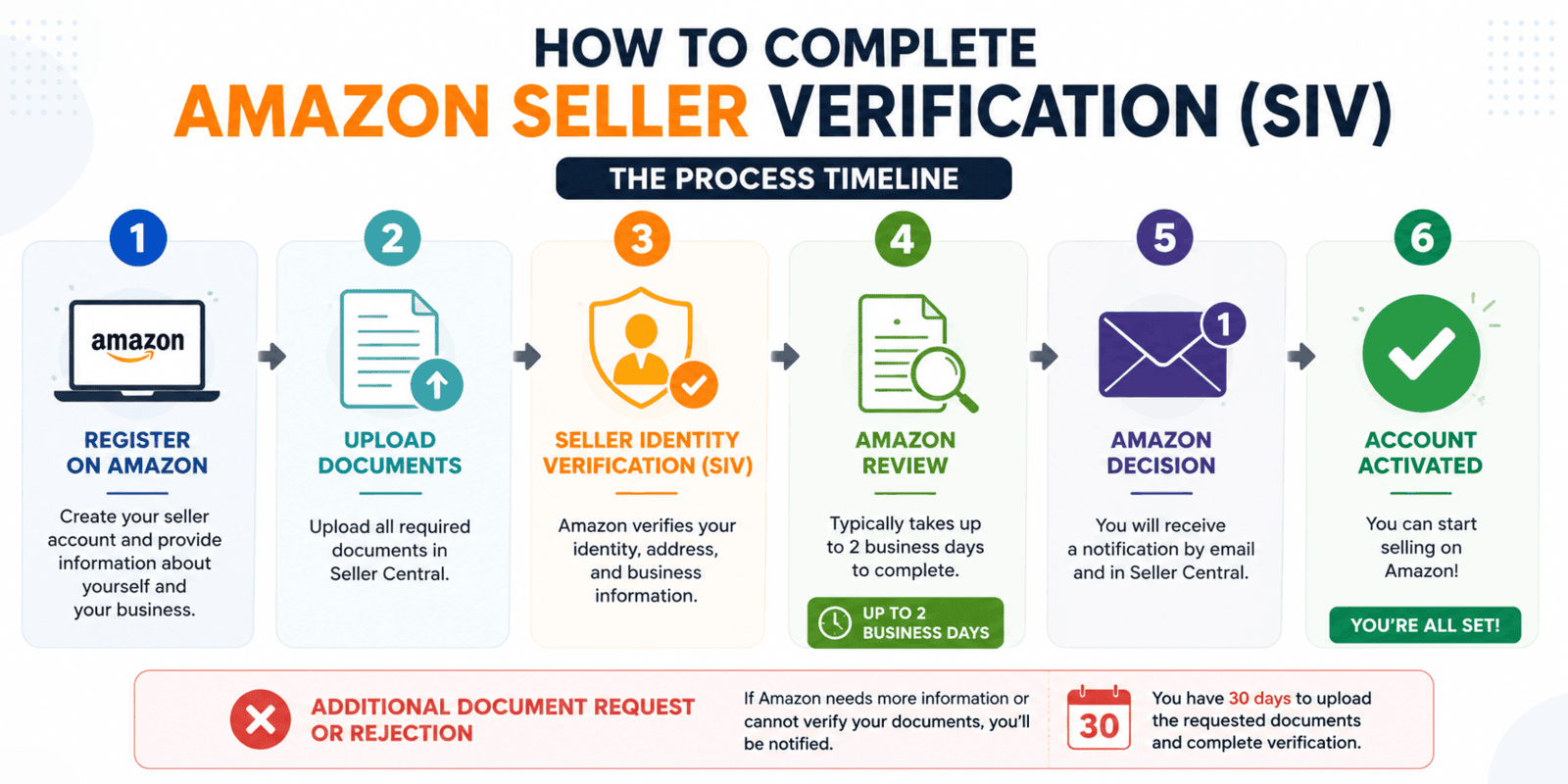
What If Your Seller Account Was Already Verified?
If your account was verified successfully but later deactivated because of policy violations, intellectual property complaints, or account health issues, you're no longer dealing with Seller Identity Verification.
Instead, your case falls under Seller Performance Review, a separate process with different documentation requirements, timelines, and appeal procedures.
Although both involve Amazon reviewing your account, they serve different purposes and shouldn't be confused.Final Tips for Passing Verification
Most verification delays aren't caused by complicated requirements—they're caused by small mistakes.
Common examples include:
an outdated bank statement;
a name that doesn't exactly match your account;
a cropped or blurry document;
banking or business information that doesn't match your registration details.
Frequently Asked Questions
How long does Amazon Seller Identity Verification take?
Can I appeal a failed verification?
Verification decisions are based solely on the documents submitted, and Amazon doesn't provide a formal appeals process for Seller Identity Verification.
If your account was previously verified and later deactivated because of policy violations or account health issues, you'll instead go through Seller Performance Review, which has its own appeals process.
What if my country isn't supported?
If your country isn't currently supported, operating through a U.S. business entity—such as an LLC or Corporation—may be an option where legally permitted.
Can I use a personal bank account?
For business accounts, Amazon expects the bank account to be registered in the company's legal name.
What if my business has multiple owners?
You can add up to four beneficial owners in the Identity Information section of Seller Central. If additional qualifying owners exist, Amazon may request further information.
Will I need to verify my account again after changing my bank account or address?
Yes.
Seller Identity Verification isn't always a one-time process. Amazon may request another verification whenever significant account information changes, including:
business address;
banking details;
legal entity information;
ownership structure.
Amazon Seller Central Help, article Global seller identity, address, and business verification;
Amazon Seller Central Help, article Seller Identity Verification;
Amazon Seller Central, article Countries accepted for seller registration;
Amazon Seller Central, article Registration requirements by store;
Amazon Seller Central Help, article Frequently asked questions about Global SIV.
Book a call now…
Book a call now…
Up to 45-min duration video-call
Topics we'll discuss:
| The next steps — there are two options
|