
Introduction
What Happened to the Listing
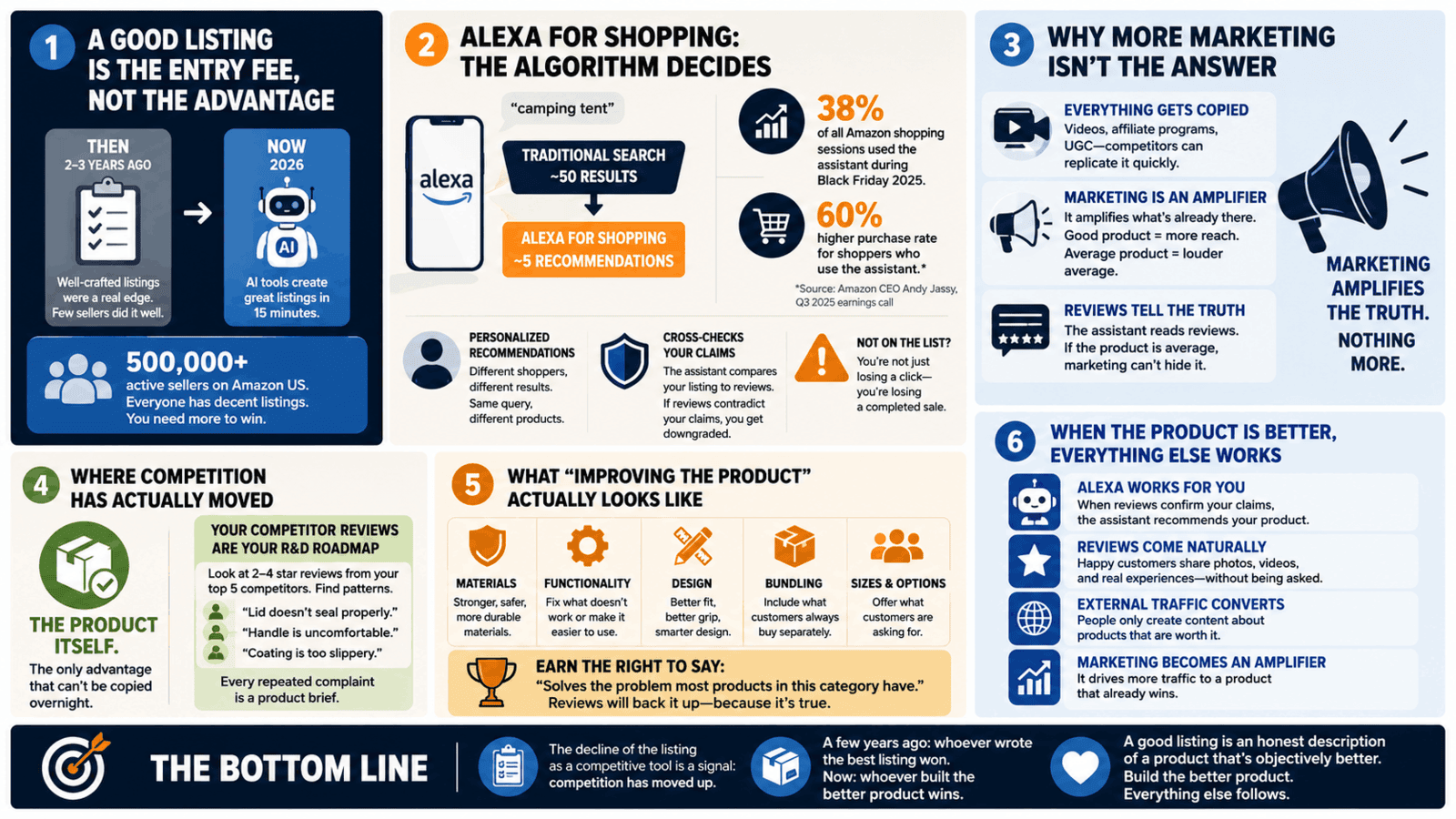
Two or three years ago, a well-crafted listing was a genuine edge. A tight title, keyword-rich bullets, A+ content with comparison charts — this took time and money, and it paid off, because most sellers weren't doing it well.
Today, AI does it in 15 minutes. Helium 10's Listing Builder, Amazon's own AI listing generator, and a dozen other tools have turned "good listing" into a baseline. There are over 500,000 active sellers on Amazon US alone. All of them have decent listings. Many have professional photography and A+ content. In that environment, a polished listing gets you in the game — it doesn't win it.
Alexa for Shopping: When the Algorithm Decides for the Buyer
Amazon has been quietly reshaping how products get discovered. In 2024, the company launched Rufus, an AI shopping assistant, which was rebranded as Alexa for Shopping in May 2026. The name changed; the logic didn't.
Here's what's different now. Traditional search returns a page of 50 results. The AI assistant narrows that to roughly five recommendations. According to research published in April 2026, that's the effective visibility window — not a page of options, but a short list. During Black Friday 2025, the assistant was active in 38% of all Amazon shopping sessions. Amazon's own number, from CEO Andy Jassy on the Q3 2025 earnings call: shoppers who use the assistant complete purchases at a 60% higher rate.
This isn't a sidebar feature anymore. It's the top of the funnel. If your product doesn't make the recommendation list, you're not losing a click — you're losing a completed sale.
The recommendations are also personalized. Two shoppers searching for "camping tent" at the same moment will see different results based on their purchase history and behavior on the platform. A father of four sees a family-size canopy. A solo traveler sees a one-person backpacking tent. Same query, different products.
Why More Marketing Isn't the Answer
The instinctive response to all of this is to double down on marketing: shoot UGC videos, run live streams, build out brand content, bring in influencers. And yes — these things work. For a while.
Video became the new standard just as fast as A+ content did before it. Affiliate programs get copied within a week: you start paying creators through Amazon Associates or Brand Referral Bonus, a competitor notices, launches the same program, and offers a slightly higher commission. UGC campaigns are available to any seller with $500 to spend.
Any marketing tool that's available to you is available to your competitors. It's a question of time and budget, not strategy.
Where Competition Has Actually Moved
Here's the uncomfortable answer: the product itself.
Competitor Reviews as an R&D Source
The method is straightforward. Take the top five competitors in your niche. Pull their two-, three-, and four-star reviews — not the one-star ones, those are mostly frustration without useful signal. Look for patterns. "Lid doesn't seal properly." "Handle is uncomfortable for smaller hands." "Coating is too slippery." Every repeated complaint is a product brief for your manufacturer.
What "Improving the Product" Actually Looks Like
When evaluating a product for private label, look for at least three ways to make it better: materials, functionality, design, or bundling. It rarely means reinventing the category. More often it's targeted changes where competitors are consistently failing:
A reinforced seam where others split. A grip material that doesn't slide. An accessory in the box that buyers always purchase separately. A size that customers have been requesting in Q&A and nobody in the niche has made.
When the Product Is Better, Everything Else Works
When the product is actually stronger than the competition, the dynamics shift.
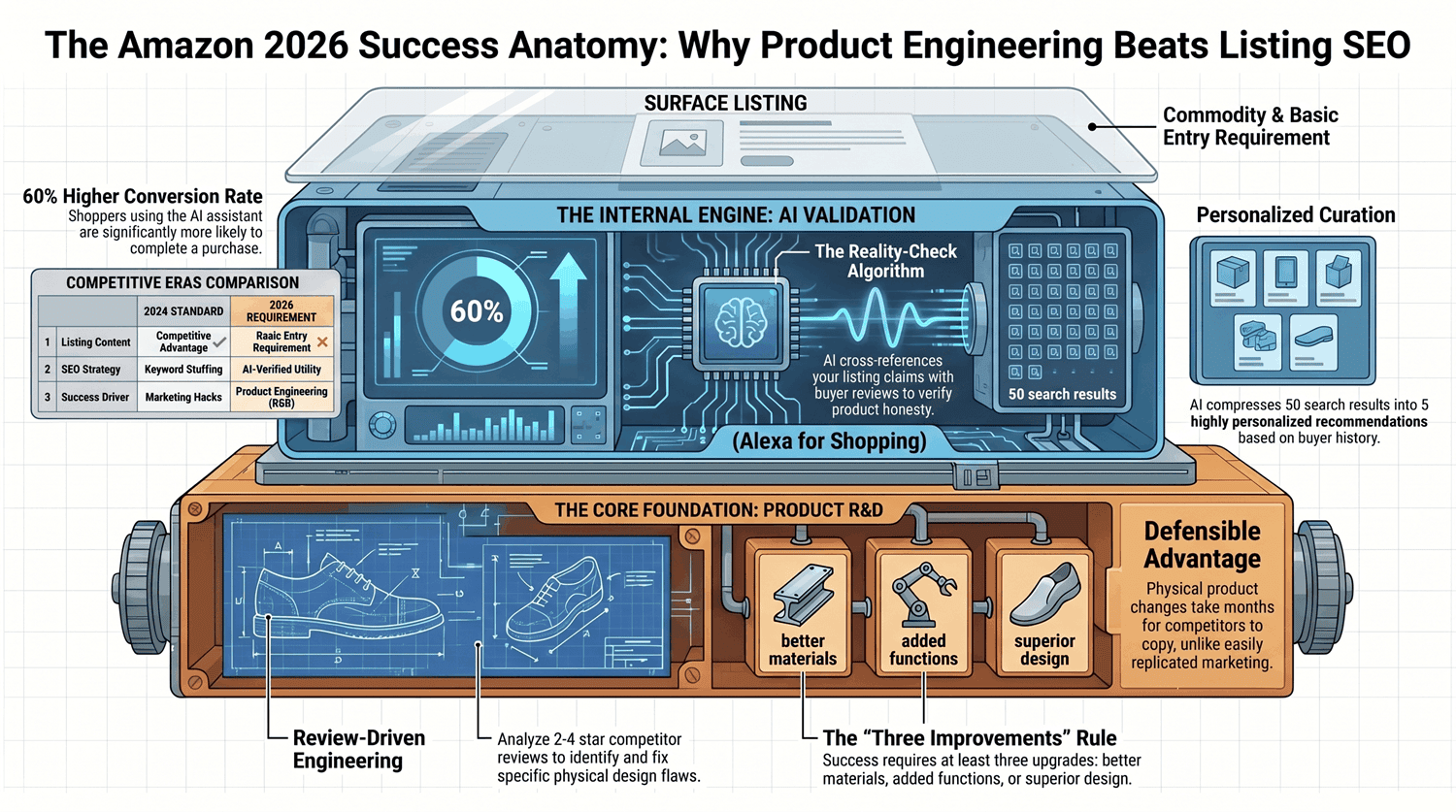
Alexa for Shopping starts working for you. The assistant compares listing claims to reviews — and when reviews confirm that the latch holds and the grip doesn't slip, the product earns its place in recommendations.
Reviews come in without prompting. When a product exceeds expectations, people write about it with photos and video on their own. You can't manufacture that. You have to earn it.
External traffic converts. Amazon's algorithm favors products that pull in visitors from outside the platform — from creators, influencers, social media. But people will only create content about your product if it's worth creating content about.
The Bottom Line
The decline of the listing as a competitive tool isn't a marketing problem. It's a signal that competition has moved to a level most sellers haven't reached yet.
A few years ago, the winner was whoever wrote the best listing. Now it's whoever built the better product.
Book a call now…
Book a call now…
Up to 45-min duration video-call
Topics we'll discuss:
| The next steps — there are two options
|