Introduction
These are questions I regularly hear from entrepreneurs preparing to launch their first product or expand an existing e-commerce business.
What Do You Need to Register an Amazon Seller Account?
Before starting, prepare the following information and documents:
A government-issued photo ID, such as a passport or driver's license
A valid email address and phone number
A verifiable residential address
Business registration details, if registering a company
A bank account to receive Amazon payouts
An eligible credit or debit card for Amazon charges
Tax information, such as an SSN or EIN, depending on your business structure
Requirements may vary depending on your legal structure and country. Make sure your registration details match your official documents. Your legal name, business name, and address should be consistent with the records Amazon may request. Even minor discrepancies can complicate identity verification.
Do You Need a Company to Sell on Amazon?
No. Amazon allows individuals to register without forming an LLC or corporation.
For US-based sellers, the main options are operating as a sole proprietor or registering through a legal entity, such as an LLC or corporation.
Starting as a sole proprietor may be simpler if you're testing a product idea or running a small operation. However, for a long-term e-commerce business, an LLC can offer practical advantages.
It helps establish a clearer separation between personal and business finances, simplifies working with partners and contractors, and may provide personal liability protection under applicable state law.
Tax treatment also matters. For example, a single-member LLC is generally treated as a disregarded entity for federal income tax purposes unless it elects another classification. Forming an LLC doesn't automatically reduce your taxes.
I recommend deciding on your legal structure before registration. Changing the entity associated with an existing Amazon account may require additional documentation and verification.
Can You Sell on Amazon US from Another Country?
Yes. You don't need to live in the United States or own a US company to sell on Amazon.com.
Amazon accepts eligible international sellers, although registration isn't available from every country. Requirements depend on the seller's location and business structure.
It's important to distinguish between citizenship, country of residence, and country of business registration.
For a company, Business Location generally refers to the country where the business is registered. For an individual, Amazon asks for the country where they conduct business.
We help Amazon sellers improve listings, optimize SEO and content, analyze competitors, and build product pages designed for both search visibility and conversion.
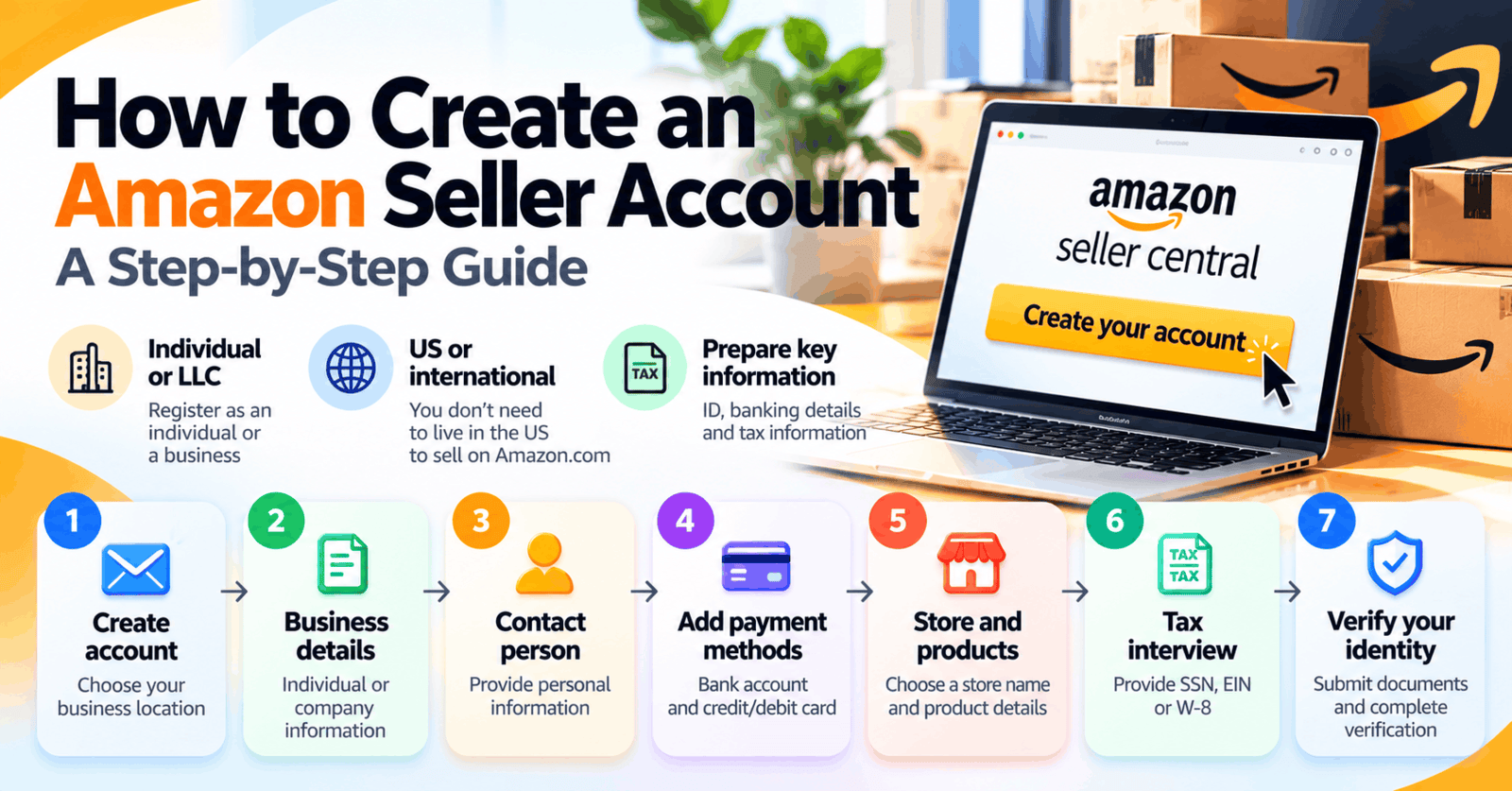
How to Create an Amazon Seller Account: Step by Step
Step 1. Create Your Account and Select Business Location
Start at the official Sell on Amazon website and begin registration.
You'll need an email address and password. I recommend using a dedicated business email that you can access long-term.
Next, select your Business Location. For a US-registered LLC or corporation, this will generally be the United States. Individual sellers should select the country where they conduct business.
Step 2. Enter Your Personal or Business Information
Amazon will ask whether you're registering as an individual or a business entity.
If you don't have a separate legal entity, select the individual option, such as None, I am an individual.
For an LLC or corporation, provide the registered legal name, business address, and applicable registration details.
Use the exact company name shown in your official records, including the legal suffix. For example, don't shorten Green Valley Products LLC to Green Valley Products.
Also,Company Registration Number and EIN aren't interchangeable.
Step 3. Provide the Primary Contact Person's Information
Amazon requires information about the person responsible for the seller account.
This typically includes their full legal name, date of birth, citizenship, residential address, and phone number.
For company accounts, Amazon may also ask whether the contact person is a business owner, beneficial owner, or legal representative.
The contact person doesn't have to be the sole owner, but their relationship to the company must be accurately represented.
Step 4. Add Your Bank Account and Payment Card
Amazon uses two separate payment methods:
Deposit Method - the bank account where Amazon sends your sales proceeds.
Charge Method - the credit or debit card used to collect selling fees and cover outstanding account charges.
For US sellers operating through an LLC or corporation, a dedicated business checking account is generally preferable. It helps separate business revenue from personal finances.
International sellers don't necessarily need a US bank account. Amazon supports eligible accounts in other countries and offers currency conversion for supported payout destinations.
For the Charge Method, Amazon generally accepts eligible Visa, Mastercard, and American Express credit or debit cards. Prepaid cards and PayPal aren't accepted as standard Charge Methods.
Step 5. Enter Your Store and Product Information
Amazon will ask you to choose a Store Name - the public-facing seller name customers see on the marketplace. You can choose this name yourself, and it doesn't have to match your LLC's legal name.
You'll also answer questions about the products you intend to sell, including whether they have UPCs or other GTINs, whether you own a brand, and whether you manufacture or resell products. You don't need to purchase UPCs just to register a seller account.
Product identifiers generally become relevant when creating new listings. If you're adding an offer to an existing ASIN, you typically don't need a new UPC. Some products may also qualify for a GTIN exemption, depending on the category and product. You can therefore complete registration before finalizing every detail of your product catalog.
Step 6. Complete the US Tax Interview
Amazon requires sellers to complete a tax interview to determine their tax status. US sellers generally provide taxpayer information associated with IRS Form W-9, using an SSN or EIN as appropriate. A sole proprietor may use an SSN or eligible EIN. For a single-member LLC, the required information depends on its federal tax classification.
Foreign sellers generally provide the appropriate information associated with an IRS Form W-8. The tax interview helps Amazon meet applicable tax reporting and withholding requirements. It doesn't replace your own federal, state, or local tax obligations.
Step 7. Complete Identity Verification
Amazon will verify your identity and, when applicable, your business information. You may need to submit a government-issued ID, proof of residential address, company documents, or other supporting records. In some cases, Amazon may also require a video call.
Information that doesn't match your documents can lead to delays or rejection. I've explained the verification process, accepted documents, and common problems in a separate guide: Amazon Seller Identity Verification: Requirements, Process, and Common Issues.
Individual vs. Professional Selling Plan: Which Should You Choose?
Amazon.com offers two selling plans. These are subscription options, not legal business structures.
The Individual Selling Plan has no monthly subscription fee but charges $0.99 per item sold, plus applicable selling fees.
The Professional Selling Plan costs $39.99 per month, regardless of sales volume.
Based on subscription fees alone, Individual is generally cheaper below 40 units per month. At around 40 units, the costs become comparable. However, Professional also provides access to Amazon Advertising, bulk listing tools, advanced reporting, and other features designed for regular sellers.
If you're testing a product or selling occasionally, Individual may be sufficient. For a private label launch or an established e-commerce business, Professional is usually the more practical choice. You can change your selling plan later.
Common Amazon Seller Registration Mistakes
Most registration problems come from a few avoidable mistakes. One is entering information that doesn't match official documents. Legal names, addresses, and business details should remain consistent throughout registration.
Another is mixing personal and company information - for example, using personal details in fields intended for an LLC's registered information.
Choosing the wrong Business Location or starting before gathering the required documents can also cause problems.
There's one mistake I particularly recommend avoiding: creating another Seller Account when your first registration encounters difficulties.
Amazon generally permits one Seller Central account per region unless there's a legitimate business need for additional accounts and the applicable requirements are met.
Opening a new account to bypass a registration problem, verification failure, or suspension can make the situation worse. My recommendation is simple: establish your business structure, prepare your documents, and check your information before submitting it to Amazon.
FAQ: Amazon Seller Account Registration
Do I Need an LLC to Sell on Amazon?
No. You can register as an individual and operate as a sole proprietor. An LLC may be worth considering for a long-term business, particularly if you want to separate business finances and establish a formal ownership structure.
Can I Use My SSN Instead of an EIN?
Yes, in certain situations. US sole proprietors can generally use an SSN for tax identification. Requirements for LLCs and corporations depend on their federal tax classification. Amazon's tax interview determines what information you need to provide.
Do I Need a Business Bank Account?
Amazon requires an eligible bank account for payouts, but a separate business account isn't mandatory for every individual seller. For an LLC or corporation, a dedicated business account is generally advisable.
Can I Have More Than One Amazon Seller Account?
Generally, Amazon allows one account per region unless you have a legitimate business need for additional accounts and meet its requirements. Don't create a new account to bypass verification issues or restrictions on an existing account.
Do I Need a US Company to Sell on Amazon.com?
No. Eligible international sellers can register without a US company. However, they must meet Amazon's country eligibility, identity verification, banking, and tax information requirements.
Book a call now…
Book a call now…
Up to 45-min duration video-call
Topics we'll discuss:
| The next steps — there are two options
|