
A Practical Guide for Amazon Sellers
Why old selling strategies stopped working—and what sellers must do now .
Many private label brand owners on Amazon have noticed the same pattern: declining conversion rates, rising ad costs, and products dropping out of top search positions despite solid optimization. The reason is straightforward—Amazon has changed.
In 2025, the platform completed its transformation from an online store into an AI-driven ecosystem. For the first time, revenue from services (advertising, logistics, seller fees, AWS) exceeded retail sales.
For sellers, this means success no longer depends only on reviews or discounts. Three factors are now critical:
how well your listing interacts with AI algorithms, operational precision in logistics, and a clear understanding of Amazon’s new marketplace economics.
Rufus AI Decides Which Product the Customer Sees
Imagine a shopper opening the Amazon app and asking Rufus—the built-in AI assistant: “Which massage gun is best for recovery after running?” Rufus doesn’t just scan listings for the keyword “massage gun.” It analyzes product attributes, reviews mentioning athletic recovery, price-to-value ratios, and user intent to deliver a personalized recommendation.
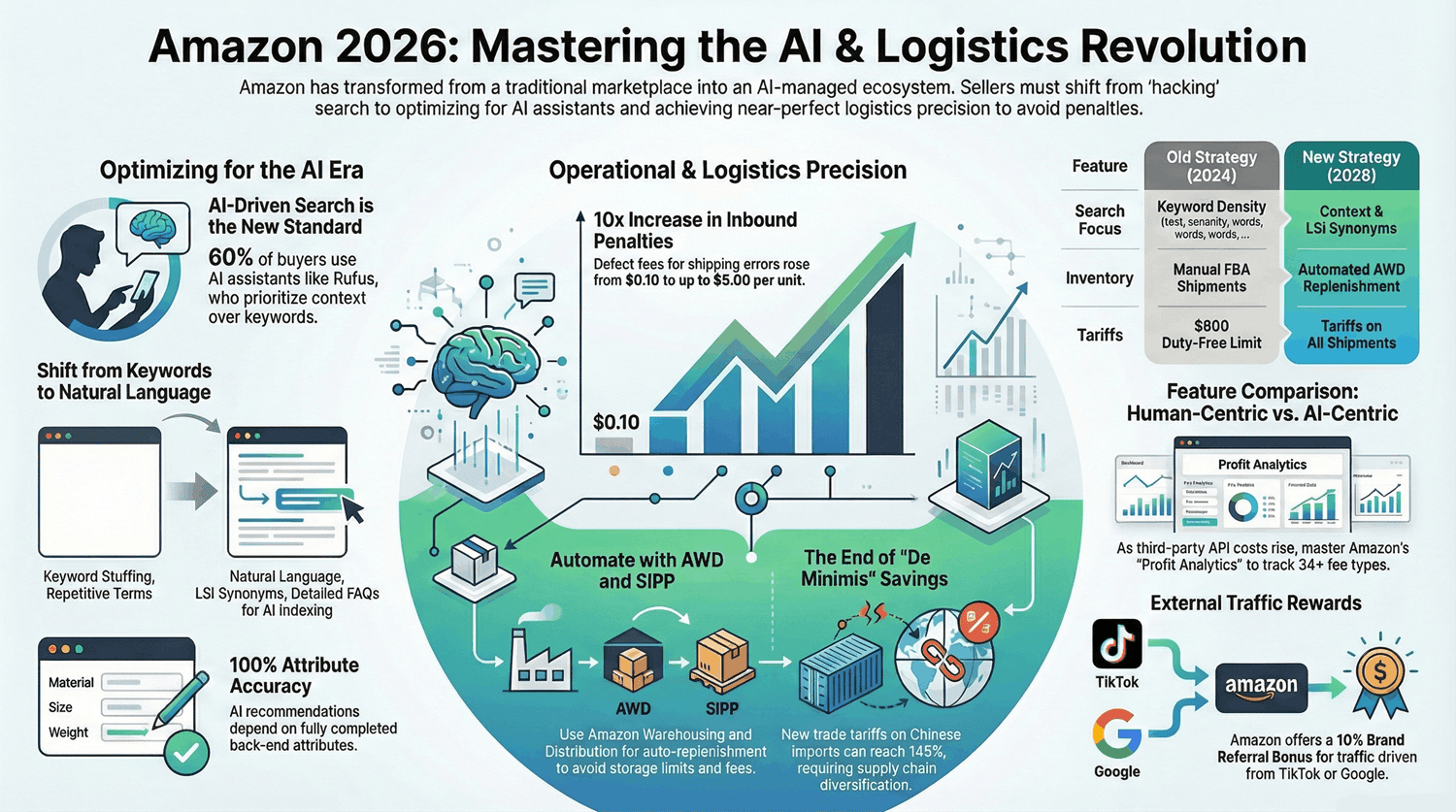
Nearly 60% of US shoppers already use generative AI for online shopping, and customers interacting with Rufus complete purchases 60% more often than users relying on traditional search. AI agents have become a primary decision-making layer.
For sellers, this is a fundamental shift. Listings were once optimized for humans—emotional headlines, sales triggers, keyword repetition. Today, the primary audience is the algorithm. If your product page isn’t structured for machine analysis, you risk losing up to a third of potential buyers. AI-mediated search already accounts for 35% of discovery traffic, and the share keeps growing.How to Optimize Listings for Rufus and Other AI Systems
Fill backend attributes with surgical precision.
AI relies on structured data. Every missing attribute—material, size, weight, use case—reduces your chances of appearing in AI recommendations.
Rebuild the Q&A section strategically.
Rufus actively pulls information from Q&A. Add 10–15 common customer questions with clear, detailed answers.
Example: “Is it suitable for deep tissue?” → “Yes. A 12 mm percussion amplitude allows effective deep-muscle recovery.”
Replace “massage gun massager muscle back massage” with
“Percussion massage gun designed for post-workout muscle recovery and tension relief.”
Rufus understands context and semantics—not keyword frequency.
Logistics Penalties Increased x10: How to Work with FBA and AWD
Amazon now demands strict operational discipline. While official FBA fee increases averaged just $0.08 per unit, the real cost structure shifted dramatically.
Inbound Defect Fees rose from $0.10–0.50 to $1.00–5.00 per unit—a 10–15× increase. Errors in packaging, labeling, or quantity mismatches can now cost hundreds of dollars per shipment. FBA storage limits were reduced from six to five months of expected sales.
At the same time, Amazon introduced a cost-saving lever: Amazon Warehousing and Distribution (AWD). Sellers using automated replenishment from AWD and maintaining inventory at roughly 70 days of demand qualify for Smart Storage Rates.
The SIPP program allows shipping products in their own packaging without an additional Amazon box, saving $0.04–0.14 per unit.Step-by-Step Logistics Optimization for Private Label Sellers
Move 70% of inbound shipments to AWD auto-replenishment.
AWD automatically feeds FBA as needed, maintaining optimal inventory without manual intervention.
Optimize packaging for SIPP eligibility.
At 10,000 units per month, savings can reach $1,400, enough to fund an extra ad campaign.
Amazon applies up to 34 different fee types. Use Profit Analytics to see per-SKU breakdowns and understand true profitability.
Keywords Are Dying: The Shift to LSI and Semantic Search
If you still repeat the main keyword 5–7 times, Amazon now flags this as spam. Since 2025, a word can appear in the title no more than twice.
The A10 algorithm now operates on LSI (Latent Semantic Indexing)—it understands meaning, not repetition. A search for “sports recovery massager” is treated as equivalent to “percussion massage gun for muscle relaxation” or “myofascial release device.”
On mobile—where up to 70% of purchases happen—images often appear before titles. Video content increases purchase likelihood by 80%. Bullet points have evolved from specs into answers.How to Rewrite Listings for Semantic Search and AI Interpretation
Replace keyword repetition with LSI synonyms.
Main keyword: massage gun
LSI variants: percussion massager, myofascial release device, deep tissue massager, muscle recovery tool, portable vibration massager.
Turn bullets into FAQ-style answers.
Instead of: “Low noise — 45 dB”
Write: “Comfortable to use at home—noise level is comparable to a quiet conversation (45 dB).”
“Enhance My Listing” analyzes your category and generates optimized copy. Refine it with emotional hooks and brand-specific benefits.
Amazon Is Closing the Ecosystem: Paid API and Data Monetization
In January 2026, Amazon introduces paid access to the Seller Partner API—the backbone of all third-party analytics tools. Platforms like Helium 10, Jungle Scout, and DataDive face sharply higher costs, likely increasing subscription prices by 30–50%.
At the same time, Amazon expands native tools: Custom Analytics (100+ performance metrics) and Profit Analytics (34 fee types, 90-day margin forecasts). Full review texts are no longer accessible; they are replaced by Voice of the Customer, which provides aggregated insights.How to Adapt to Amazon’s New Data Policy
Master native tools before third-party prices rise.
Set automated reports in Profit Analytics and Custom Analytics—many insights aren’t available elsewhere.
Drive external traffic to earn bonuses.
Amazon rewards off-platform traffic from Google, TikTok, and Instagram. Brand Referral Bonus returns up to 10% of purchase value and improves organic rankings.
Since 2025, unverified third-party access is automatically blocked. Ensure agencies and freelancers are officially registered.
Trade Tariffs and New Pricing Reality: How to Protect Margins
The removal of the de minimis rule was one of 2025’s most painful changes. On May 2, the US eliminated the $800 duty-free threshold for China and Hong Kong, and on August 29 extended it globally.
Tariffs on Chinese goods reached 145%, fundamentally altering import economics. Postal shipments face either 120% of declared value or a fixed $100–200 fee per package.
SmartScout data shows an average 29% price increase across Amazon categories. Many sellers report 20–40% cost increases for specific product lines, forcing price hikes or margin compression.
Amazon responded by launching Amazon Haul (US) and Amazon Bazaar (14 countries)—storefronts for sub-$20 products with 1–2 week delivery. The marketplace now operates on a two-tier model: premium FBA goods with fast shipping and low-cost items with longer delivery times.
Amazon also tightened supply-chain transparency requirements. Mass account suspensions of resellers and arbitrage sellers became common in late 2025. Sustainable models remain limited to Private Label and verified Wholesale.How to Diversify Risk Under the New Tariff Regime
Shift production to lower-tariff countries.
Vietnam, India, Thailand, and Bangladesh offer more favorable trade terms with the US than China.
Use AWD as a tariff buffer.
Maintain 2–3 months of inventory in US-based AWD warehouses to hedge against customs delays and sudden policy changes.
Japan and Germany combine strong purchasing power with lower competition from Chinese sellers. Use Marketplace Product Guidance to assess demand.
Survival and Growth Strategy for Amazon in 2026
The 2025 changes are not isolated updates—they form a unified strategy. Amazon is now a closed, AI-managed ecosystem controlling every step from discovery to fulfillment.
What will define success in 2026:
AI becomes the primary buyer.
Rufus and Alexa+ already handle ~40% of searches. By late 2026, this may reach 60–70%.
Operational precision is mandatory.
Paid APIs, new FBA rates, and 10× penalty increases make mistakes extremely costly.
Amazon favors sellers who ensure quality, stable inventory, and full documentation. Casual resellers will be phased out.
2026 Readiness Checklist
✅ Master Profit Analytics—know true SKU-level margins
✅ Rewrite listings for AI—natural language, LSI, structured attributes
✅ Enable AWD auto-replenishment—reduce penalties, unlock Smart Storage
✅ Optimize packaging for SIPP—save $0.04–0.14 per unit
✅ Diversify manufacturing—target low-tariff countries
✅ Launch external traffic campaigns—earn up to 10% Brand Referral Bonus
Sellers who invest in automation, analytics, and a deep understanding of Amazon’s new rules will not just survive—but grow.
Book a call now…
Book a call now…
Up to 45-min duration video-call
Topics we'll discuss:
| The next steps — there are two options
|