Introduction
Many Amazon sellers — especially beginners — reach out for help with the same question: “I didn’t do anything wrong. Why did Amazon suddenly suspend my account?”
In some cases, the reason is obvious — serious policy violations or prohibited activities. But quite often the situation is much more mundane: a gradual deterioration of the Account Health Rating that eventually pushes the account into the danger zone.
What makes this especially frustrating is how quickly it can happen. Yesterday the account was operating normally. Today the dashboard shows a warning. Tomorrow sales are stopped.
The core issue is that many sellers treat Account Health as a formality and only start paying attention once the situation becomes critical.
However, Amazon has been gradually building a system where account health is a measurable operational metric, not just an abstract risk indicator.
The good news is that in 2026 sellers have more tools than ever to monitor and control their account health.
In this article, we’ll break down how Amazon’s Account Health Rating works, what actions help keep your account in the green zone, and which mistakes most often lead to account suspensions.What Is Amazon Account Health Rating (AHR) and Why It Matters
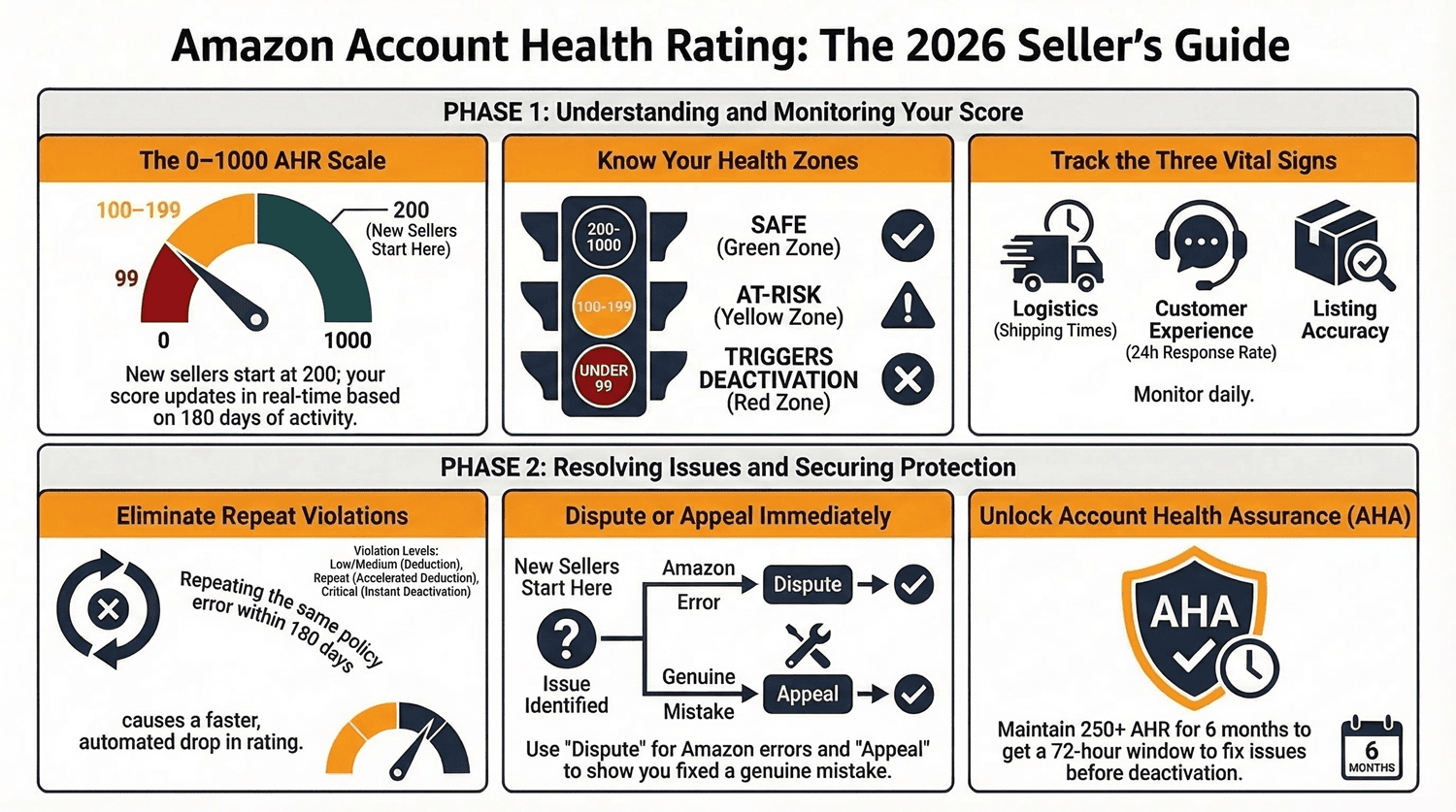
The Account Health Rating (AHR) is a numerical score ranging from 0 to 1000 that reflects the risk of account deactivation due to policy violations.
It is displayed in the Account Health Dashboard and updates almost in real time as violations appear or are resolved.
Amazon divides the score into three operational zones:
Green zone (200–1000) — the account meets Amazon’s performance and compliance standards
Yellow zone (100–199) — the account is at risk and requires attention
Red zone (99 or lower) — the account is at immediate risk of suspension or has already been restricted
New sellers typically start with an AHR of 200, and the score then evolves based on account activity over the previous 180 days.
It’s important to understand that AHR is not simply a penalty counter. It is a composite indicator that reflects:
the severity of violations
how often they occur
the scale of the seller’s business
What Changes in Amazon Account Health Management in 2026
Amazon has not introduced an entirely new scoring system for sellers in 2026, but the role of Account Health Rating has become significantly more central to enforcement decisions.
Previously, Account Health was often treated as a secondary diagnostic metric. Today it functions more like a core compliance indicator that influences suspension decisions directly.
The first major change is greater automation.
Amazon increasingly relies on machine learning systems to detect policy violations, recurring behavioral patterns, and inconsistencies in seller activity.
As a result, enforcement actions may occur faster, and manual review often happens after initial restrictions have already been applied.
For sellers, this shortens the reaction window. Waiting and hoping that an issue resolves itself is no longer a viable strategy.
The second shift is a more holistic risk assessment.
In 2026 Amazon tends to evaluate accounts in context rather than by isolated metrics. A borderline Account Health Rating combined with buyer complaints, documentation issues, or policy violations may already be enough to trigger restrictions.
The Account Health Dashboard has effectively become a central compliance hub, bringing together logistics performance, listing quality, customer experience, and policy compliance.
A third major factor is the increased weight of repeated violations.
If the same policy is violated multiple times within the 180-day evaluation window, each new violation typically carries greater weight and lowers the Account Health Rating faster.
For certain policies, the tolerance for repeat violations may be as low as two occurrences before the system escalates the issue to a critical level.
In practice, this means that patterns of repeated mistakes — not isolated errors — are among the most common reasons accounts suddenly lose large amounts of AHR points.
Amazon is also increasingly distinguishing between disciplined sellers and high-risk sellers.
Accounts with consistently strong health metrics may qualify for the Account Health Assurance program, which provides additional protection and time to resolve issues before suspension.
For sellers with weaker compliance records, however, the rules are becoming stricter and enforcement faster.
The conclusion is straightforward: Account Health is no longer just a report to check occasionally — it is an operational metric that requires continuous monitoring.Why Repeated Policy Violations Are Especially Dangerous
Not all policy violations affect Account Health equally.
Amazon classifies violations by severity levels, ranging from low impact to critical.
Critical violations — such as selling counterfeit products, manipulating reviews, or abusing Amazon systems — can result in immediate suspension regardless of the current Account Health Rating.
However, one of the most underestimated risks is repeat violations.
When the same policy is violated multiple times within the 180-day monitoring window, the system treats each new violation as more severe.
Eventually, the violation may automatically escalate to a critical level even if the original issue seemed relatively minor.
This is why Amazon repeatedly emphasizes that sellers should not only fix violations but also eliminate the root cause to prevent them from happening again.What Actually Helps Maintain a Healthy Amazon Account
One of the most underestimated factors affecting Account Health is logistics performance.
Late shipments, missing tracking numbers, or incorrect handling times can quickly damage seller metrics and contribute to policy violations.
Even when using Fulfillment by Amazon (FBA), sellers should closely monitor inventory levels and avoid order cancellations caused by stockouts.
Another crucial factor is customer communication and service quality.
Amazon expects sellers to respond to buyer messages within 24 hours, resolve issues quickly, and minimize cancellations or complaints.
A poor customer experience can push an otherwise healthy account into the warning zone surprisingly fast.
Listing quality also plays a major role.
Inaccurate product descriptions, misleading claims, outdated images, or incorrect product conditions can trigger buyer complaints and lead to policy violations.
Amazon explicitly states that accurate listing content and proper inventory management are essential components of maintaining account health.How to Respond When a Violation Appears
If a violation occurs, the most important step is to act quickly.
Amazon generally responds more favorably to sellers who acknowledge problems and take immediate steps to correct them.
There is also an important distinction between dispute and appeal.
A dispute is appropriate when the seller believes the violation was issued in error and provides evidence supporting that claim.
An appeal, on the other hand, is used when the violation is valid but the seller explains the cause, the corrective actions taken, and the steps implemented to prevent recurrence.
Successfully resolving a violation may restore some AHR points. However, the violation itself may still remain within the 180-day evaluation history and contribute to repeat-violation tracking.Account Health Assurance: Additional Protection for Responsible Sellers
Amazon offers a program called Account Health Assurance (AHA) for professional sellers who maintain strong compliance metrics.
To qualify, sellers typically must maintain an Account Health Rating above 250 for at least six months, without remaining below that threshold for more than ten days during the evaluation period.
The key advantage of this program is additional protection before suspension.
If a serious issue arises, Amazon may contact the seller directly and allow up to 72 hours to resolve the problem collaboratively before taking enforcement action.
However, the program does not protect accounts involved in fraudulent, illegal, or intentionally deceptive activities.
Another practical requirement is maintaining an active emergency contact. If Amazon cannot reach the seller, the additional protection may not apply.The Most Common Mistakes That Lead to Suspensions
One of the biggest mistakes sellers make is ignoring the Account Health Dashboard.
Violations rarely disappear on their own. Closing a listing or removing a product does not automatically remove the violation from Amazon’s system.
Another dangerous strategy is trying to circumvent Amazon policies, such as manipulating reviews or modifying listings to hide problems.
In 2026 Amazon increasingly relies on automated detection systems and machine learning models, which means these tactics are more likely than ever to trigger critical violations.
Finally, repeating the same mistakes multiple times remains one of the most common causes of sudden AHR drops and account suspensions.Conclusion
Book a call now…
Book a call now…
Up to 45-min duration video-call
Topics we'll discuss:
| The next steps — there are two options
|