Introduction
What Is MCP, And What Does It Have To Do With Amazon?
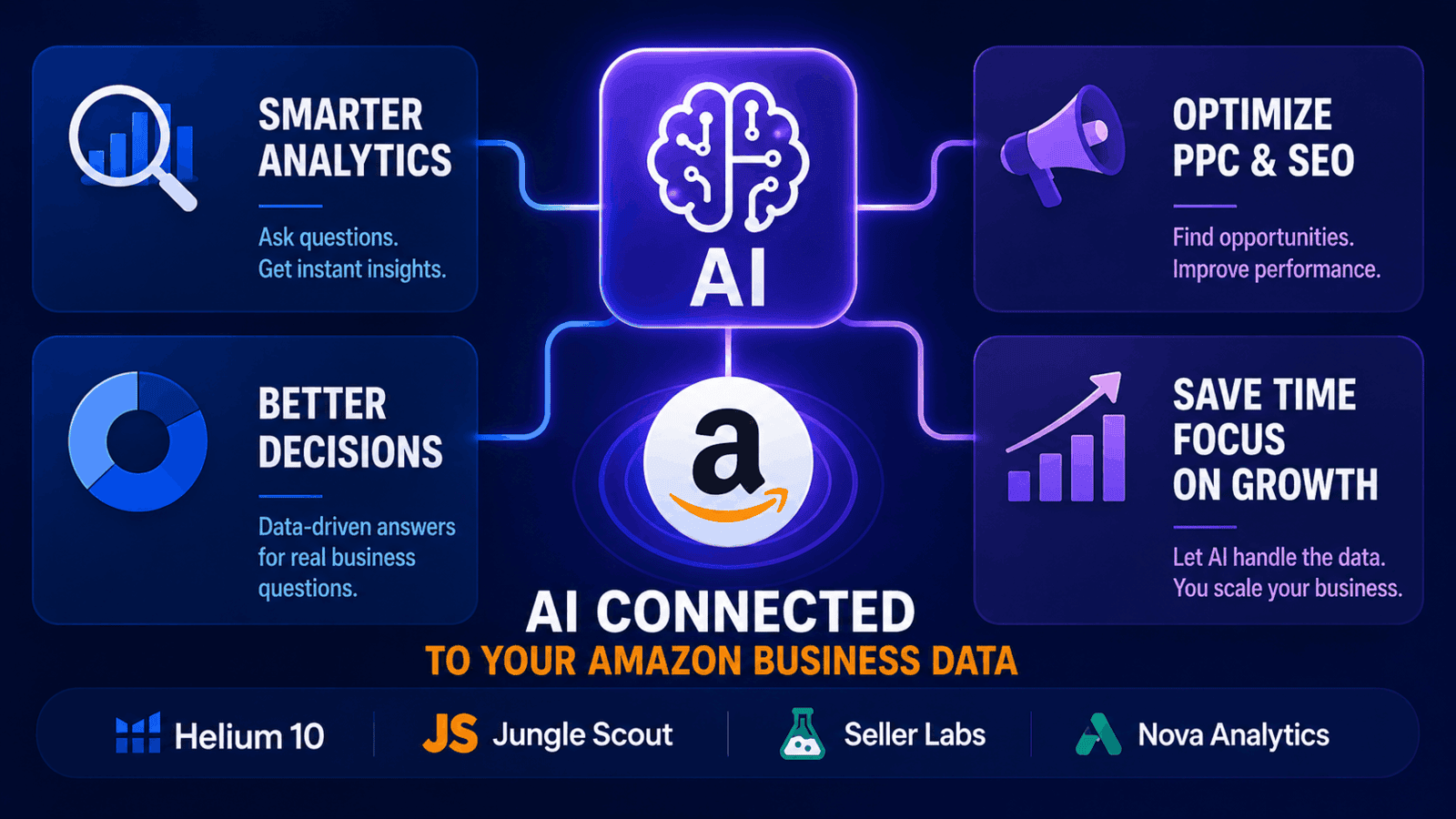
MCP stands for Model Context Protocol. It is an open standard that allows AI applications to connect with external data sources and tools. The concept sounds more technical than it actually is.
Suppose a seller asks ChatGPT, “Why did sales for this ASIN decline over the past 30 days?” On its own, ChatGPT cannot know the answer. It cannot see that seller's Seller Central account, ad spend, keyword rankings, or FBA inventory. The seller first has to provide that information.
With MCP, an AI assistant can request available data from a connected service, compare the relevant metrics, and then look for possible causes.
Why Would An Amazon Seller Need MCP?
What Does Helium 10 MCP Offer?
We help Amazon sellers improve listings, optimize SEO and content, analyze competitors, and build product pages designed for both search visibility and conversion.
Jungle Scout MCP: A Stronger Focus On The Market
Seller Labs: From Analysis To Action
Seller Labs focuses much more heavily on a seller's own Amazon business. The platform pulls information through Amazon APIs and organizes data on sales, advertising, inventory, fees, returns, profitability, and Search Query Performance - Amazon's reporting on how shoppers interact with products in search.
This allows sellers to ask highly specific questions. They might look for products where profit declined after ad spend increased, or identify search terms that continue consuming budget without generating enough orders.
Seller Labs also goes a step further. Its MCP is not limited to reading and analyzing information. AI can propose a bid adjustment, pause or activate a campaign, and send the change to Amazon after the user approves it.
At that point, MCP starts moving beyond analytics and into account management - which also makes proper controls much more important.
Nova Analytics: Analysis Without Write Access
Nova Analytics is less established among Amazon sellers than Helium 10 or Jungle Scout, but its approach to MCP is worth considering. The platform says it provides 477 metrics covering sales, advertising, profitability, fees, returns, inventory, and Search Query Performance across 21 Amazon marketplaces.
The major difference is that Nova's MCP is read-only. AI can analyze the data but cannot use the connection to change ad campaigns or account settings. There is a clear rationale behind this approach. Misinterpreting a report is one thing; automatically changing a large advertising budget is another.
Nova also makes an important point about MCP in general: simply connecting AI to hundreds of data fields does not guarantee useful analysis. The underlying data still needs to be clean and properly structured. Otherwise, an AI assistant may have access to the numbers without correctly understanding what they mean.
Which Amazon MCP Solution Makes Sense?
Comparing these platforms purely by the number of MCP tools would be misleading because they focus on different use cases.
Platform | Main focus | Best suited for |
|---|---|---|
| Helium 10 | Keywords, competitors, advertising, business data | Amazon SEO, PPC, and seller analytics |
| Jungle Scout | Market, categories, brands, competitors | Niche and competitive analysis |
| Seller Labs | Seller Central and Amazon Ads data | Business analytics and advertising management |
| Nova Analytics | Sales, profitability, PPC, inventory | Seller analytics without AI write access |
For sellers already using Helium 10 or Cobalt, MCP alone is probably not a reason to switch platforms. A better approach is to look at what data the AI can actually access, how well that data is structured, and whether the connection is read-only or can also make changes.
Is It Safe To Connect AI To Amazon Data?
This question becomes much more important when MCP moves from analysis to action. If ChatGPT misinterprets an ACoS trend, a seller can review the reasoning and reject the conclusion. If an AI system can automatically change dozens of bids or a campaign budget, the consequences of a mistake become much more tangible.
For now, critical actions are best kept under human control. AI can gather the data, identify an issue, and recommend an action, while changes to budgets, bids, and other important settings still require approval.
Before connecting any MCP service, sellers should also understand what information it can access and how that access can be revoked.
What About Amazon's Own MCP?
Amazon does not currently offer sellers a ready-to-use MCP integration inside Seller Central.
However, Amazon Selling Partner Developer Services has published sample solutions that demonstrate how MCP can be used with Data Kiosk, Amazon's system for accessing analytics through its APIs.
These are developer tools rather than turnkey Seller Central features. They have to be deployed and configured, so comparing them directly with commercial solutions such as Helium 10 or Seller Labs would not be accurate.
Still, their existence is significant. It shows that Amazon itself is exploring how MCP can be used within the broader Selling Partner API ecosystem.
What Could MCP Change For Amazon Sellers?
Traditionally, a good Amazon analytics platform needed dashboards, filters, charts, and dozens of reports. With MCP, some of that work can shift to an AI assistant. Instead of finding the right report and combining the numbers manually, a seller can describe the problem in plain language and let AI retrieve the relevant data.
That means the value of an analytics platform may increasingly depend not only on its interface, but on the quality and depth of the data it can make available to AI.
Amazon MCP is still at an early stage, but the direction is becoming clear. The next step in using AI for an Amazon business is not simply writing more sophisticated prompts or generating more listing copy. It is giving AI secure access to real business data and using it as a practical analytics tool.
Amazon MCP FAQ
What Is MCP For Amazon?
MCP (Model Context Protocol) is an open standard that allows AI assistants to access external data and tools. For Amazon sellers, that can include sales, advertising, keywords, competitors, inventory, and other business metrics, depending on the connected service.
Can ChatGPT Connect To Amazon Through MCP?
Yes, although usually not directly to Seller Central. A compatible service such as Helium 10, Jungle Scout, or Seller Labs provides access to a specific set of Amazon data and tools. The exact capabilities depend on the platform and subscription.
Which Amazon seller tools support MCP?
Notable solutions include Helium 10, Jungle Scout, Seller Labs, and Nova Analytics. Helium 10 combines SEO, advertising, and business analytics; Jungle Scout focuses more on market intelligence; Seller Labs emphasizes seller account and advertising data; and Nova focuses on read-only seller analytics.
Can AI Change Amazon Ads Through MCP?
With some services, yes. Helium 10 and Seller Labs support certain actions involving advertising campaigns, including bid and budget changes. Because these actions can directly affect performance and spend, important changes should still be reviewed and approved by a person.
Is It Safe To Connect Seller Central Data Through MCP?
That depends less on MCP itself and more on the service providing the connection, its permissions, and how it handles data. Sellers should check exactly what access is being granted, whether the service can modify account data, and how permissions can be revoked.
Book a call now…
Book a call now…
Up to 45-min duration video-call
Topics we'll discuss:
| The next steps — there are two options
|