
Introduction
Since around fall 2025, more and more sellers have been coming to me with the same concern: the strategies that used to work on Amazon are becoming less effective and far less predictable.
Traffic is still there, products are ranking well — but shoppers seem to pass by. They compare less, spend less time on listings, and increasingly choose competitors that don’t appear obvious at first glance.
The reason is simple: a new player has entered the sales process inside Amazon — the AI assistant Rufus. And it’s already changing how products are discovered and selected.
The good news is that this shift is something you can adapt to. In this article, I’ll break down how Rufus has evolved, how it’s reshaping customer behavior, and what it practically means for private label sellers.What Changed in Rufus Since Late 2025
At first, Rufus felt like an add-on — essentially a smarter FAQ inside Amazon. By 2026, it has become deeply embedded into the shopping experience.
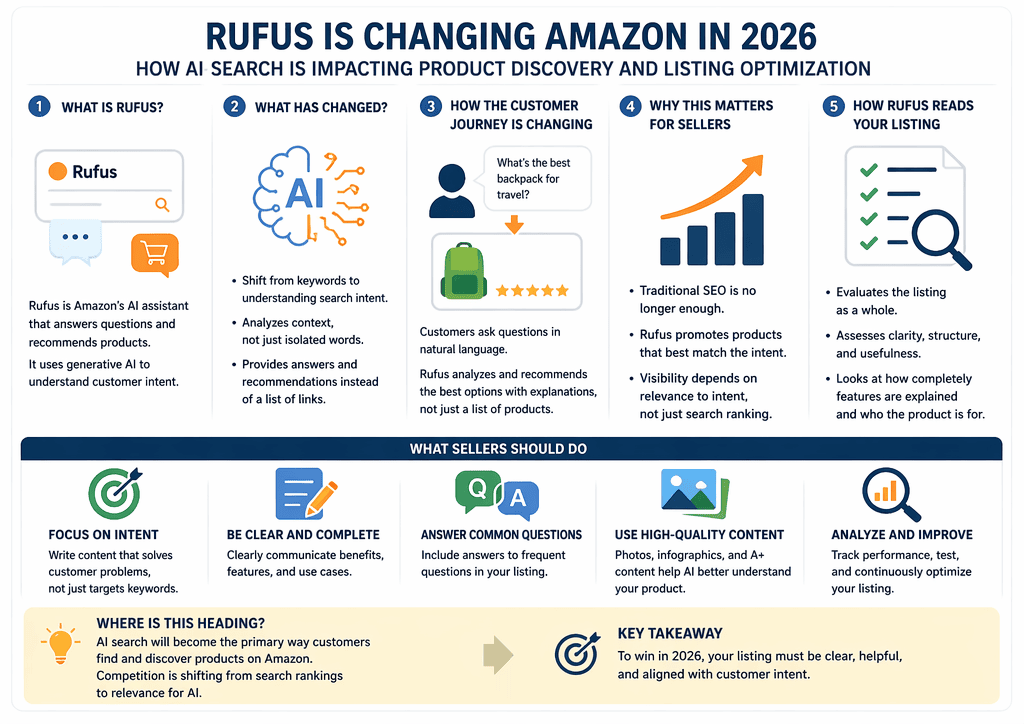
The biggest shift is this: Rufus no longer just responds to queries — it interprets them. Instead of relying on keywords alone, it tries to understand intent: why the customer is searching, in what context, and with what expectations.
More broadly, this reflects a larger shift in Amazon search itself. The system is moving away from keywords toward meaning. It now understands context, synonyms, and purchase intent — which means keyword stuffing no longer delivers the same results.
At the same time, Rufus has become more “memory-driven.” It takes into account previous behavior, preferences, and interactions. As a result, search results are no longer just relevant — they’re personalized.
In essence, Amazon is moving toward a model where Rufus isn’t just a feature, but a layer between the customer and the catalog — a kind of concierge that guides the decision-making process.
How Rufus Is Changing the Customer Journey
For years, the Amazon shopping journey followed a familiar pattern: search → browse → compare → read reviews → decide.
With Rufus, that journey is getting shorter.
Customers are increasingly asking instead of searching. Instead of typing “best bath mat,” they might ask, “What bath mat works best for my bathroom?”
If they’ve previously purchased items for a bathroom, Rufus may infer details — like tile flooring — and recommend products specifically suited for that context.
At the same time, search results are becoming dynamic. Two users entering a similar query may see completely different recommendations based on their behavior, purchase history, and how they interact with listings.
This leads to three key changes:
- Fewer listings viewed per session
- Less reliance on traditional scrolling
- Greater influence of AI-driven recommendations
In my experience, some users are already skipping the comparison phase altogether. They trust Rufus’s interpretation and choose from its suggestions. According to Amazon, over 250 million shoppers interacted with Rufus in 2025, and during peak periods, up to 30–40% of sessions included AI assistance.
Why This Matters for Private Label Sellers
This shift is especially critical for private label sellers. Unlike major brands with external traffic, PL businesses depend heavily on visibility within Amazon itself.
Previously, competition was mostly about ranking in search. Now there’s another layer: being selected by Rufus.
And that layer can’t be ignored.
It’s no longer enough to optimize for keywords and conversion rates. Rufus evaluates products based on how well they answer a user’s intent.
At the same time, the evaluation logic is changing. Behavioral signals are becoming more important — how long users stay on the page, whether they engage with content, whether they read reviews.
Even conversion is now contextual: your performance is effectively compared against a narrow set of similar products, not the entire category.
This creates a “winner-takes-more” dynamic, where some products receive disproportionate attention while others never enter the consideration set.
How Rufus “Reads” Your Listing
One of the biggest shifts is the move from keywords to meaning. Rufus evaluates the listing as a whole — title, bullet points, description, reviews, and even the Q&A section.
It’s not about having the right keywords — it’s about how clearly and consistently the product is explained.
In simple terms, the system is asking:
“Can I confidently recommend this product for a specific use case?”
AI models are also increasingly applying “common sense.” They infer missing attributes based on context. For example, if a product is meant for outdoor use, the system expects to see information about weather resistance — even if the user didn’t explicitly search for it.
This brings us to a key concept: signal vs. noise.
Over-optimized, keyword-heavy listings with vague or bloated language are losing effectiveness.
What works better now are listings where:
- Information is structured
- There are no contradictions between sections
- Use cases are clearly described
In practice, this means shifting from features to application. Not just “waterproof,” but “suitable for use in heavy rain or humid environments.”
Reviews and the Q&A section also play a growing role — Rufus actively uses them to understand the product more deeply.
What Sellers Should Do Now
This shift requires a different approach to listing creation.
First, stop writing purely for keywords. Focus on real customer questions: where the product is used, what problems it solves, and what limitations it has.
Second, strengthen the explanatory layer. Don’t just list features — explain what they mean in practice. Whenever possible, give direct answers: whether the product fits a specific use case, model, or condition.
Third, ensure consistency across the listing. Title, bullets, and description should complement each other — not repeat or contradict.
It’s also worth paying attention to backend attributes. Fields that once seemed secondary now help the algorithm better understand and position your product.
The Q&A section deserves special focus as well. In many cases, it becomes a direct source of answers that AI assistants use when responding to customer questions.
In practice, even small structural improvements — without changing the product itself — can significantly improve how AI interprets your listing.
Finally, be careful with SEO. Keyword stuffing is far less effective than clear, well-structured, and readable content.
Where This Is Heading
Most likely, Amazon will continue strengthening Rufus as the primary interface between customers and products.
This will impact not only organic rankings but also advertising — especially through in-conversation recommendations. We’ve already seen early signs of Amazon monetizing Rufus suggestions.
At the same time, traditional metrics like keyword ranking are becoming less reliable. With personalized search results, different users may see different outcomes for the same query.
We’re moving toward a model where competition is no longer just about ranking — but about being selected by AI.
FAQ
Do keywords still matter for Amazon SEO in 2026?
Yes, but their role has changed. Keywords need to be integrated naturally into content that clearly explains the product.
How do I optimize a listing for Amazon AI search?
Focus on clarity, use cases, and direct answers to customer questions rather than keyword density.
Is Rufus replacing traditional Amazon search?
Not entirely, but it is becoming a key layer in how products are discovered and recommended.
Conclusion
Rufus is not just another Amazon feature — it represents a shift in how customers make decisions.
Shoppers are searching less and delegating more of the decision-making process to AI.
For private label sellers, this means that traditional SEO is no longer enough. Your listing needs to be understandable not only to humans but also to AI — clearly explaining the product, answering key questions, and presenting a complete picture.
Those who adapt early will gain a significant advantage by being included in AI recommendations — not just search results.
Checklist: Optimizing Your Listing for Rufus & AI
Before publishing or updating your listing, check:
- Is it immediately clear what the product is and what it’s used for?
- Are real use cases described, not just features?
- Do you explain what each feature means in practice?
- Is there consistency across title, bullets, and description?
- Does the listing answer key customer questions?
- Is the language natural and easy to read (not keyword-heavy)?
- Do different sections complement rather than repeat each other?
- Are key benefits reinforced by reviews and Q&A?
- Is it clear in which scenarios AI should recommend this product?
- Have you removed unnecessary “noise” like clichés or vague claims?
If your Amazon business, product, or listing isn’t reaching its full potential, schedule a free consultation with us—no obligations, just expert guidance! ↓
Book a call now…
Book a call now…
Up to 45-min duration video-call
Topics we'll discuss:
| The next steps — there are two options
|