
E-commerce nears $10T, Amazon-only brands lose share, FBA removal fees change timing, and Sponsored Brands Collections shift toward AI-driven formats
News #1. The E-commerce Market Nears $10 Trillion — What This Changes for Amazon Sellers
What happened
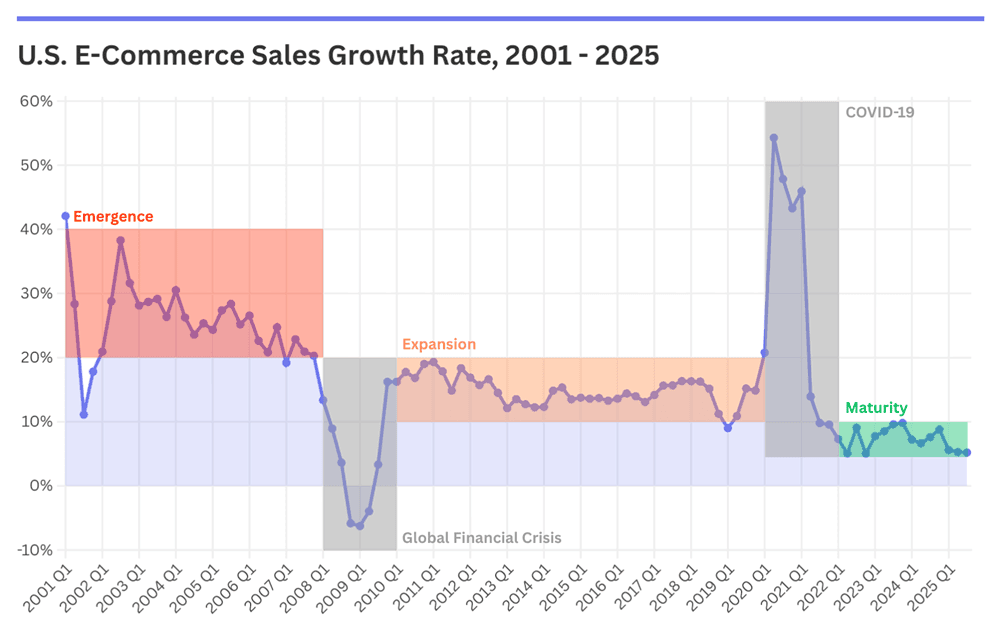
The research outlines three clear stages in the market’s development over the past 25 years:
Emergence (2001–2007): explosive growth of 20–40% per quarter, as online shopping shifted from novelty to habit.
Expansion (2010–2019):10–20% per quarter, driven by platform scaling and logistics infrastructure.
Maturity (since 2022): stable 5–10% per quarter; in Q3 2025, growth stood at 5.2%.
Why it matters
The market’s base is now massive. $275 billion in Q3 2025 alone exceeded the entire cumulative e-commerce volume prior to Q2 2005 ($270 billion).
Growth trajectories were disrupted twice — during the 2008–2009 global financial crisis and the 2020–2021 COVID-19 pandemic — but each time the market returned to its trend within roughly two years. Absent new global shocks, analysts expect growth to remain in the 5–8% range in the near term.
What it means for Amazon sellers
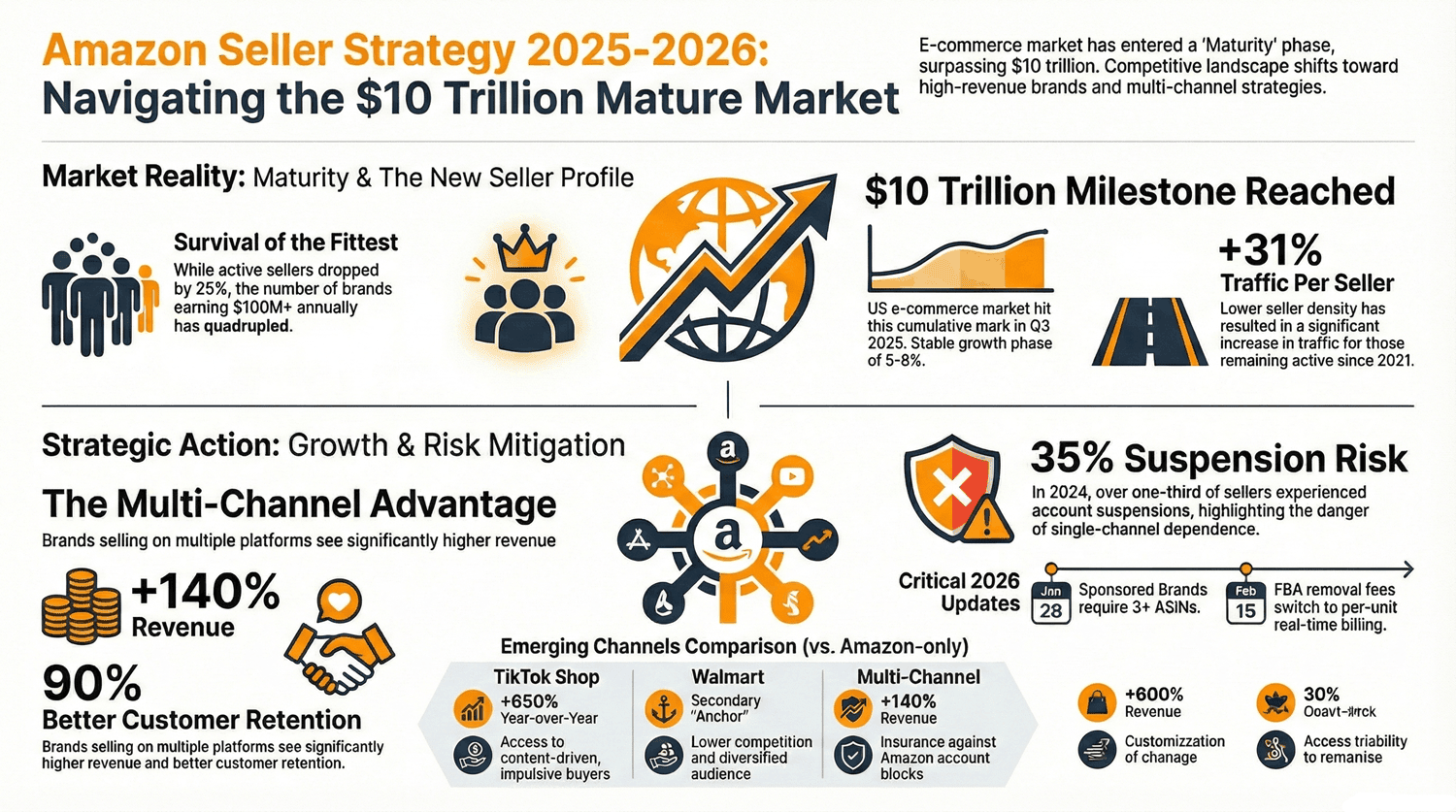
A mature market doesn’t just mean slower growth — it means structural change in competition. The number of active sellers on Amazon has dropped 25% from its peak, while the number of sellers generating $100M+ annually has quadrupled.
One positive signal: traffic per active seller has increased by 31% since 2021. In other words, the market is consolidating around fewer, more professional players — creating better conditions for sellers who operate with scale, data, and strategy.
E-commerce has entered its maturity phase. The opportunity hasn’t disappeared — it has shifted. For Amazon sellers, growth now comes less from market expansion and more from efficiency, brand strength, and professional execution within a very large, very stable ecosystem.
News #2. Brands Selling Only on Amazon Are Losing Share — Multichannel Sellers Are Growing Faster
Helium 10 analysts released a new report with a blunt takeaway: relying on a single sales channel doesn’t just limit growth — it increases risk. One telling data point: in 2024, more than 35% of sellers were affected by account suspensions or restrictions.
What happened
The study compares Amazon-only sellers with brands that actively operate across multiple platforms. The results are striking:
Multichannel brands generate 140% more revenue on average;
They also retain 90% more customers over time.
The report highlights that in the U.S., TikTok Shop has clearly moved beyond the “experiment” phase. In 2024, the platform reached $9 billion in GMV, posting an eye-catching 650% year-over-year growth.
Why it matters
Selling exclusively on Amazon comes with very real trade-offs:
Single-point-of-failure risk: account suspensions or restrictions can halt a business overnight — and they’re not rare.
Rising traffic costs: with roughly 1.9 million active sellers competing for visibility, ad bids climb while organic reach declines.
Limited demand control: sellers are fully dependent on one platform’s algorithms, policies, and seasonality — often at the expense of margin.
What it means for Amazon sellers
If Amazon is your primary channel, it still makes sense to keep it as the core revenue engine. But long-term stability increasingly comes from building outside the marketplace:
TikTok Shop offers access to an audience that buys from content — videos, live streams, and creator recommendations — not just keyword search. This can lower acquisition costs and accelerate new product launches.
Walmart Marketplace can serve as a second pillar, with a different customer base, often softer competition, and incremental volume without total dependence on Amazon’s rules.
Takeaway
Additional sales channels shouldn’t be treated as “nice-to-have” diversification. For Amazon sellers, multichannel expansion is increasingly a risk hedge and a new source of demand — especially as growth inside Amazon becomes more expensive and competitive.
News #3. Amazon Changes How FBA Removal and Disposal Fees Are Charged — Now Per Unit, as Processed
Amazon will change how FBA removal and disposal fees are charged starting February 15, 2026. Instead of billing a single lump sum once an order is completed, fees will now be charged per unit, at the moment each item is actually removed or disposed of. Fee rates themselves remain unchanged — only the billing timing is different.
What happened
Previously, sellers were billed once the entire removal or disposal order was fully closed. Under the new system, charges will be applied incrementally, as each unit is processed. These transactions will appear in Payments → Transaction View, and no action is required from sellers.
Why it matters
The update affects cash flow and cost visibility. Disposal typically takes around 14 business days, but during peak periods it can stretch beyond 30 days. Removal orders can take 90 days or longer, especially when carrier transport is involved.
Before, the final charge often arrived all at once at the end of a long processing cycle. Now, costs will be spread over time, more closely matching operational reality.
What Amazon sellers are saying
Seller reaction has been mixed. Some welcome the change, arguing it may make it easier to dispute individual charges. Others are concerned that one consolidated invoice will be replaced by dozens or even hundreds of small transactions, complicating reconciliation.
There are also concerns about reporting inconsistencies — for example, cases where inventory is marked as a “vendor return”. Sellers want clearer end-to-end visibility into how and when items are ultimately removed or disposed of.
This is a timeline change, not a fee increase. While it improves transparency and smooths cash flow, it also adds accounting complexity. Sellers may need tighter tracking processes to monitor removal and disposal activity unit by unit.
News #4. Sponsored Brands Collections — Minimum 3 ASINs, Less Manual Creative, More AI
What happened
Sponsored Brands Collections will replace existing Product Collections inside the Ads Console. Campaigns that currently include 1–2 ASINs will be allowed to keep running and be optimized, but new ad groups can no longer be created with fewer than three products.
Why it matters
Amazon is reducing the amount of manual creative control. According to the update, custom headlines and lifestyle images are being phased out, while product selection and presentation will increasingly rely on AI-driven dynamics. Manual product selection is still available, but creative flexibility is more limited than before.
What it means for Amazon sellers
Sellers who relied on 1–2 SKU Product Collections should prepare to rebuild campaign structures around 3+ ASINs.
The focus shifts from individual hero products to assortment strategy.
Bundling 3–10 related products in one collection creates opportunities for cross-selling and promoting full product lines — but requires careful curation to avoid diluting conversion rates.
Takeaway
Sponsored Brands Collections signal a move toward catalog-level advertising, powered increasingly by AI. Sellers who adapt their assortments and campaign structure early will be better positioned as Amazon continues to standardize and automate creative formats.
Book a call now…
Book a call now…
Up to 45-min duration video-call
Topics we'll discuss:
| The next steps — there are two options
|