
Amazon and Shopify reach nearly 50% of the U.S. market, Amazon introduces an AI Agent Policy, Walmart reports revenue and ad growth
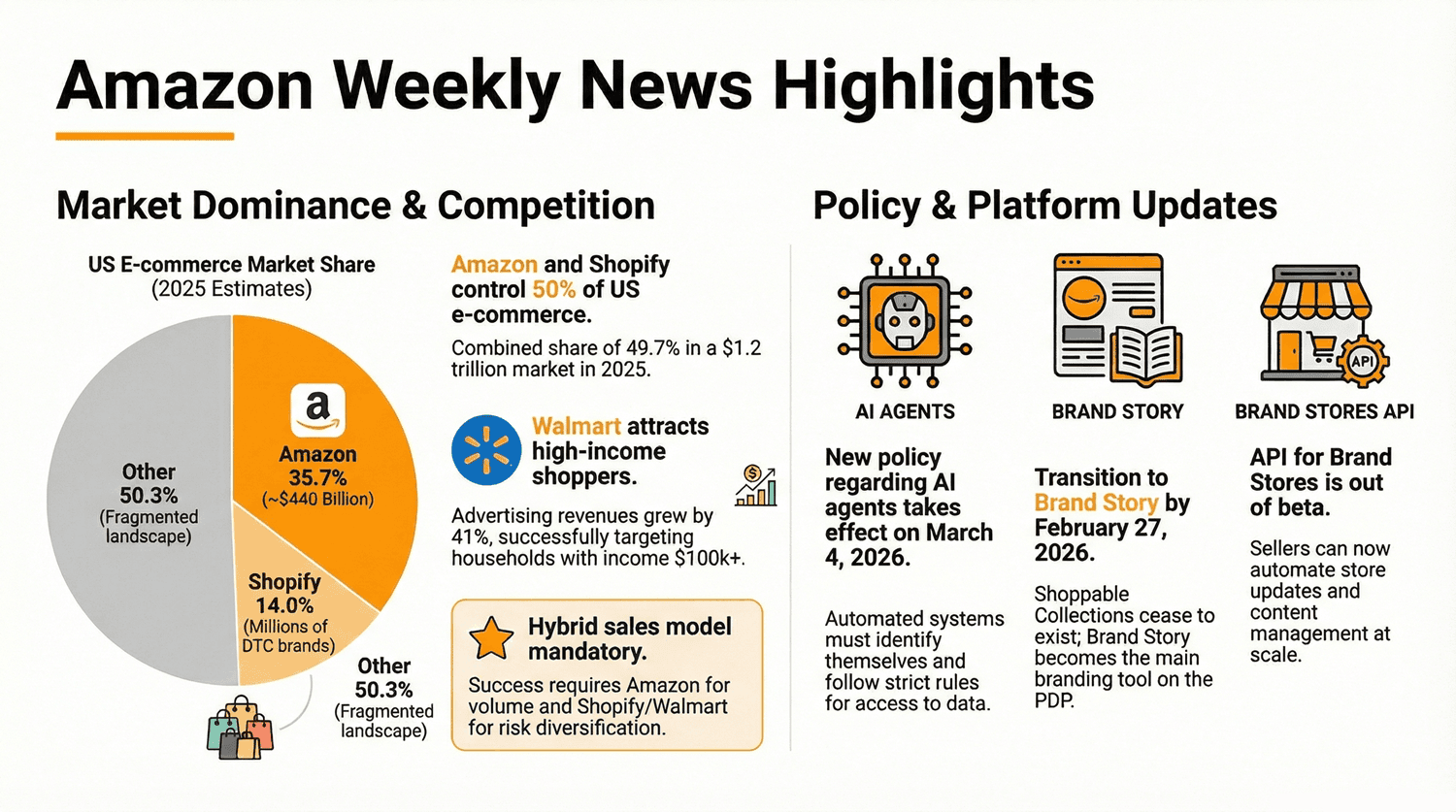
News #1. Amazon and Shopify Now Account for Nearly Half of U.S. E-commerce
Nearly every second dollar spent online in the U.S. now flows either through Amazon or via Shopify’s infrastructure. The market is becoming more concentrated — and that is reshaping how brands approach scaling.

What happened
According to analysts’ estimates, by 2025 the combined share of Amazon and Shopify reached approximately 49.7% of the total U.S. e-commerce market, which is valued at around $1.2 trillion.
Amazon maintains leadership with roughly 35.7% of online sales (about $440 billion in gross merchandise volume, GMV), remaining the country’s largest marketplace. Shopify accounts for around 14% of the market, enabling sales for millions of independent online stores and DTC brands. Notably, Shopify has begun publicly emphasizing its scale in terms of aggregated merchant GMV, marking the first time its market share has been framed in this way. Over the past five years, that volume has grown by more than 50%, reflecting both platform expansion and broader adoption of the infrastructure model.
As a result, nearly half of U.S. e-commerce is concentrated either inside Amazon’s marketplace or on Shopify’s technological backbone.Why it matters
This is not only about the growth of two companies, but about the structure of the market itself. Large platforms continue to absorb a growing share of transactional volume, while commerce outside major ecosystems becomes increasingly fragmented.
Amazon reinforces its role as the primary destination for consumers seeking selection and speed. Shopify, in turn, enables brands to build proprietary sales channels and work directly with their audiences.
Scaling is increasingly organized around major platforms — either through marketplace participation or via owned storefronts built on leading infrastructure.What it means for Amazon sellers
For most sellers, Amazon remains the primary source of volume and a proven growth engine, supported by the marketplace’s traffic scale.
At the same time, Shopify’s expansion shows that brands are gradually diversifying risk and investing in additional channels — primarily their own online stores. This provides greater margin control, stronger repeat purchase mechanics, and direct customer data ownership.
The emerging model is more balanced: core revenue is generated on Amazon, while parallel channels are developed to support long-term flexibility and reduce dependence on a single traffic source.News #2. Amazon Introduces New Rules for AI Agents Effective March 4, 2026
Amazon updates its Business Solutions Agreement and introduces a dedicated Agent Policy. The focus is tighter control over AI and automated systems accessing the platform.
What happened
Effective March 4, 2026, updates to the Business Solutions Agreement (BSA) will come into force. Amazon is introducing a new Agent Policy regulating AI agents and any automated software accessing platform services.
Such systems must now clearly identify themselves as automated, comply with the updated policy requirements, and terminate access upon Amazon’s request. The platform is also strengthening restrictions on the use of its materials and services for AI development, including explicit safeguards against reverse engineering — meaning the replication of Amazon technologies within third-party AI systems.
Additionally, a separate agreement will apply to the Mexico store. This introduces a legal separation between the U.S./Canada and Mexico marketplaces, which, according to the company, simplifies local regulatory adjustments and potential future rule changes.Why it matters
Amazon continues to formalize its control over automation. The company had previously restricted unauthorized data scraping and bot activity; now these requirements are embedded directly into the core agreement. The use of AI tools is shifting from a purely technical matter to a contractual and legal framework.
What it means for Amazon sellers
The updates directly impact developers of automated solutions, who will need to ensure their tools comply with the new policy.
However, sellers should also review which AI and automation services are connected to their accounts and confirm compliance, as responsibility for platform access ultimately remains tied to the seller account itself.News #3. Walmart Strengthens Its Position in E-commerce and Advertising
Walmart closed its fiscal year with sales growth, an expanding higher-income customer base, and continued scaling of Walmart Connect. Online operations are becoming an increasingly important growth driver.
What happened
Following the fourth quarter of its fiscal year ending January 31, 2026, Walmart reported growth in total revenue and comparable U.S. store sales. The company separately highlighted an increase in customers with annual incomes above $100,000 — a segment that continues to contribute to growth.
Online sales, including both first-party and third-party marketplace activity, remain among key performance drivers. The company emphasizes ongoing technology investments, including AI-based tools for assortment management, personalization, and logistics, aimed at improving operational efficiency and conversion.
Walmart’s advertising division, Walmart Connect, grew 41% year over year, with advertising revenue approaching $6.4 billion. Advertising and the 3P marketplace are becoming increasingly significant contributors to overall profitability and growth.Why it matters
Walmart is gradually reinforcing its position not only as an offline retailer, but as a technology-driven e-commerce platform. Growth in higher-income shoppers reshapes demand patterns, while investment in AI and advertising infrastructure strengthens the competitiveness of the ecosystem.
Advertising is emerging as one of the fastest-growing segments, following a trajectory previously observed at Amazon.What it means for Amazon sellers
Walmart is increasingly competing for mid- to premium-segment brands. The growth of higher-income audiences and expanded advertising tools make Walmart Marketplace a more predictable and scalable channel.
For sellers, this supports considering Walmart as an additional growth lever. Amazon remains the foundational volume platform, while diversification into Walmart’s expanding ecosystem allows brands to reach broader audiences and reduce reliance on a single sales channel.News #4. Amazon Phases Out Shoppable Collections and Expands Brand Stores via API
What happened
Starting February 27, 2026, Amazon will discontinue support for Shoppable Collections Beta — a module within A+ Content that allowed interactive product groupings directly on product detail pages (PDP). This format will be removed from both PDPs and the A+ Content Manager. Instead, Brand Story will appear on product pages where configured.
Part of the Shoppable Collections functionality is being integrated into Brand Story, reinforcing it as the primary branding tool on the product page.
At the same time, Amazon has released Brand Stores API from beta. Brands and agencies can now automate Store management — updating pages, content blocks, structure, and assortments via integrations.Why it matters
Amazon is reducing parallel brand content formats and clarifying its architecture:
Brand Story becomes the core branding module on the product detail page (PDP).
Brand Store functions as the full in-platform brand storefront.
Brand Stores API enables automation and scalable management of that storefront.
What it means for Amazon sellers
For sellers and brands, the changes imply:
Shoppable Collections are no longer available — it is advisable to ensure Brand Story is properly configured to maintain branded visibility on product pages.
Brand Story becomes the central tool for cross-selling and showcasing product lines on PDPs.
Brand Store combined with API capabilities opens automation opportunities: assortment synchronization, content scaling, and faster updates of promotions and collections.
Book a call now…
Book a call now…
Up to 45-min duration video-call
Topics we'll discuss:
| The next steps — there are two options
|