
Walmart accelerates retail media growth, TikTok drives external demand to Amazon, ChatGPT tests conversational AI advertising, U.S. tariff rulings renew trade uncertainty

News #1. Walmart Accelerates Retail Media Growth and Narrows the Gap with Amazon
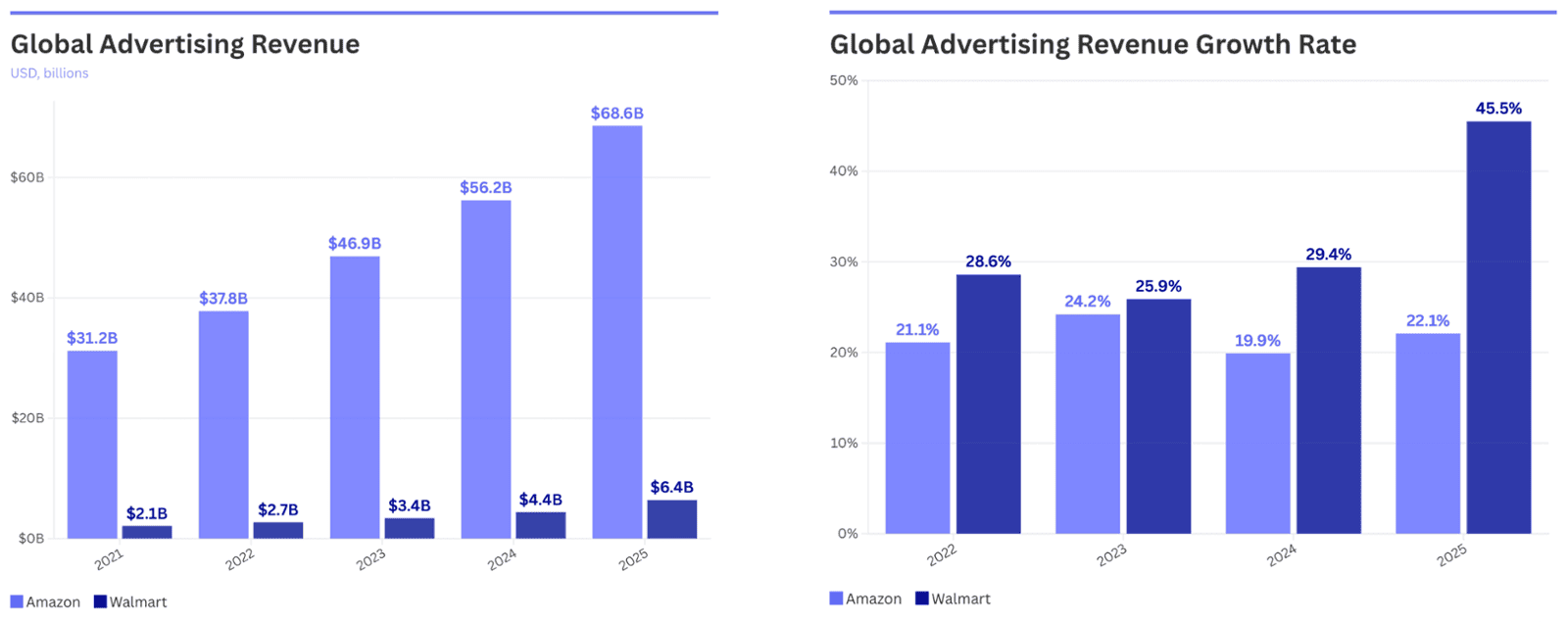
Walmart’s advertising business is growing faster than Amazon’s, intensifying competition for brand budgets across e-commerce platforms.
What happened
According to analysts, Walmart’s advertising revenue increased by 46% in fiscal 2025, while Amazon’s ad revenue grew by 22% year over year. In absolute terms, Amazon remains significantly larger (about $68 billion versus $6.4 billion for Walmart), but Walmart’s growth rate is notably higher.
Advertising accounts for nearly 8% of Amazon’s GMV (gross merchandise value), compared to roughly 4% at Walmart, indicating that Walmart Marketplace’s retail media infrastructure is still at an earlier stage of development.Why it matters
Advertising, alongside organic search and AI-driven discovery, is becoming one of the primary traffic drivers in U.S. e-commerce. Walmart’s faster growth reflects a gradual reallocation of brand budgets and the strengthening of its marketplace as a viable alternative for brands and third-party sellers (3P).
What it means for Amazon sellers
For sellers, this signals rising competition for visibility and growing importance of a multi-channel strategy. Amazon maintains unmatched scale and depth of demand, but Walmart is steadily building a comparable advertising ecosystem, influencing budget allocation and off-Amazon expansion strategies.
News #2. TikTok Shop Strengthens Demand for Amazon
TikTok Shop is scaling rapidly and increasingly influencing sales within Amazon Marketplace.
What happened
In Q3 2025, TikTok Shop generated approximately $19 billion in GMV, a scale comparable to eBay. The platform is moving beyond pure social commerce and becoming a meaningful player in the U.S. e-commerce market.
Analysts report that brands promoting products simultaneously on TikTok Shop and Amazon—through content, advertising, and optimized listings—saw new customer acquisition increase by 40%. TikTok also removed its requirement to use only its internal fulfillment system, simplifying integration with sellers’ existing logistics.Why it matters
TikTok increasingly generates primary demand before shoppers enter Amazon. Users discover products in their feed, develop purchase intent, and then search for them directly on Amazon—not to browse, but to buy.
As a result, TikTok is capturing the top of the funnel, while Amazon remains the core conversion and scaling engine. This shifts competition for attention beyond the marketplace and strengthens the role of external traffic in overall demand generation.What it means for Amazon sellers
Sellers need to actively work with external traffic sources. Viral exposure on TikTok can directly increase branded search and sales on Amazon. TikTok is not replacing Amazon—it is becoming a demand engine that influences advertising allocation and overall growth strategy.
News #3. Conversational Commerce: Ads in ChatGPT Enter Retail Testing
Retail is experimenting with new ad formats as embedded ads in ChatGPT mark an early step toward AI-driven conversational commerce.
What happened
Advertising tests have begun inside OpenAI’s ChatGPT for registered users in the United States on free and Go plans. Sponsored messages appear below chat responses, clearly labeled and separate from the AI-generated answer. The pilot aims to measure the effectiveness of AI-based advertising in real purchase-intent scenarios. Major retailers and brands across sectors are participating.
Ads are currently visible only within U.S. chats. Plus, Pro, and higher-tier plans remain ad-free. Early examples include travel and product-related ads triggered contextually by user queries.Why it matters
Embedding advertising inside AI conversations changes the traditional path to purchase. Instead of banners or standard PPC placements, users encounter relevant product suggestions at the moment of active intent. Conversational commerce creates a new interaction layer between brand and buyer within emerging AI-driven discovery systems.
For marketers and sellers, the test will indicate whether AI ads can meaningfully generate demand and incremental traffic.What it means for Amazon sellers
This introduces a new source of external traffic. AI-based ads may generate product interest that converts on Amazon Marketplace.
Search dynamics may also shift. While keywords and on-platform SEO remain critical, part of demand may now originate before users enter the marketplace.
Measurement becomes essential: sellers must track the path from AI interaction to Amazon purchase. Although testing is currently limited to the U.S., conversational commerce may evolve into a practical channel within a broader multi-channel strategy.News #4. Retailers Seek Tariff Refunds After U.S. Supreme Court Ruling
What happened
On February 20, 2026, the Supreme Court ruled 6–3 that large-scale tariffs imposed under IEEPA required congressional approval. The case concerns tariffs introduced during the Trump administration.
After the ruling, companies—including major apparel retailers and global brands—filed claims in the U.S. Court of International Trade seeking refunds. Outcomes will depend on documentation accuracy and filing deadlines.
Donald Trump publicly criticized the decision and signaled the use of alternative legal mechanisms to maintain trade pressure. The administration subsequently announced temporary import surcharges of 10–15%.Why it matters
Despite the ruling, U.S. trade policy remains unstable. Potential refunds may be offset by new tariffs, preserving elevated cost structures. This ongoing uncertainty affects supply chains, pricing, and planning.
What it means for Amazon sellers
Amazon sellers must focus on landed cost—total product cost including duties, shipping, and customs processing. If acting as importer of record, sellers must ensure accurate product classification, documentation, and timely refund claims while coordinating with U.S. Customs and Border Protection.
More broadly, tariff volatility impacts margins, pricing strategy, and consumer purchasing power, influencing stability across international e-commerce and social commerce channels.Book a call now…
Book a call now…
Up to 45-min duration video-call
Topics we'll discuss:
| The next steps — there are two options
|