
Amazon Haul continues to expand, Seller Central receives new AI analytics tools, Helium 10 analyzes advertising budget allocation, and Walmart introduces new seller support programs
News #1. Amazon Haul surpasses 3,000 sellers
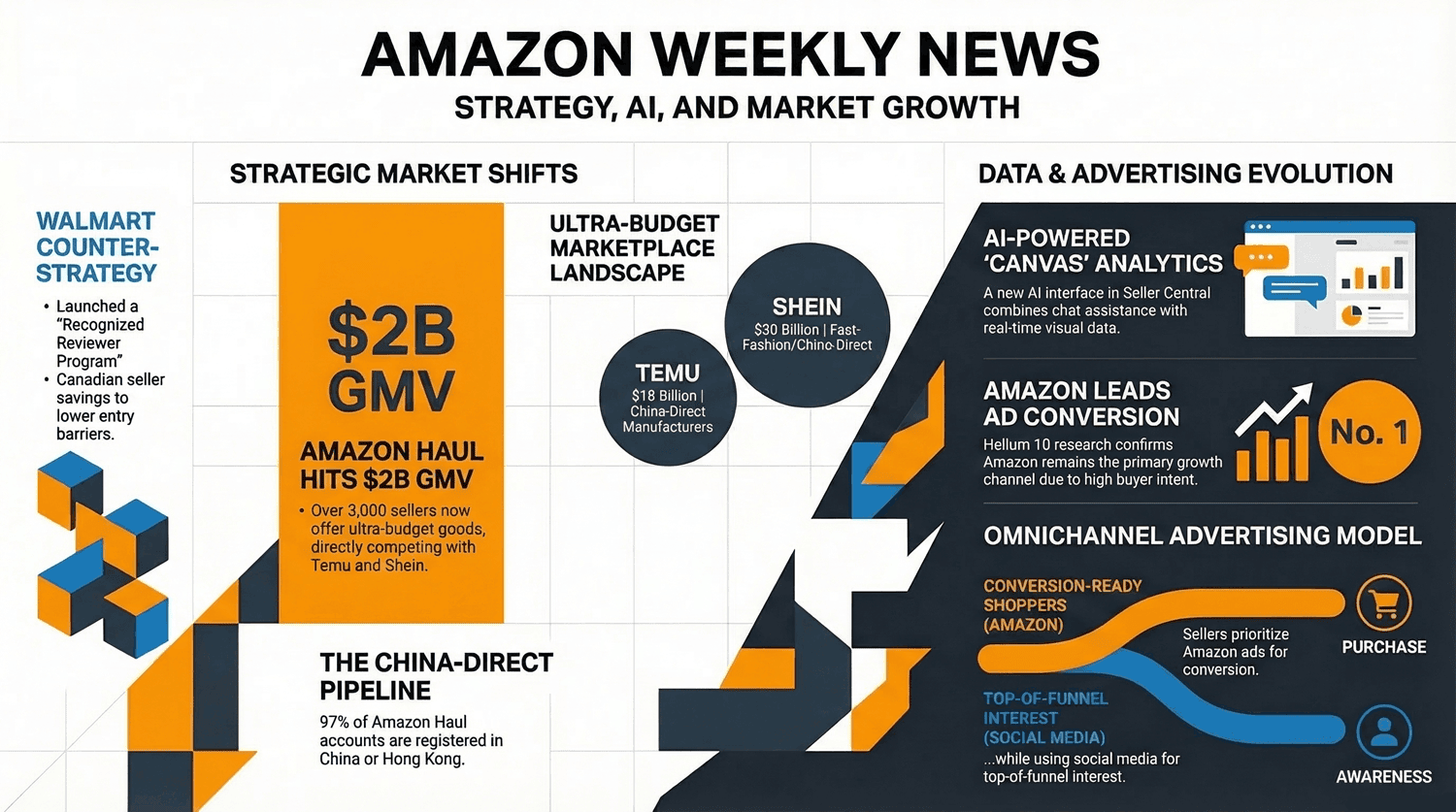
Amazon’s discount-focused Haul program continues to expand. Analysts estimate the section already hosts more than 3,000 sellers, while its annual gross merchandise value (GMV) is approaching $2 billion.

What happened
Amazon Haul launched in the U.S. in late 2024 as a section within Amazon Marketplace focused primarily on products priced below $20. The program now includes nearly 3,300 sellers. About one-third of them sell items under $10, while a large portion operates in the $10–$20 range. Around 1,200 sellers have an average catalog price above $20, suggesting many brands are experimenting with the channel using limited SKUs rather than shifting their full assortment.
Most sellers come from China. In the under-$10 segment, about 97% of seller accounts are registered in China or Hong Kong. Shipping often relies on longer delivery windows of 10–11 days.Why it matters
Amazon is effectively creating its own ultra-low-price segment within U.S. e-commerce. Until recently, much of that demand was captured by platforms like Temu and Shein, which built their model on low prices and direct shipments from China.
With Haul, Amazon aims to keep part of this traffic inside its ecosystem. Buyers stay within Amazon even if they accept slower delivery in exchange for lower prices.
However, the situation is complicated by ongoing uncertainty around U.S.–China trade tariffs. Changes in import duties can directly impact landed costs and make long-term planning in the ultra-budget segment less predictable.What it means for Amazon sellers
For private label brands, Haul currently functions more as an additional tool rather than a primary sales channel. Although its scale is still far behind Temu and Shein (roughly $18B and $30B GMV respectively), it can serve as a testing ground for new low-price products before a full launch on Amazon Marketplace.
This allows sellers to gather early feedback from target audiences, validate demand, and refine the product if needed. The core brand economics—scaling sales, advertising, and repeat purchases—still largely happen within the traditional Amazon Marketplace environment.
For now, sellers are mostly watching how this segment develops. Amazon brings a loyal customer base, broad reach, and powerful advertising tools, but its platform fees remain higher than those of many Chinese marketplaces competing in the ultra-low-price category.News #2. Amazon introduces Canvas AI analytics in Seller Central
Amazon has begun rolling out a new AI-driven interface called Canvas inside Seller Central. The feature combines chat assistance with visual analytics to help sellers explore business data and make decisions directly within the platform.

What happened
Amazon is introducing Canvas, a new workspace inside Seller Central designed as an AI-powered environment where sellers can ask questions and receive personalized business insights.
When sellers interact with Seller Assistant, the system automatically generates a dashboard displaying sales charts, category trends, inventory levels, and recommended actions. The interface updates dynamically: sellers can refine questions, generate new visualizations, or analyze different time periods.
Canvas effectively merges conversational AI with analytics dashboards, enabling sellers to explore scenarios such as product opportunities, competitive analysis, and promotional planning within Amazon Marketplace.Why it matters
Amazon is gradually shifting Seller Central toward an AI-driven decision interface. Instead of relying on multiple static reports, sellers now receive a single workspace that combines data, analysis, and suggested actions.
This approach simplifies how sellers interact with Amazon Marketplace data and reduces the time between identifying a trend and making a business decision. At the same time, it strengthens the role of Amazon’s own analytics ecosystem.What it means for Amazon sellers
The main advantage of Canvas is fully personalized analytics. Sellers can request reports from virtually any angle—by product, category, inventory status, sales trends, or promotions.
In practice, sellers simply ask questions and receive visual insights directly inside Seller Central. This significantly speeds up data analysis and helps merchants make faster decisions about inventory, product selection, and advertising strategies within Amazon Marketplace.News #3. Helium 10 study: Amazon remains the primary advertising channel for sellers
A new report from Helium 10 analyzes how brands allocate advertising budgets across marketplaces and external channels. The findings show that advertising within Amazon remains the core growth engine for most sellers.
What happened
Helium 10 released a report examining how brands distribute advertising budgets in an omnichannel commerce environment. The study reviewed how sellers invest in marketing across different platforms—from Amazon Marketplace to independent websites and social media channels.
The results indicate that Amazon advertising remains the main source of customer acquisition. Most brands start their marketing strategy with Amazon’s internal ad tools and then complement them with external traffic sources such as social media, search advertising, and other marketplaces.
This strategy reflects the nature of Amazon traffic: many users arrive with strong purchase intent, making advertising directly tied to sales performance on the platform.Why it matters
The report highlights how advertising budgets are evolving across the U.S. e-commerce landscape. While brands increasingly operate across multiple platforms, Amazon continues to function as the central conversion hub.
Because shoppers often come to Amazon ready to buy, advertising tools within Amazon Marketplace remain tightly connected to both sales and product visibility in search results. External marketing channels typically focus more on awareness and traffic generation.What it means for Amazon sellers
For sellers, the findings reinforce a practical strategy: build the core advertising structure inside Amazon Marketplace, where ads directly influence ranking and conversion.
External channels such as social media and search ads can generate additional demand, but the primary scaling of sales still happens within Amazon’s ecosystem.News #4. Walmart expands seller support programs on its Marketplace
What happened
Walmart launched the Recognized Reviewer Program, a system designed to help new products collect their first reviews. Sellers can provide free product samples to selected participants—verified buyers chosen by Walmart—who then publish honest feedback on the product page. Reviews include a label indicating that the item was provided as a sample.
The initiative helps new listings gather early reviews and build buyer trust, which is particularly important when launching new products.
At the same time, Walmart Marketplace Canada announced the Seller Savings Program 2026, aimed at lowering operational costs for sellers. The program includes reduced referral fees in certain categories, logistics discounts, and additional marketing tools available within the platform. The goal is to attract more sellers and expand product selection in the Canadian marketplaceWhy it matters
Walmart continues lowering entry barriers for marketplace sellers. Faster access to early reviews simplifies product launches, while cost-reduction programs help reduce financial pressure when entering a new platform.
These initiatives are part of Walmart’s broader strategy to expand its marketplace assortment and compete more aggressively for sellers across the North American e-commerce market.What it means for Amazon sellers
For Amazon sellers, these developments create additional opportunities for channel diversification. Walmart Marketplace is gradually making product launches easier and reducing initial costs, making it a viable secondary sales channel—while Amazon remains the primary platform for scaling brands.
Book a call now…
Book a call now…
Up to 45-min duration video-call
Topics we'll discuss:
| The next steps — there are two options
|