
Amazon: seller economics and review control; Shopify: AI operations; product differentiation as a growth condition in e-commerce
News #1. Amazon and sellers: mutual dependence continues to grow
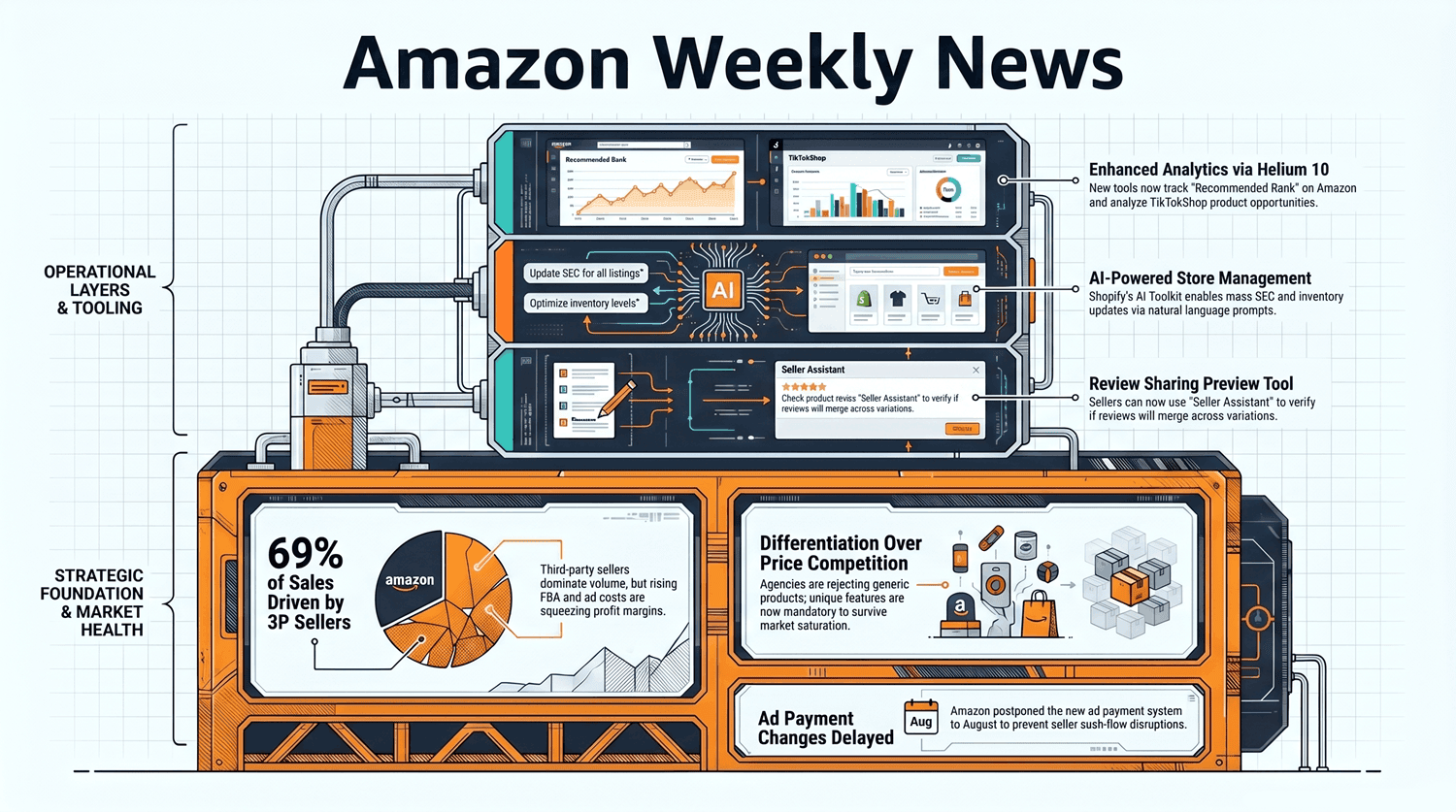
New data shows that despite rising costs, most third-party sellers continue to rely on Amazon due to its unmatched scale.
What happened
Despite these pressures, there is no large-scale seller exit. Even as diversification becomes more widely discussed, most sellers continue to treat Amazon as their primary sales channel.
Why it matters
The growth model of Amazon Marketplace is shifting. Expansion is increasingly driven by higher revenue per seller rather than by adding new sellers. At the same time, the share of mandatory costs within the ecosystem is rising, directly reducing margins and making cost management a key factor.
This reflects a broader shift toward performance efficiency within the platform.
What it means for Amazon sellers
Sellers need to focus more precisely on unit economics. This includes controlling FBA costs, managing advertising spend, and being more selective with product launches.
Amazon Marketplace remains the primary demand and conversion engine. At the same time, expanding into additional channels such as Shopify or Walmart Marketplace becomes a practical step toward reducing dependency and strengthening long-term stability.
News #2. Seller Assistant now shows review sharing eligibility across variations
Amazon introduces a tool that allows sellers to check in advance how reviews will be distributed across product variations.
What happened
The rule remains unchanged: review sharing is allowed only for variations with minor differences, such as color, pattern, or pack size. Functional differences, such as flavor, prevent review sharing. If variation structures are inconsistent, review sharing may be disabled entirely. In search results, only eligible reviews are reflected, while Best Sellers Rank remains unaffected.
Why it matters
Previously, sellers could only see the outcome after making changes to variation structures. Now, they can evaluate the impact in advance. This reduces the risk of losing aggregated ratings and provides more control over listing visibility and conversion.
The update highlights tighter control over catalog structure within Amazon Marketplace.
What it means for Amazon sellers
This helps avoid situations where reviews stop supporting the entire product line, which directly affects conversion and advertising efficiency within retail media.
News #3. Product uniqueness becomes a key competitive factor on Amazon
A recent case highlights why advertising alone cannot compensate for a lack of differentiation.
What happened
Experts note increasing pressure in Amazon Marketplace from large-scale manufacturers, particularly from China, competing on price and speed to market. In this environment, launching another similar product quickly leads to price competition and margin decline, even with active advertising.
Why it matters
Competition is shifting from price to product. In saturated categories, demand concentrates around listings with clear differentiation—functional, visual, or packaging-based.
This changes the structure of market entry. Without proper niche analysis and competitive positioning, the likelihood of reaching profitability decreases from the start.
What it means for Amazon sellers
Product strategy must come before sourcing. Sellers need to define how their product stands out and validate demand before launching.
In practice, this means focusing on differentiation early. Strong advertising within Amazon Marketplace cannot compensate for the absence of unique product value.
News #4. Shopify AI Toolkit connects external AI agents to store operations
What happened
Shopify introduced AI Toolkit, an infrastructure that allows external AI agents to integrate directly with store operations via API. Unlike traditional AI tools focused on content, this system provides access to Shopify data and operational workflows.
It supports integration with tools such as Claude Code, Cursor, and Gemini CLI. Once connected, AI agents can execute tasks using natural language prompts.
Key capabilities include:
— bulk product updates
— editing SEO and metafields
— managing collections
— inventory checks and adjustments
— report generation
— bulk tagging
— theme modifications
Why it matters
At the same time, system architecture becomes more important. Store performance increasingly depends on how well AI integrations and data access are configured.
What it means for Amazon sellers
For Amazon sellers, Shopify serves as a flexible extension for multi-channel operations. AI Toolkit enables faster scaling, testing, and catalog management outside Amazon.
Amazon Marketplace remains the core conversion engine, while Shopify strengthens operational flexibility and supports channel diversification.
Other Amazon News
Amazon delays advertising payment model update after market feedback
Amazon postponed the rollout of its updated payment system for Amazon Ads until August following feedback from sellers and agencies. The change was expected to accelerate billing cycles, but concerns about increased cash flow pressure led to the delay. The current system remains in place temporarily, stabilizing cash flow for sellers активно using advertising budgets.
Helium 10 expands analytics tools and launches TikTok Shop Chrome extension
Helium 10 introduced new features, including Amazon Recommended Rank for evaluating how well products align with recommended positions in Amazon search results. The platform also expanded keyword and visibility tracking tools. In addition, a Chrome extension for TikTok Shop was released, allowing sellers to analyze products and content directly within the platform.
The U.S. digital advertising market reached $294.6 billion in 2025, with growth driven primarily by social media and video formats. This increases competition for advertising budgets across platforms, including Amazon Ads, Google, and Meta. For Amazon, this creates additional pressure to retain advertisers within its ecosystem through performance-driven tools, as budgets shift toward social and video channels.
Book a call now…
Book a call now…
Up to 45-min duration video-call
Topics we'll discuss:
| The next steps — there are two options
|