
AI becomes a core seller tool; Rufus personalizes search via profiles; Amazon tightens listing control; Walmart expands Marketplace through offline logistics
News #1. E-commerce sellers adopt AI at scale
AI has become a working tool for marketplace sellers, but measurable impact is still concentrated in content rather than sales growth.
What happened
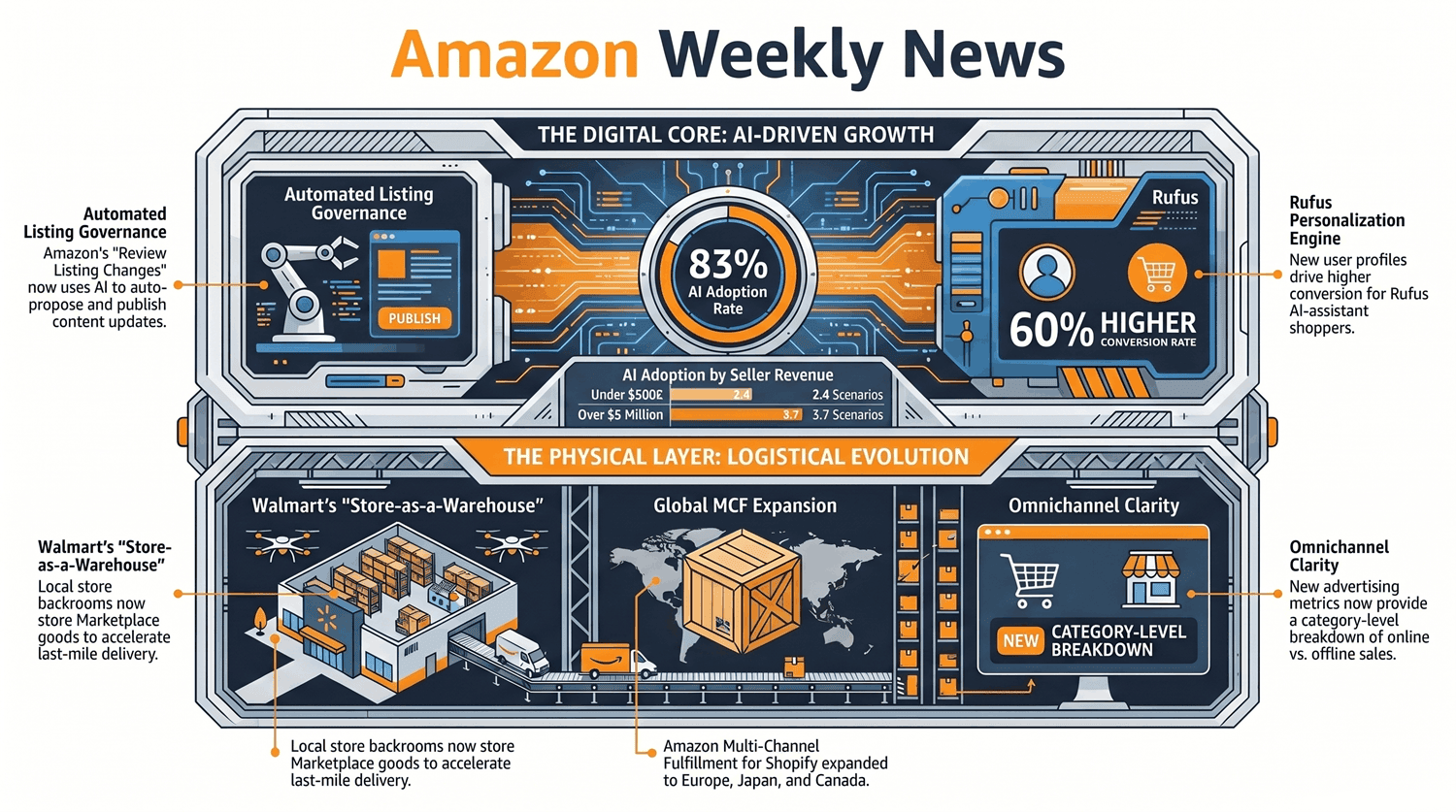
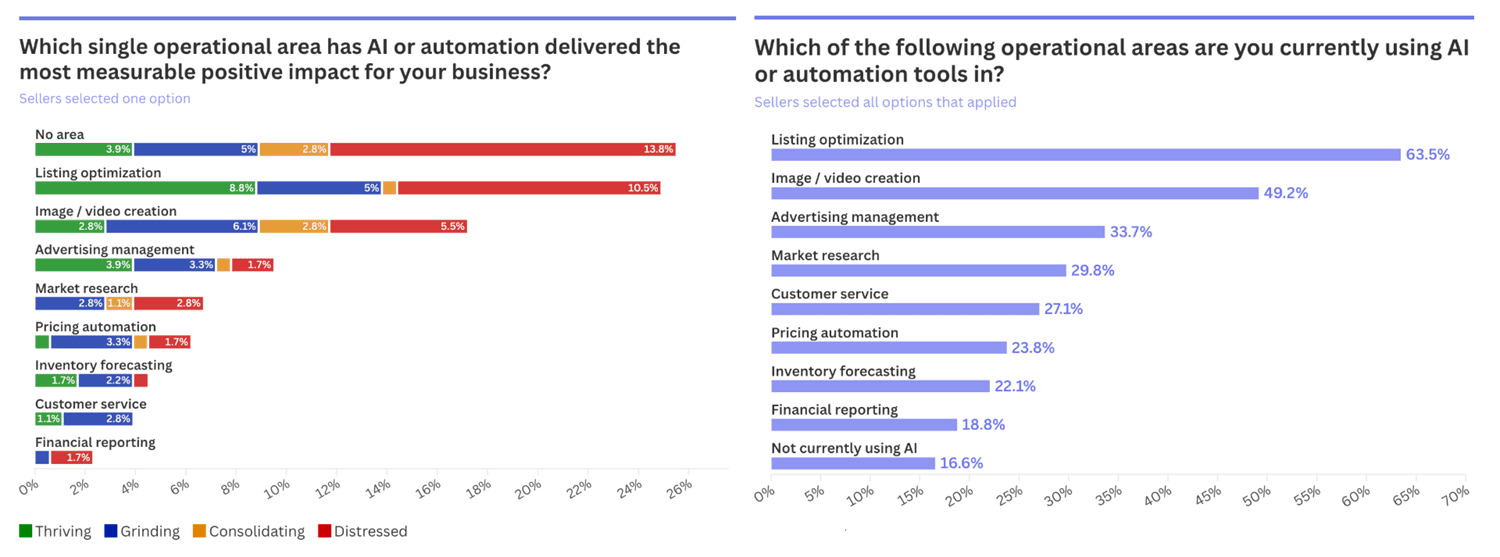
According to Marketplace Pulse, 83.4% of marketplace sellers already use AI (artificial intelligence) in their operations. On average, each seller applies 3.2 use cases. Most applications are content-related: 63.5% use AI for listing optimization, and 49.2% for generating images and video. Advertising management, competitor analysis, pricing, and inventory forecasting are used significantly less.
Expectations still exceed actual outcomes. The most common response—25.4% of sellers—is that they see no measurable impact. Larger sellers use AI more actively: businesses under $500K revenue average 2.42 use cases, while those above $5M reach 3.67.Why it matters
AI reduces the cost and time required to produce content for Amazon Marketplace, but results vary across sellers. Among stronger, growing businesses, around 16% report no measurable impact, while among sellers with weaker revenue and margin performance, that share is roughly twice as high.
This suggests AI works more effectively where processes are already structured, but does not independently solve demand or margin challenges.What it means for e-commerce sellers
For sellers, AI should be treated as a tool to accelerate listing management, visual content production, and operational workflows. It improves efficiency and simplifies execution, but still requires human validation and editing. Business growth continues to depend on fundamentals: product quality, pricing, advertising, and operational discipline.
News #2. Amazon Rufus connects search with buyer profiles
Amazon is testing a new personalization layer in Rufus, linking search results to detailed buyer profiles.
What happened
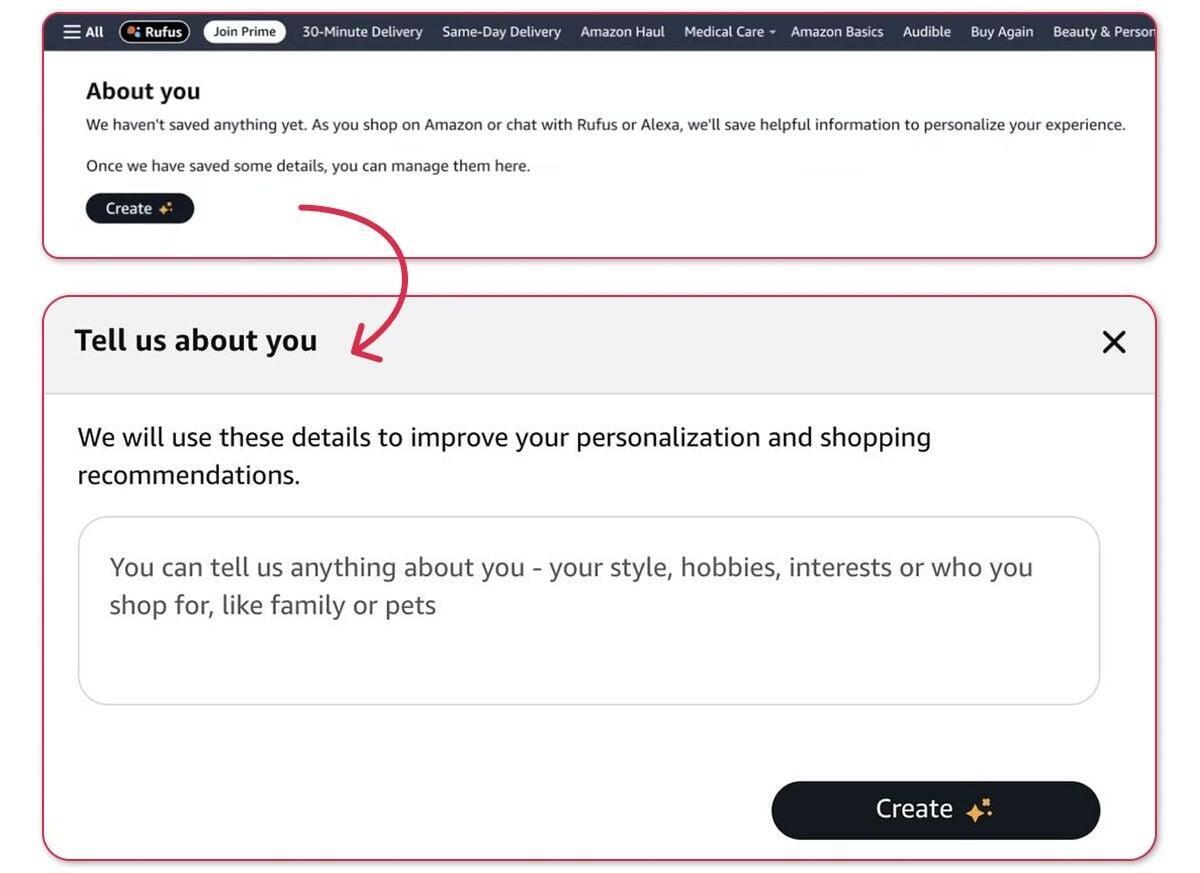
Amazon is rolling out the “Tell us about you” feature in Rufus, its AI shopping assistant. Users can describe their lifestyle, household, hobbies, pets, or intended use cases. This data is stored in the account profile and applied across Amazon shopping, Rufus interactions, and Alexa.
The key shift is that search queries remain the same, but results vary depending on the buyer profile. Two users searching for “storage bins” may see different results: one optimized for “family with three children in a small apartment,” another for a “minimalist home office.”
For Amazon Marketplace, this introduces an additional ranking layer: listings are evaluated not only by keywords, reviews, and conversion rates, but also by alignment with usage scenarios.Why it matters
Rufus is already a significant shopping interface. According to Amazon, over 300 million customers used it in 2025, and users interacting with Rufus convert 60% more often.
Personalized search based on buyer profiles can therefore directly impact ASIN visibility and reshape demand distribution within the platform.What it means for Amazon sellers
At this stage, analytics tools do not show which audiences Rufus targets with specific listings. Sellers should review their listings: copy, visuals, and backend keywords must clearly reflect usage scenarios and context.
These elements now serve not only indexing purposes but also as signals for Rufus. Generic feature descriptions should be complemented with clear use cases such as “for pet owners,” “for small apartments,” or “for families with children.”News #3. Amazon updates Review Listing Changes with AI edits
Amazon expands automated listing management, combining AI-generated edits with limited seller review windows.
What happened
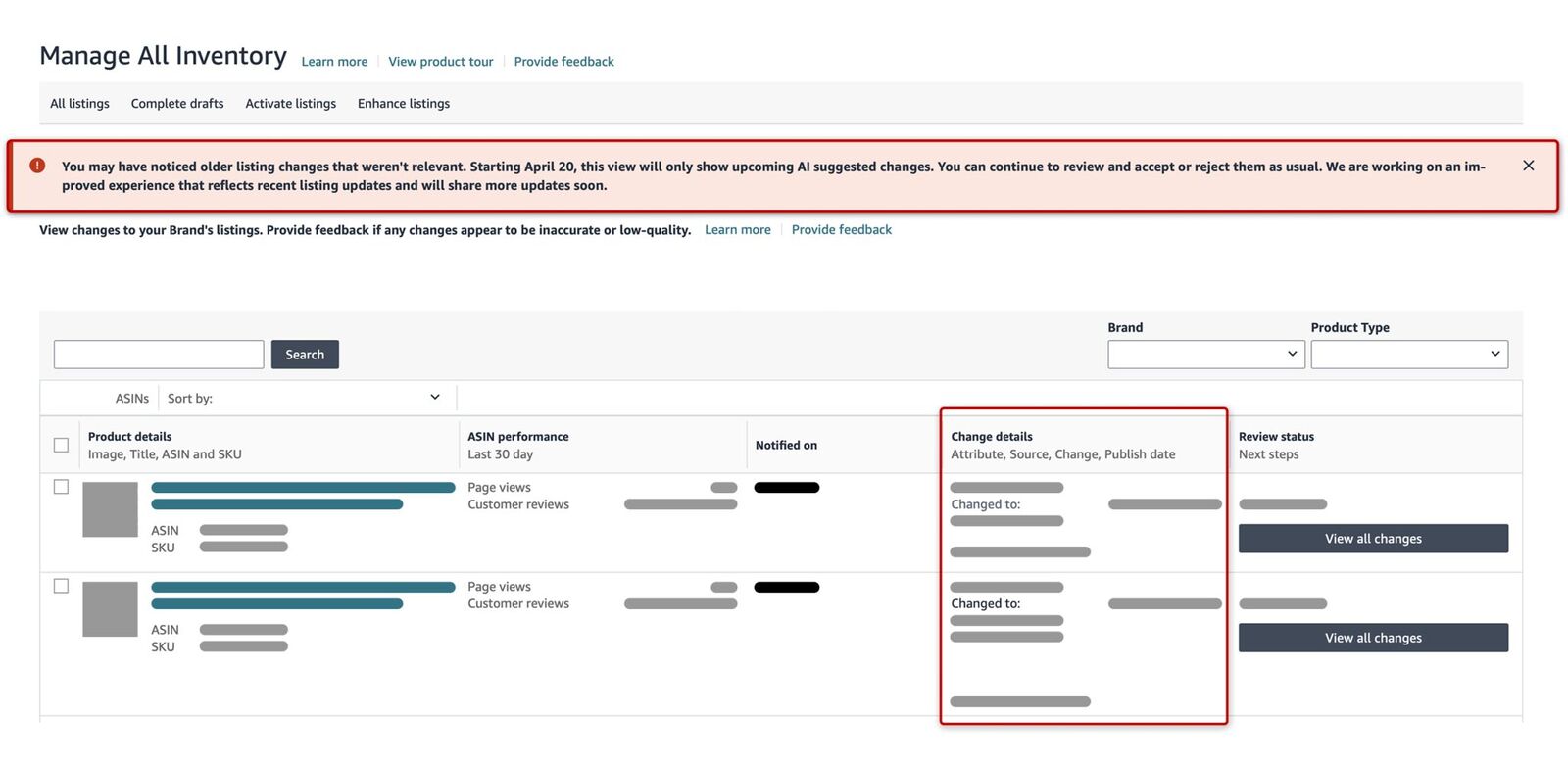
Since April 20, Amazon has updated the Review Listing Changes section in Seller Central. It now displays active AI recommendations and Amazon-initiated changes across all ASINs linked to a brand, including listings shared with other sellers. History is available for the past 60 days.
The tool also shows upcoming changes marked “Soon to be published on,” indicating the deadline for seller review. AI analyzes titles, bullet points, descriptions, and attributes to improve relevance.
Amazon can apply changes independently. If sellers disagree, they can respond via a “thumbs down,” prompting automatic revision or escalation to a case. Image and category changes are not yet included.Why it matters
Content management within Amazon Marketplace is becoming more centralized. The platform increasingly influences the final structure of listings, including shared ASINs.
This affects both search visibility and conversion, as content is aligned with catalog standards. At the same time, the response window for sellers is limited.What it means for Amazon sellers
Sellers need to regularly monitor Review Listing Changes and respond before publication deadlines. Responsibility for oversight remains on the seller side.
In practice, this adds a validation layer: sellers must track updates across all brand ASINs and quickly challenge inaccurate or undesirable edits.News #4. Walmart places Marketplace products in physical stores
What happened
Walmart has launched a pilot where products from Walmart Marketplace sellers are stored in backrooms of selected supermarkets. The company confirmed this following media reports.
This effectively moves part of the warehousing function closer to the end customer. Stores are used as local storage and fulfillment points, enabling faster delivery and reducing reliance on large distribution centers.Why it matters
Walmart is reinforcing its logistics model using its offline infrastructure. Turning stores into micro-fulfillment points reduces last-mile costs and shortens delivery times—key conversion drivers in the U.S. e-commerce market.
It likely also addresses warehouse capacity constraints driven by sales growth, solving both logistics efficiency and storage limitations simultaneously. This strengthens Walmart Marketplace as a logistics-enabled platform, not just a sales channel.What it means for e-commerce sellers
In practice, this can reduce logistics costs and improve delivery speed on Walmart Marketplace. Sellers should consider Walmart as an additional channel to expand reach and distribute operational risk, while maintaining Amazon as the core scaling platform.
Other Amazon News
Omnichannel metrics in Amazon Advertising
Amazon added category-level breakdowns to omnichannel metrics (cross-channel performance data). Advertisers can now see which product categories drive sales both online and offline, enabling more precise budget allocation within retail media (marketplace-based advertising).
MCF + Shopify expands beyond the US and UK
Amazon extended its Multi-Channel Fulfillment app for Shopify to Europe, Japan, and Canada. Sellers can now use a unified FBA inventory pool to fulfill Shopify orders without additional infrastructure, simplifying inventory management and reinforcing Amazon as a logistics backbone in a multi-channel model.
According to analysts at Rest of World, trust in AI is significantly higher in Asia (up to ~80% in China vs. ~50% in the US). This accelerates online business launches and increases supply on global marketplaces, including Amazon Marketplace, intensifying competition through faster and lower-cost operations.
Book a call now…
Book a call now…
Up to 45-min duration video-call
Topics we'll discuss:
| The next steps — there are two options
|