Amazon raises barriers for wholesale and arbitrage, takes logistics beyond the marketplace, expands ads in AI search, and builds control over AI agents
News #1. A Barrier for Wholesale and Online Arbitrage: Amazon Tightens Seller Access to Brands and Categories
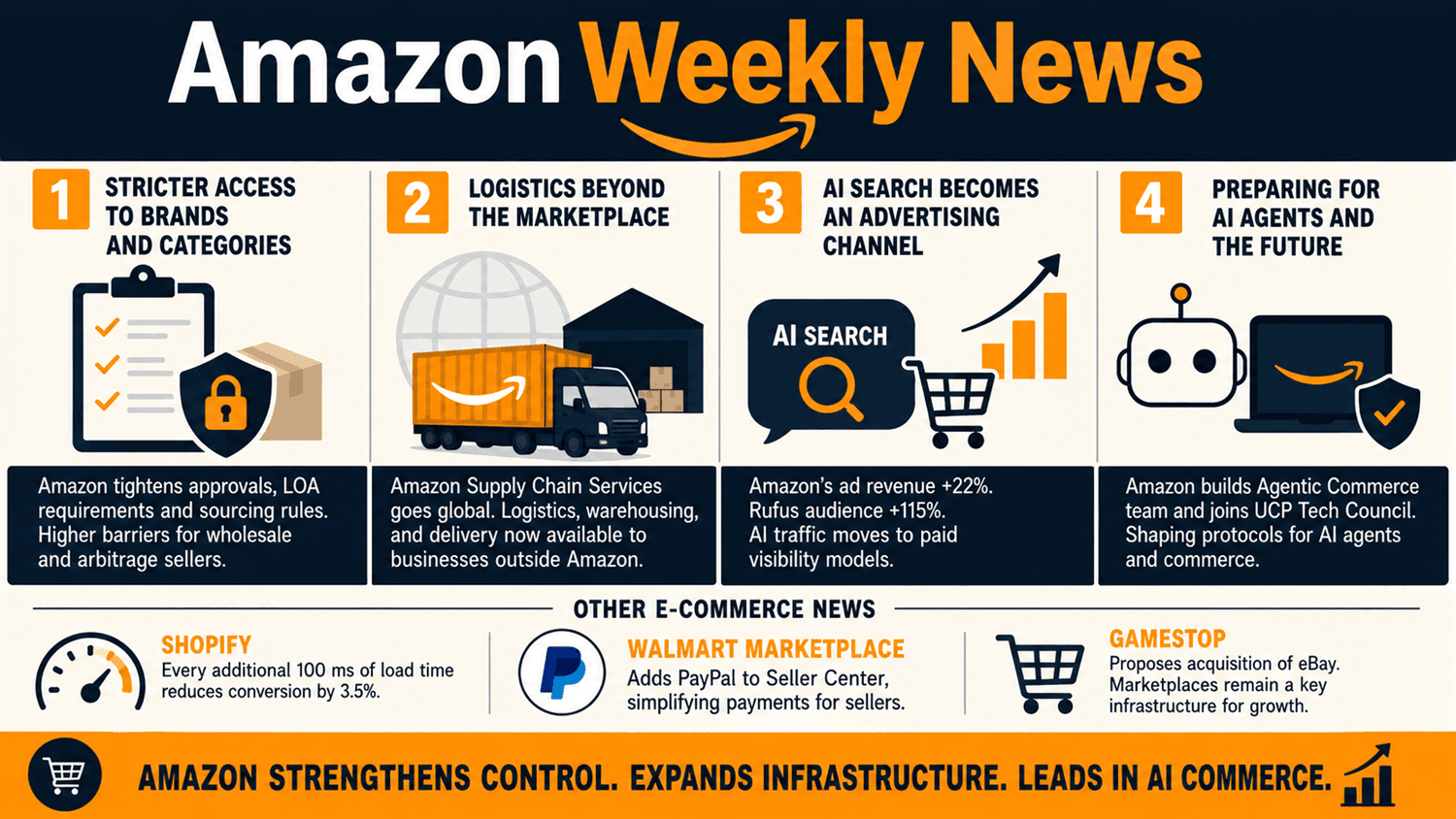
New clarifications around approvals, LOAs, and sourcing from authorized distributors increase control over who can sell on the Marketplace and on what terms.
What happened
Amazon has publicly reiterated seller approval rules in Seller Central: certain brands, categories, and products require prior approval, proof of product origin, and documentation from rights holders. The focus is on the Letter of Authorization (official brand permission), invoices from authorized suppliers, and listing restrictions. In practice, Amazon is strengthening not only its anti-counterfeit policy but also control over distribution channels, reducing opportunities for unofficial resale. For some sellers, this raises entry barriers into specific categories and brands, particularly in the U.S.
Why it matters
Amazon continues shifting from an open marketplace model toward a more formalized access system. Control over product origin, brand permissions, and suppliers reduces counterfeit risk but increases seller dependence on official supply chains. Profitability increasingly depends not only on demand but also on access to legitimate inventory. This is especially relevant for wholesale and arbitrage models, where unofficial sourcing becomes more risky.
What it means for Amazon sellers
This increases the importance of a stable supply chain strategy. Operating on Amazon Marketplace now requires transparent sourcing, verified documentation, and consistent relationships with brands or authorized distributors. In practice, this strengthens the value of private label models, exclusive agreements, and legally compliant supplier relationships.
News #2. Amazon Expands Logistics Beyond the Marketplace
Amazon transforms its internal logistics into an external service, offering supply chain infrastructure to companies outside its own platform.
What happened
Amazon has expanded Supply Chain by Amazon into a full platform—Amazon Supply Chain Services. It now offers international shipping via Amazon Global Logistics, warehousing through Amazon Warehousing and Distribution, inventory distribution, fulfillment, and delivery to both Amazon sellers and businesses operating on other channels. Existing tools remain, including the Partnered Carrier Program and Amazon Managed Service. Essentially, Amazon is bringing infrastructure built for Marketplace and Prime to the broader market as a standalone B2B service, scaling both logistics capacity and supply chain software management from production to the end customer.
Why it matters
Amazon is strengthening its position not only as a marketplace but as an infrastructure operator in e-commerce. The company is now competing at the level of storage, delivery, and inventory management. This creates a new revenue stream and expands Amazon’s control over product movement. For the market, this reinforces Amazon’s role as an operational platform where logistics becomes a separate business alongside retail, AWS, and advertising.
What it means for Amazon sellers
Amazon continues to grow as the primary scaling infrastructure. Deeper supply chain integration, potential reduction in landed cost (total cost including duties and logistics), and faster inventory turnover make Amazon an even stronger base for private label. At the same time, a multi-channel strategy gains an additional advantage: Amazon serves not only as the main sales channel but also as a logistics backbone.
News #3. Amazon and ChatGPT Shift AI Product Search Toward an Advertising Model
Amazon and OpenAI confirm that organic traffic from AI chats is giving way to paid visibility models.
What happened
According to Amazon, “nearly 20% of shoppers” who interact with an ad prompt in Rufus continue the conversation about that product. This is one of the first public indicators of advertising effectiveness within an AI shopping interface. At the same time, OpenAI has opened ChatGPT’s advertising platform to all U.S. advertisers and moved away from a direct purchase commission model (previously обсуждалась ставка около 4%). In effect, ChatGPT is no longer developing a model where sellers receive traffic without advertising as the primary visibility mechanism. Analysts estimate that the U.S. AI commerce market could reach $1 trillion by 2030, with 68% of consumers already using AI tools for shopping in the past three months.
Why it matters
A new demand structure is forming: AI search is becoming not an alternative to marketplaces but an additional advertising layer. Amazon is already seeing growth—its advertising revenue increased by 22% in Q1 2026, Rufus audience grew by 115% year-over-year, and shopper engagement rose nearly 400%. This increases seller dependence on ad spend within Amazon Marketplace and shifts AI commerce toward a model where access to demand is increasingly budget-driven.
What it means for Amazon sellers
Amazon remains the core scaling infrastructure, while advertising in AI dialogues becomes a new level of competition for demand. Sellers will need to integrate AI-driven ad placements into their overall advertising strategy within Amazon.
News #4. Amazon Quietly Prepares Protocols for ChatGPT and AI Agents
What happened
Amazon is forming an Agentic Commerce team to integrate its marketplace with ChatGPT and other AI interfaces where product discovery increasingly starts. Previously, Amazon restricted unauthorized external system access to its data and customer journey, effectively blocking AI agents. Now, the company is moving toward controlled integration—managing AI channels through its own infrastructure while retaining control over reviews, advertising, and transactions. Amazon is also part of the UCP Tech Council, an initiative developing the Universal Commerce Protocol—a set of technical standards for interactions between AI agents, platforms, and sellers. This suggests Amazon is not only protecting its ecosystem but also participating in shaping the rules of AI commerce.
Why it matters
AI is becoming a new entry layer into e-commerce, where product search and selection can occur outside Amazon. Instead of resisting this shift, Amazon is positioning itself within external purchase flows as a controlled infrastructure layer. This reduces the risk of losing customers while increasing the importance of access rules for AI interaction with platform data.
What it means for Amazon sellers
Structured listings, strong brand content, and readiness to operate in an environment where AI agents generate traffic become increasingly important. At the same time, customer base, payments, advertising, and reviews remain under Amazon’s control.
Other Amazon News
Shopify: Every additional 100 ms of load time reduces conversion by 3.5%
Shopify data shows a direct link between site speed and sales: every 100 ms delay reduces conversion by an average of 3.5%. For DTC and Shopify brands, technical performance directly affects revenue. In practice, storefront speed becomes part of unit economics.
Walmart Marketplace adds PayPal to Seller Center
Walmart now allows sellers to use PayPal to pay platform fees. While not a strategic shift, it reduces operational friction for international and multi-channel sellers who require flexible financial management. Walmart continues simplifying Seller Center, lowering entry barriers and strengthening its role as a complementary sales channel alongside Amazon.
GameStop proposes acquisition of eBay
GameStop has made an offer to acquire eBay. The interest is driven not only by the scale of the deal but also by CEO Ryan Cohen, who has turned GameStop into a profitable company since 2021 through cost reduction and operational restructuring. Analysts are now considering whether this approach could be applied to eBay, where a combination of marketplace, recommerce, and a large customer base could enable expansion beyond traditional retail. Even if the deal does not proceed, the move highlights growing interest in marketplaces as scalable infrastructure, where operational efficiency and cost control are as important as technology.
Book a call now…
Book a call now…
Up to 45-min duration video-call
Topics we'll discuss:
| The next steps — there are two options
|