Amazon shortens product titles, opens Seller University to AI-powered search, TikTok Shop gains influence, and Walmart expands its retail media business
News #1. Amazon Cuts Product Title Length to 75 Characters
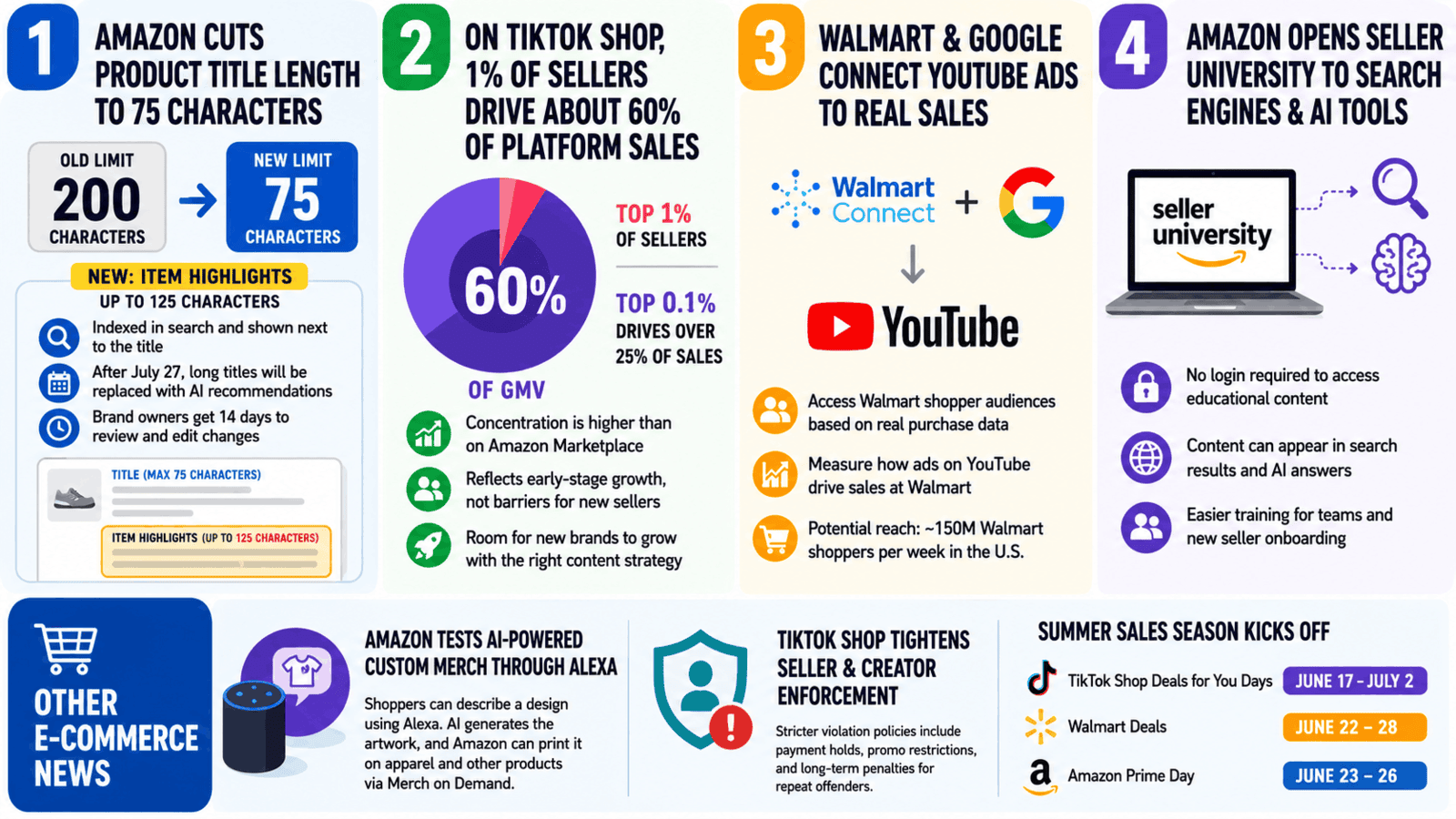
Amazon is introducing a major change to listing optimization: product titles will be limited to 75 characters, down from the previous 200-character standard. Additional product details will move into a new field called Item Highlights.
What happened
Amazon is updating product title requirements across nearly all categories. Starting July 27, product titles must be no longer than 75 characters, including spaces. Sellers will be able to use a new Item Highlights field with up to 125 additional characters for materials, use cases, and other key product information. Item Highlights will appear in search results and on product detail pages and will be indexed for search.
Listings with titles exceeding the limit after July 27 will gradually be updated using Amazon-generated AI recommendations. Listings will remain active throughout the process, and brand owners will have 14 days to review and modify suggested changes.Why it matters
For years, sellers used product titles as a primary location for keywords, product specifications, sizes, colors, and model information. Amazon is now separating core product identification from supporting details.
The move is designed to improve the mobile shopping experience, where long titles are often truncated. However, sellers in technical and specification-heavy categories are concerned about losing visibility for important attributes before the customer clicks into the listing. Discussions in Seller Forums already highlight concerns about updating large catalogs, issues with Item Highlights, and skepticism toward automated AI-generated edits.What it means for Amazon sellers
Sellers should begin updating listings before the deadline. The most important keyword, product type, and primary attribute should fit within the first 75 characters, while secondary details can be moved into Item Highlights.
One key unknown remains: how much search weight Amazon will assign to Item Highlights. Based on the structure Amazon has published, the field is likely to sit between the product title and bullet points in terms of importance, but its actual impact on ranking and indexing will only become clear after rollout.News #2. On TikTok Shop, 1% of Sellers Generate About 60% of Platform Sales
A new Marketplace Pulse study highlights a high concentration of sales on TikTok Shop in the United States. Analysts argue that this pattern reflects the platform's growth stage rather than a lack of opportunity for new sellers.
What happened
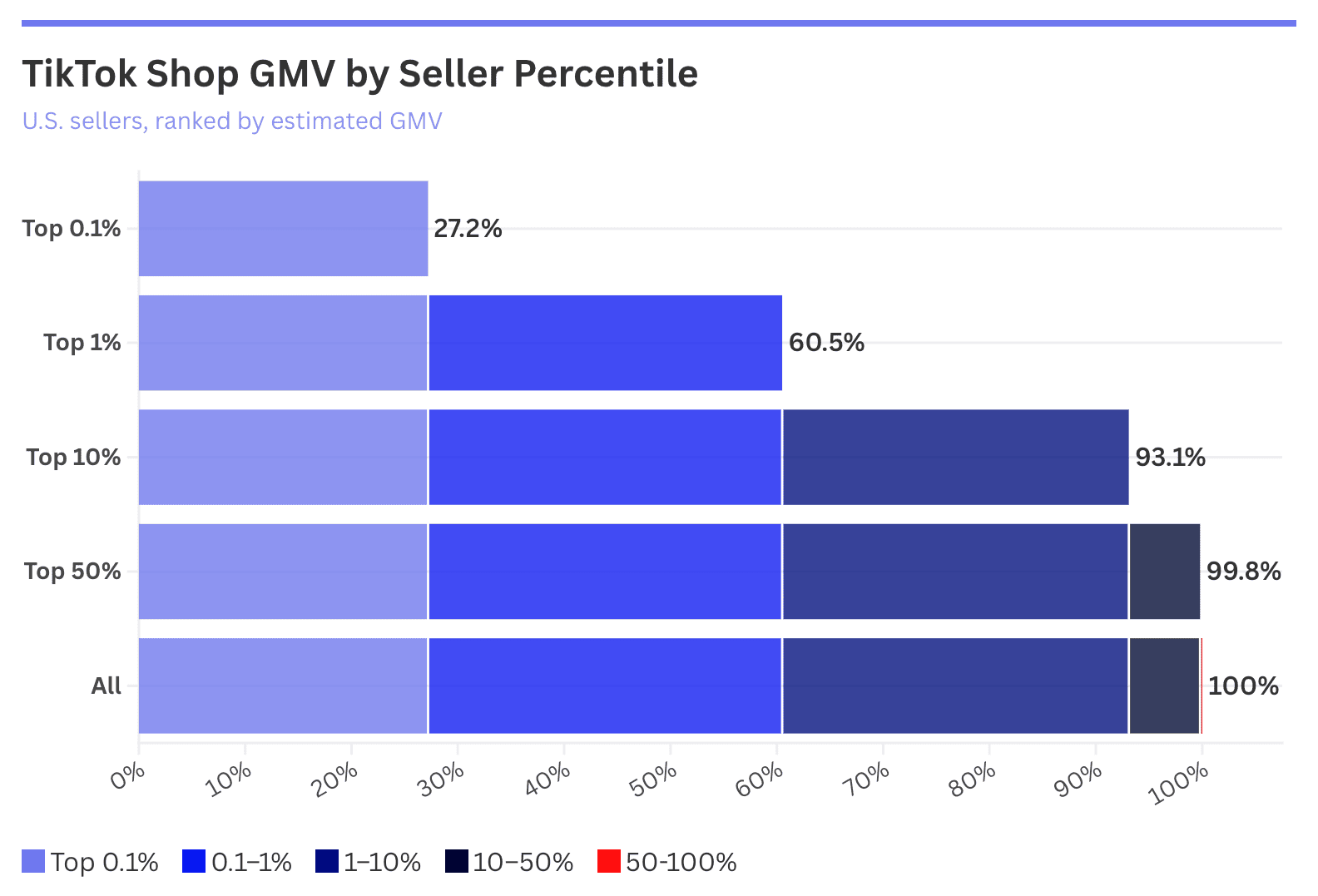
Marketplace Pulse analyzed nearly 100,000 TikTok Shop US sellers and found that roughly 1% of sellers account for about 60% of gross merchandise value (GMV). The top 0.1% alone generate more than a quarter of all sales.
According to the report, sales concentration on TikTok Shop is currently higher than on Amazon Marketplace. By comparison, around 1.6% of Amazon's active third-party sellers generate roughly half of marketplace sales. The study is based on marketplace estimates rather than official TikTok data, but it provides valuable insight into how revenue is distributed across one of the fastest-growing platforms in U.S. e-commerce.Why it matters
High sales concentration is common among rapidly growing marketplaces. During early growth stages, a relatively small group of sellers often captures a large share of demand because they adopt new tools and content strategies ahead of competitors.
Importantly, this is not the result of regulatory barriers or platform restrictions. Instead, it reflects a marketplace that is still evolving. The fact that TikTok Shop is now being tracked by major research firms and industry publications is itself noteworthy. Just a few years ago, the platform received limited attention from professional e-commerce analysts.What it means for e-commerce sellers
The findings suggest that TikTok Shop is maturing rather than becoming inaccessible to newcomers. The platform continues to attract both shoppers and brands, creating opportunities for new entrants.
Many of today's leading TikTok Shop sellers built their position through early adoption and effective content execution rather than structural advantages. For brands exploring multi-channel growth, the report is another reminder that TikTok Shop is becoming increasingly difficult to ignore.News #3. Walmart and Google Connect YouTube Ads to Real Purchases
Walmart Connect has announced a partnership with Google that allows advertisers to target Walmart audiences on YouTube and measure the impact of those campaigns on actual sales.
What happened
Walmart Connect has integrated its audience and measurement tools into Google Display & Video 360 (DV360). The initial rollout focuses on YouTube advertising.
Brands can now target audiences built from Walmart purchase data and measure whether those campaigns generate sales through Walmart's online and offline channels. Walmart says the integration could potentially reach roughly 150 million weekly shoppers in the United States.Why it matters
Retail media is expanding beyond marketplace websites. Instead of using first-party shopper data only inside its own ecosystem, Walmart is extending those audiences into external advertising channels.
For brands, this creates an opportunity to combine real purchase behavior with YouTube targeting and more accurate sales attribution. The broader trend reflects growing demand for advertising systems that connect media exposure directly to transactions rather than relying solely on clicks and impressions.What it means for e-commerce sellers
Purchase data is becoming one of the most valuable assets in digital advertising. Major marketplaces are increasingly using that data beyond their own platforms.
As a result, brands gain more opportunities to acquire customers outside marketplace environments while measuring business outcomes more precisely. Competition among large commerce platforms is increasingly centered on advertising technology, audience data, and attribution capabilities.News #4. Amazon Opens Seller University to Search Engines and AI Assistants
What happened
Amazon announced that Seller University content no longer requires account login. Educational resources covering listings, FBA, advertising, and other Amazon programs can now be shared through direct links with employees, contractors, and business partners.
Amazon also confirmed that official Seller University content may appear in search engine results and AI-generated answers.Why it matters
Historically, much of Amazon's official educational content was hidden inside Seller Central and less visible to external search.
As AI-powered search becomes more common, sellers increasingly look for answers through ChatGPT, Gemini, and other AI systems. By making Seller University publicly accessible, Amazon is positioning its own documentation as a primary source of information rather than relying on third-party blogs, forums, and interpretations of platform policies.What it means for Amazon sellers
For new sellers, the change makes it easier to research Amazon requirements before opening an account. Existing businesses can more easily train team members and share official documentation internally.
Over time, sellers may increasingly encounter Amazon's own guidance when searching for policy explanations, listing requirements, and operational best practices, reducing reliance on unofficial sources.Other Amazon News
Amazon tests AI-powered custom merchandise through Alexa
Amazon is testing a new Alexa feature that lets shoppers create custom product designs using text prompts. AI generates the artwork, and Amazon can print it on apparel and other products through Merch on Demand.
TikTok Shop tightens seller and creator enforcement
TikTok Shop is introducing stricter violation policies, including payment holds, promotional restrictions, and long-term penalties for repeat offenders as the platform continues to formalize its marketplace operations.
TikTok Shop's Deals for You Days runs from June 17 to July 2, Walmart Deals takes place June 22–28, and Amazon Prime Day is scheduled for June 23–26. The period is expected to become one of the busiest shopping and advertising windows of the first half of the year.
Book a call now…
Book a call now…
Up to 45-min duration video-call
Topics we'll discuss:
| The next steps — there are two options
|