Amazon clarifies Item Highlights ranking, AI shopping raises visibility questions, U.S. lawmakers target seller protections, and Shein feels the impact of de minimis changes
News #1. Amazon Confirms Item Name and Item Highlights Carry Equal Search Weight
Amazon has shared more details on its major product listing update. The company confirmed that the new Item Highlights field is used in search ranking on the same basis as the product title.
What happened
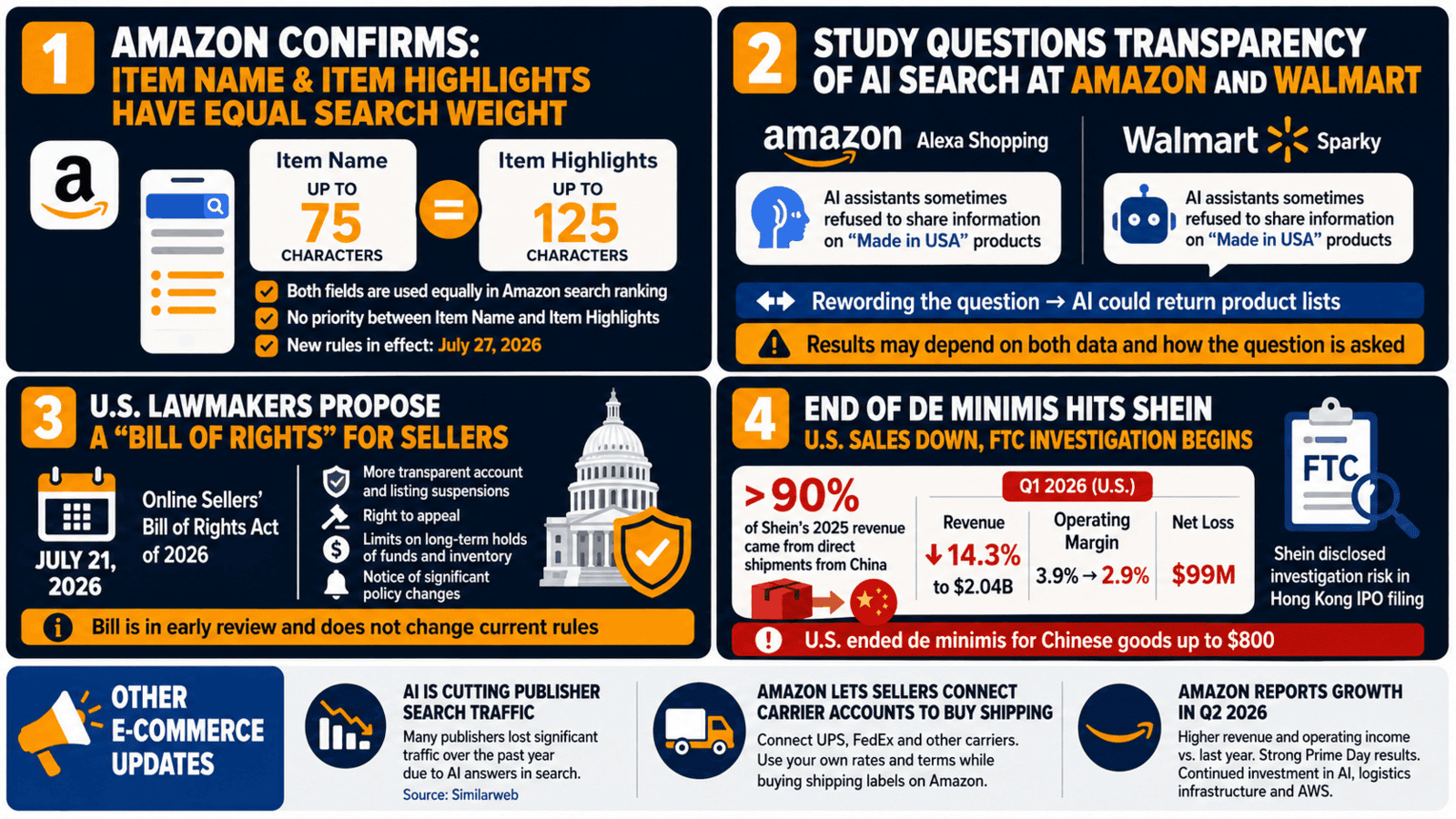
Amazon published additional guidance on the product title rules introduced on July 27, 2026. Under the new structure, the product title, now labeled Item Name, is limited to 75 characters, while up to 125 additional characters can be added through the new Item Highlights field.
The most important clarification is that Amazon Search uses both fields equally. Neither Item Name nor Item Highlights receives greater priority in search and discovery.
The core title requirements remain unchanged. Sellers should avoid long keyword-heavy titles, promotional language, repeated words, and prohibited special characters. If a listing does not comply, Amazon may automatically adjust the title or reduce its visibility in search results.
Amazon has not yet published a separate set of detailed rules for Item Highlights. However, the company recommends using the field for concise product attributes, materials, compatibility details, and use cases, written as short comma-separated phrases.Why it matters
Amazon continues to make its catalog more mobile-friendly and easier for both shoppers and AI-powered search systems to process. The key takeaway is that moving important product details from the title into Item Highlights should not reduce search visibility, since both fields are treated equally by Amazon Marketplace algorithms.
What it means for e-commerce sellers
Amazon sellers should update their listings before Amazon applies automated changes. The most important product information should remain in Item Name, while secondary features and benefits can move to Item Highlights.
Source: Amazon Seller Central
News #2. Study Raises Questions About AI Search Transparency at Amazon and Walmart
What happened
Researchers found that both AI assistants sometimes declined to provide information when asked to identify products “Made in USA.” After the prompt was slightly reworded, however, the systems were able to return lists of relevant products.
The report argues that the platforms appear capable of analyzing country-of-origin information and identifying potentially questionable claims, but do not always use those capabilities in customer-facing responses.
Amazon disputed the findings. The company said country-of-origin information is shown on product detail pages when it is provided by manufacturers or third-party sellers.
Why it matters
Shoppers are increasingly receiving product recommendations through AI assistants rather than traditional marketplace search results. These systems decide which product information to surface and how to frame it.
The study suggests that results may depend not only on the product data itself, but also on how the shopper phrases the query. That makes complete and accurate listing data increasingly important not only for Amazon Search, but also for AI shopping interfaceWhat it means for e-commerce sellers
As AI Shopping gains traction, product visibility is moving beyond traditional Amazon SEO. Detailed specifications, country-of-origin information, and correctly completed listing attributes may influence both search rankings and the answers shoppers receive from AI assistants.
News #3. U.S. Lawmakers Propose a “Bill of Rights” for Marketplace Sellers
A new U.S. bill could strengthen protections for third-party sellers operating on Amazon, Walmart, and other major online marketplaces.
What happened
On July 21, a group of lawmakers introduced the Online Sellers’ Bill of Rights Act of 2026.
The proposal would direct the Federal Trade Commission to develop rules protecting sellers on large online marketplaces.
The measures under consideration include clearer procedures for account and listing suspensions, a formal right to appeal, limits on prolonged holds involving seller funds and inventory, and mandatory notice before major platform policy changes take effect.Why it matters
The bill arrives as regulators pay closer attention to the relationship between major marketplaces and the third-party businesses that depend on them.
The proposal is still at an early stage and does not change current Amazon or Walmart policies. However, it shows that account suspensions, appeals, fund holds, and marketplace enforcement are now being discussed at the federal level.
If the initiative gains support, it could lead to more formal rules governing seller-platform relationships and greater oversight of large marketplaces.What it means for e-commerce sellers
There are no immediate changes for Amazon sellers. Still, the bill shows that opaque enforcement decisions, prolonged fund holds, and limited appeal options are becoming a regulatory issue and could eventually lead to stronger seller protections.
Source: Becca Balint, Ecomwatch
News #4. Shein Hit by the End of De Minimis as U.S. Sales Fall and FTC Scrutiny Grows
What happened
According to Marketplace Pulse, more than 90% of Shein’s 2025 revenue still came from products shipped directly from China to U.S. customers.
Despite years of discussion around localization, the company remains highly dependent on a cross-border fulfillment model.
After the U.S. ended de minimis treatment for Chinese shipments valued at up to $800, the financial impact became more visible. In the first quarter of 2026, Shein’s U.S. revenue fell 14.3% year over year to $2.04 billion. Operating margin declined from 3.9% to 2.9%, and the company reported a quarterly loss of $99 million.
Shein is also facing an investigation by the U.S. Federal Trade Commission. In documents related to its Hong Kong IPO, the company warned investors that the review could result in financial penalties and other business consequences.Why it matters
Shein’s performance shows how sensitive cross-border e-commerce economics can be to changes in trade policy.
In addition to U.S. restrictions on de minimis treatment for Chinese goods, the European Union has also prepared an additional charge on low-value imported parcels.
For companies built around low-cost direct shipping from China, these measures mean higher landed costs, more complex logistics, and pressure on margins.What it means for e-commerce sellers
The Shein case points to a broader trend: the U.S. and Europe are gradually revisiting the rules that supported the expansion of cross-border e-commerce.
If that continues, local inventory, warehouse coverage, and fulfillment infrastructure will become an even more important competitive advantage for brands and marketplace sellers.Source: Marketplacepulse, Ecomwacth, Retaildive
Other E-commerce News
AI Is Cutting Publisher Search Traffic as More Brands Turn to E-commerce
According to Similarweb data, many major online publishers lost a significant share of search traffic over the past year as AI-generated answers became more common in search engines.
Analysts say more companies are shifting their focus away from traditional content traffic and toward owned e-commerce channels, marketplaces, and retail media. For brands, this is another sign that AI is reshaping shopper behavior and that product visibility increasingly depends on more than traditional SEO. Marketplace presence, AI search visibility, and participation in advertising ecosystems are becoming more important.
Amazon Lets Sellers Connect Carrier Accounts to Buy Shipping
Amazon has started rolling out the ability to connect UPS, FedEx, and other carrier accounts directly to Buy Shipping.
Sellers can use their negotiated carrier rates and shipping terms while keeping the benefits of purchasing labels through Amazon. The update could give more flexibility to businesses operating hybrid or multi-carrier fulfillment models.
Amazon Reports Revenue Growth in the Second Quarter of 2026
Amazon reported higher revenue and operating income in the second quarter of 2026 compared with the previous year.
The company also highlighted strong Prime Day performance and continued investment in artificial intelligence, logistics infrastructure, and AWS.
For Amazon sellers, the results show that the platform continues to expand its customer reach, retail media ecosystem, and technology stack for product discovery and conversion.Source: EcomWatch, Amazon Seller Central, Amazon
Book a call now…
Book a call now…
Up to 45-min duration video-call
Topics we'll discuss:
| The next steps — there are two options
|