
Amazon is expanding AI-powered search, new EU rules complicate cross-border sales, TikTok Shop gains ground in the U.S., and Shopify sees stronger conversion from AI traffic
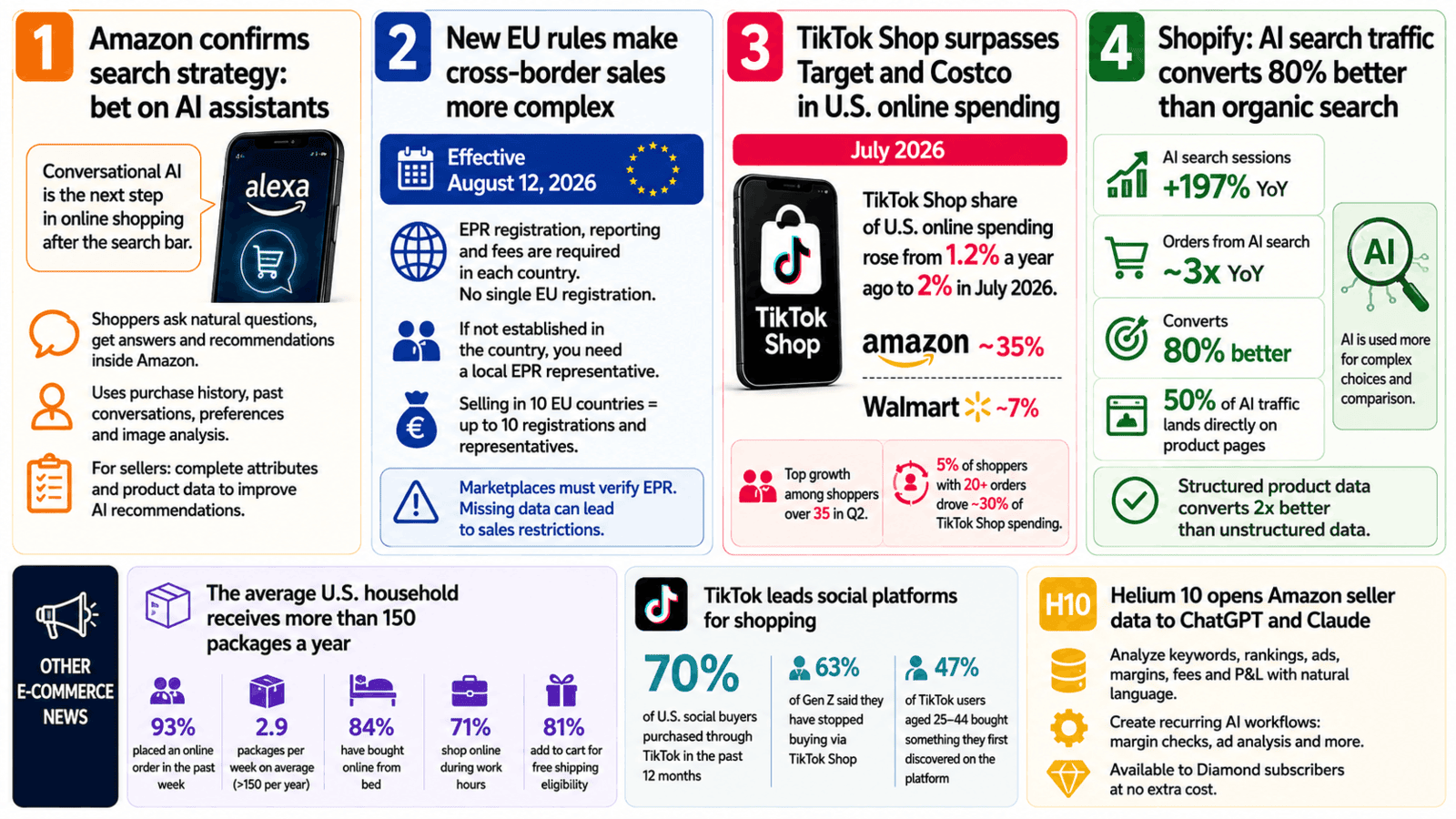
News #1. Amazon confirms its search strategy: AI assistants are the next step
Amazon is making its direction for product discovery increasingly clear. Worldwide Amazon Stores CEO Doug Herrington described conversational AI as the next stage of online shopping beyond the traditional search bar.
What happened
Doug Herrington discussed the development of Alexa for Shopping, Amazon’s AI shopping assistant that brings together technology from Rufus and Alexa+. Shoppers can already ask natural-language questions instead of entering precise search terms, then receive answers and personalized recommendations directly within Amazon.
Herrington said the traditional catalog-search model is running into the limits of Amazon’s enormous selection. With hundreds of millions of products available, expanding that selection further requires a better way to help shoppers find the right item. Amazon sees conversational AI as that solution.
Why it matters
Herrington’s comments confirm the direction of Amazon Search: AI assistants are becoming part of the core infrastructure for product discovery and selection. Shoppers increasingly don’t need to formulate an exact keyword query. AI can understand the task and context, then identify relevant products.
What it means for e-commerce sellers
For Amazon sellers, accurate attributes and detailed product data are becoming critical. Review your listings and complete as many relevant fields as possible, including specifications, materials, dimensions, compatibility and use cases. The better Amazon understands a product, the more information its AI has to match it with the right shoppers.
Source: Amazon
News #2. New EU packaging rules make cross-border selling significantly more complex
The EU’s new Packaging and Packaging Waste Regulation (PPWR) began applying on August 12. For e-commerce sellers, the biggest change is the need to handle registration and related costs separately in each country where products are sold.
What happened
The basic principle is straightforward: a company selling a packaged product must contribute to the cost of collecting and recycling that packaging in the country where it is sold and ultimately becomes waste.
For cross-border e-commerce, that means country-by-country obligations. A seller shipping to France, Germany and Italy, for example, may need three registrations under national EPR (Extended Producer Responsibility) systems, along with separate reporting and packaging fees. There is no single EU-wide registration.
Why it matters
The biggest burden is the fixed cost of registrations, local representatives and ongoing compliance in each market. These costs do not necessarily scale with sales, meaning a small seller may face many of the same basic administrative requirements as a large brand.
What it means for e-commerce sellers
Map every EU country where you currently receive orders and check the EPR requirements separately: registration, local representation, reporting and fees. Then recalculate the economics of smaller markets. If compliance costs exceed the profit generated there, temporarily switching off advertising and sales may make more sense than continuing to sell without meeting PPWR requirements.
News #3. TikTok Shop surpasses Target and Costco in its share of U.S. online spending
TikTok Shop continues to gain traction in the U.S. In July, the platform accounted for roughly 2% of Americans’ online spending — more than the online stores of Target, Costco and Home Depot.
What happened
According to Consumer Edge data based on U.S. credit and debit card transactions, TikTok Shop’s share of online spending increased from roughly 1.2% a year ago to 2% in July 2026. Amazon remains far ahead at around 35%, while Walmart accounts for roughly 7%.
Growth is no longer being driven only by younger shoppers. In Q2, spending among customers over 35 posted the fastest year-over-year growth.
Why it matters
TikTok Shop is gradually moving beyond impulse purchases triggered by short-form videos. The platform is expanding its fulfillment capabilities, bringing in major brands and testing a membership program with free shipping and other benefits.
What it means for e-commerce sellers
TikTok Shop increasingly makes sense not only as a customer acquisition channel but also as an additional U.S. sales channel. The growth of shoppers over 35 and repeat purchasing suggests brands can test more than viral products, including categories aimed at broader audiences.
Source: Business Insider
News #4. Shopify: AI search traffic converts 80% better than organic search
What happened
Traffic from AI platforms to Shopify stores increased 197% year over year, while orders from that traffic roughly tripled. Organic search traffic also grew 12% and still sends significantly more shoppers overall.
The biggest difference is what visitors do after they arrive. Shoppers landing on product pages from AI sources converted approximately 80% better than visitors from organic search. In categories where shoppers need to compare specifications, compatibility, reviews and use cases, the conversion gap reached roughly 2x.
Why it matters
The data suggests AI and traditional search are already serving different shopping needs. AI is particularly useful for more complex decisions where customers need to compare specifications, compatibility, reviews and multiple alternatives.
What it means for e-commerce sellers
Source: Shopify
Other E-commerce News
The average U.S. household receives more than 150 packages a year
A FinanceBuzz and Bank of America survey of 2,000 Americans shows just how routine online shopping has become. 93% placed an online order in the previous week, while the average household receives 2.9 packages per week — more than 150 a year. Some 84% have shopped online from bed and 71% during working hours. Free shipping, reviews and loyalty programs play a major role: 81% have added products to their cart specifically to qualify for free shipping.
TikTok leads social platforms for shopping
According to Bazaarvoice and EMARKETER, 70% of U.S. social buyers purchased through TikTok in the past 12 months, more than through any other social platform. But the audience is far from uniform: 63% of Gen Z respondents said they had stopped buying through TikTok Shop, while 47% of TikTok users aged 25–44 had purchased a product they first discovered on the platform. The data adds to evidence that TikTok Shop is gaining traction beyond its youngest audience.
Helium 10 opens Amazon seller data to ChatGPT and Claude
Helium 10 has launched an MCP (Model Context Protocol) integration that connects seller account data with ChatGPT, Claude and other AI tools. Sellers can use natural-language questions to analyze keywords, rankings, advertising, margins, fees and P&L without manually exporting reports. They can also build recurring AI workflows for tasks such as margin checks and ad campaign analysis. The integration is available to Diamond subscribers at no additional cost.Source: FinanceBuzz, EMARKETER, Helium 10
Book a call now…
Book a call now…
Up to 45-min duration video-call
Topics we'll discuss:
| The next steps — there are two options
|