Amazon & E-Commerce Weekly News #54

08.24.2026 11:25 AM

Amazon launches AWD in Europe and prepares to scale Prime Air, U.S. e-commerce growth accelerates, while Alibaba says 250 million users have already tried AI shopping
Amazon and E-commerce Weekly News For Sellers 54

News #1. 
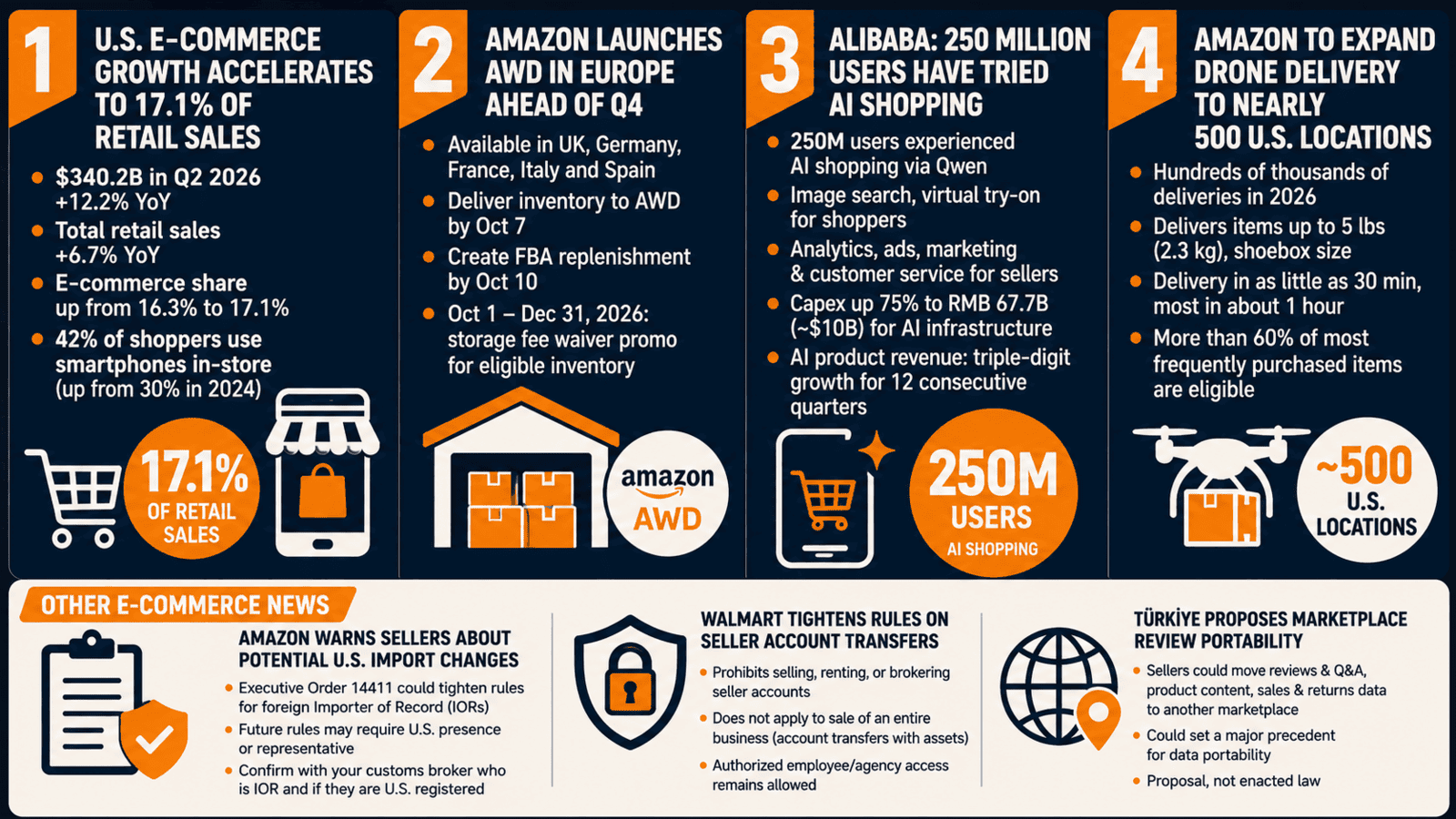
U.S. E-commerce Growth Accelerates and Reaches 17.1% of Retail Sales

Online retail continues to gain share in the U.S. market. E-commerce sales grew nearly twice as fast as overall retail in the second quarter of 2026.
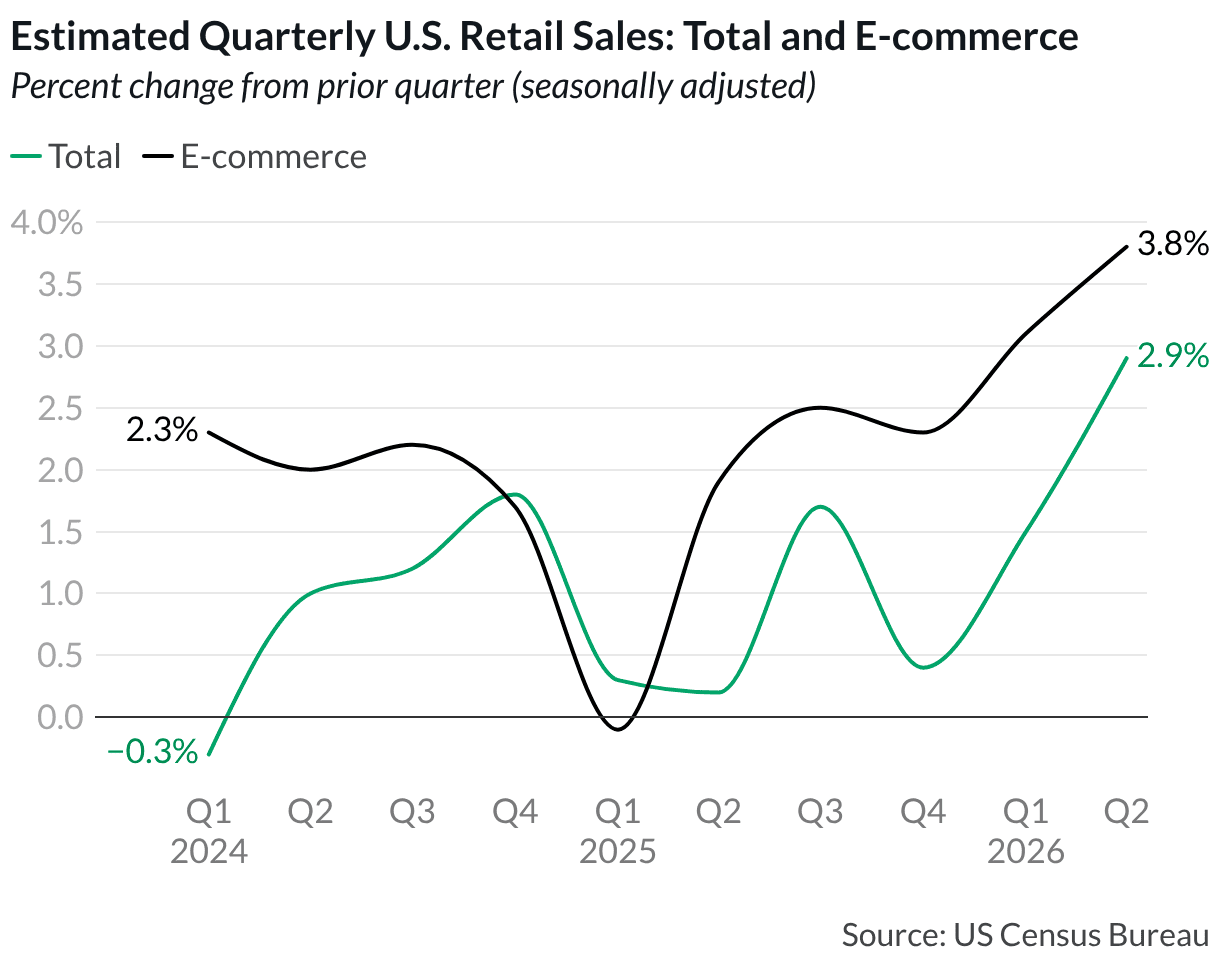
estimated quarterly u.s. retail sales total and e-commerce
What happened

According to the U.S. Census Bureau, U.S. e-commerce sales reached $340.2 billion in Q2 2026, up 12.2% year over year. Total retail sales grew 6.7% over the same period, while e-commerce increased its share of retail from 16.3% to 17.1%.

Separate PYMNTS Intelligence research also shows how digital shopping is increasingly influencing purchases inside physical stores. 42% of U.S. consumers now use smartphones while shopping in-store, up from 30% in 2024, to research products, read reviews, compare prices and check payment options. Meanwhile, 60% want retailers to match lower competitor prices, while only 47% of merchants currently offer such guarantees.

Why it matters

U.S. e-commerce continues to capture a larger share of consumer spending, while the line between online and offline shopping is becoming less distinct. A shopper can discover a product in a physical store, compare reviews and pricing on Amazon Marketplace or another online channel, and complete the purchase wherever the overall offer is stronger.

What it means for e-commerce sellers

Faster online growth creates additional upside for sellers, but also makes competition more transparent. Pricing, ratings, availability and delivery speed can now be compared in real time—even from the store aisle. A strong Amazon Marketplace offer and well-managed multi-channel presence are becoming increasingly important.

News #2.
Amazon Launches AWD in Europe Ahead of Q4

Amazon is expanding its fulfillment network in Europe. Amazon Warehousing and Distribution (AWD) is now available to sellers in the UK, Germany, France, Italy and Spain.

What happened  

Amazon launched AWD in five European markets on August 20. Instead of sending an entire shipment directly into FBA, sellers can place bulk inventory in AWD, where Amazon stores it and automatically replenishes FBA as needed. AWD inventory does not use the same FBA storage limits.

The timing is particularly relevant ahead of Q4. Amazon recommends delivering inventory to AWD by October 7 and creating FBA replenishment by October 10. From October 1 through December 31, 2026, Amazon is also running a promotion that waives storage fees for qualifying inventory in European AWD facilities. Sellers should check their specific eligibility and terms in Seller Central.

Why it matters  

AWD allows brands to keep larger inventory positions inside Amazon’s fulfillment network without overloading FBA with long-term stock. For sellers importing in bulk or holding several months of inventory, this can simplify FBA replenishment and reduce the risk of going out of stock.

What it means for e-commerce sellers  

AWD has already become part of Amazon’s logistics infrastructure in the U.S. European sellers can now use the same model. Ahead of Q4, brands shipping larger volumes should compare AWD with their current warehousing setup and consider keeping reserve inventory in AWD while replenishing FBA based on demand.

Source: Amazon

News #3.
Alibaba Says 250 Million Users Have Already Tried AI Shopping

Alibaba has disclosed the scale of AI adoption across its e-commerce ecosystem: 250 million users have already had their first AI-powered shopping experience through Qwen.

What happened  

In its quarterly results, Alibaba said 250 million users have already experienced AI shopping through Qwen. The company is deploying AI across both sides of its marketplace ecosystem.

For shoppers, that includes new product discovery tools such as image search and virtual try-on. For merchants, Alibaba is developing AI for analytics, advertising, marketing and customer service.

Investment remains aggressive. Alibaba’s capital expenditures increased 75% to RMB 67.7 billion, or roughly $10 billion, largely driven by AI infrastructure. Revenue from AI-related products has posted triple-digit growth for 12 consecutive quarters.

Why it matters  

The 250 million figure shows that AI shopping is already reaching mass-market scale on major e-commerce platforms. Alibaba is also moving beyond shopper-facing assistants toward specialized AI agents designed to help merchants operate their businesses.

What it means for e-commerce sellers  

For private label sellers sourcing through Alibaba, AI can speed up early-stage supplier discovery, but it should not replace due diligence. Sellers still need to compare suppliers, validate factories and use RFQs when sourcing a specific product against a defined specification.

Source: Alibaba

News #4. 
Amazon Plans to Expand Prime Air to Nearly 500 U.S. Locations

Amazon is preparing for a major expansion of Prime Air. By the end of 2026, drone delivery is expected to reach nearly 500 U.S. cities and communities—roughly six times its current footprint.

What happened  

Amazon says Prime Air has already completed hundreds of thousands of deliveries in 2026. Eligible packages can weigh up to 5 pounds (2.3 kg) and be roughly the size of a large shoebox. Amazon says more than 60% of its most frequently purchased products meet those requirements.

Drone deliveries can arrive in as little as 30 minutes, with most orders delivered in about an hour.

Competition is also increasing. Walmart is approaching 2 million drone deliveries and continues expanding with Wing, while Uber and DoorDash are investing in their own or partner-based drone delivery programs.

Why it matters  

Delivery speed is becoming another battleground among major e-commerce platforms. But drone delivery remains small relative to conventional fulfillment: Amazon delivers roughly 20 million packages per day in the U.S., while Prime Air has completed only hundreds of thousands of deliveries during the year so far.

For now, drones are an additional fulfillment layer—not a replacement for Amazon’s existing logistics network.

What it means for e-commerce sellers  

Prime Air’s expansion reinforces the importance of fast, efficient fulfillment. Compact products under 5 pounds may also gain access to ultra-fast delivery as coverage expands, giving eligible Amazon sellers another way to compete on delivery speed.

Other E-commerce News

Amazon Warns Sellers About Potential Changes To U.S. Import Rules  
Amazon has alerted sellers to Executive Order 14411, which could tighten requirements for foreign companies acting as Importer of Record in the U.S. Future rules may require a U.S. presence or representative, although the exact requirements and timeline have not yet been finalized. Amazon recommends confirming with your customs broker who acts as IOR for your shipments and whether that entity is registered in the U.S.

Walmart Tightens Rules On Seller Account Transfers  
Walmart updated its Marketplace Seller Code of Conduct to explicitly prohibit selling or renting seller accounts, brokering account transfers, or using other accounts to bypass platform restrictions. The rule does not prevent the sale of an entire business when the Walmart Marketplace account transfers as one of its assets, and authorized employee or agency access remains permitted.

Türkiye Proposes Marketplace Review Portability  
Türkiye’s Ministry of Trade has drafted rules that could allow sellers to move reviews and Q&A, product descriptions and images, as well as sales and returns data from one marketplace to another. If adopted in its current form, the proposal could become an important precedent for marketplace data portability. For now, it remains a draft rather than enacted law.
If your Amazon business, product, or listing isn’t reaching its full potential, schedule a free consultation with us—no obligations, just expert guidance! ↓

​​Book a call now…

Up to 45-min duration video-call

 Topics we'll discuss:
  1. Your Brand Story: Share your background and issues what your face up. 
  2. Current Performance: Tell us about your Amazon business currently — successes, challenges, etc.
  3. Vision for the Future: Describe your ideal goals and growth plans.
 The next steps — there are two options
  1. If it's a fit: We'll begin preparing a customized Amazon Growth Audit for you.
  2. If not a match: No problem at all, you have no obligations moving forward.