Amazon expands in Canada amid a tariff fight, introduces paid access to faster delivery, automates Sponsored Products video, and joins YouTube Shopping
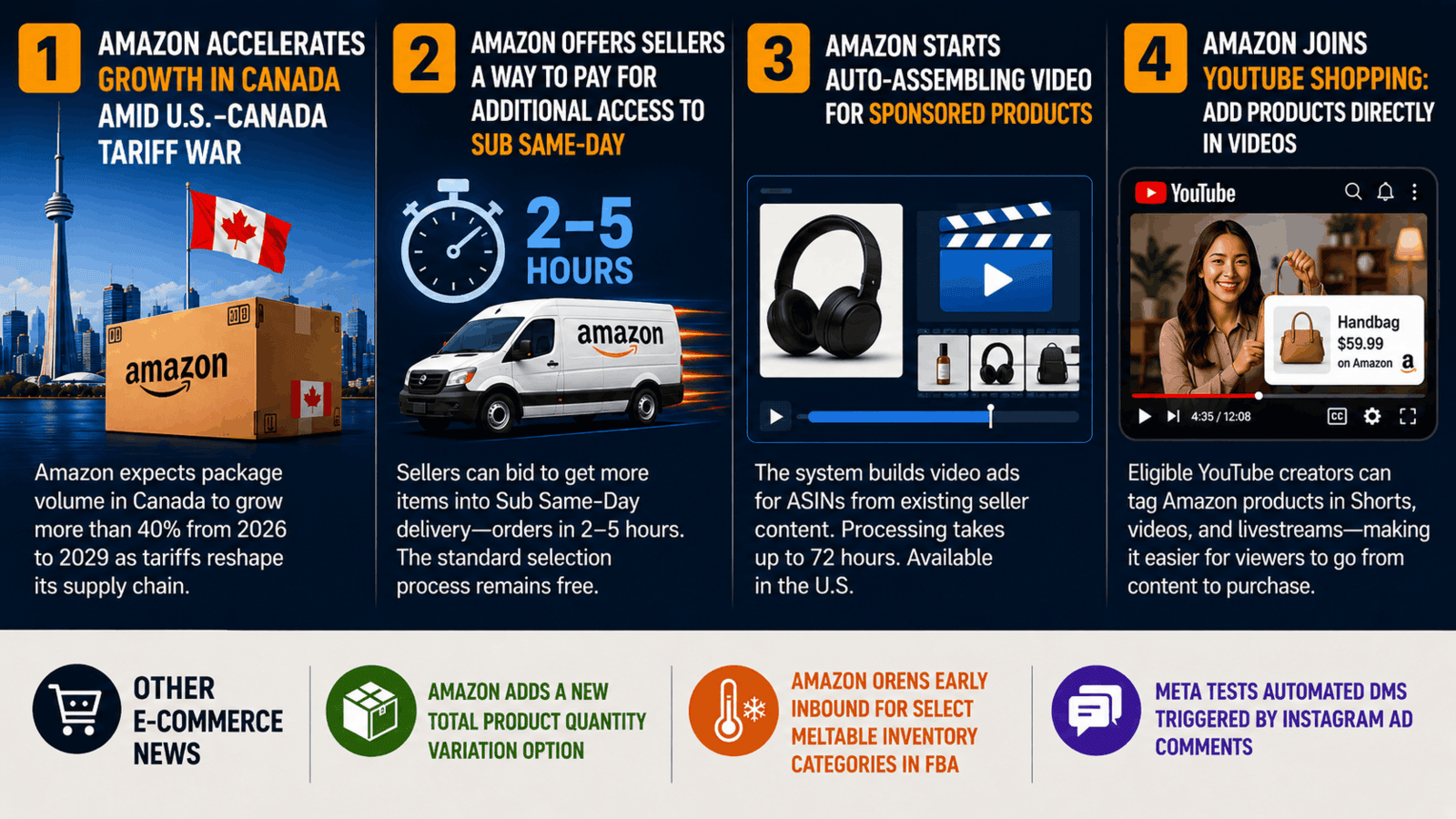
News #1. Amazon doubles down on Canada as the U.S.-Canada tariff fight escalates
What happened
Why it matters
The tariff policy is producing an unintended effect: for some products, sourcing from China for the Canadian market can be more economical for Amazon than moving goods from the U.S. Yet the company is not scaling back its Canadian growth plans. Delivery competition is one reason - Walmart, Loblaws, and Best Buy are already outpacing Amazon on speed in parts of the Canadian market.
What it means for e-commerce sellers
Amazon.ca sellers should recalculate landed costs across different supply routes. This is particularly important for Remote Fulfillment from the U.S.: depending on the product, holding inventory in Canada or importing directly from China may be more economical than routing inventory through the U.S.
Source: Business Insider
News #2. Amazon lets sellers bid for additional Sub Same-Day capacity
Amazon has started inviting some FBA sellers to bid for additional product placement in Sub Same-Day (SSD), which delivers orders within hours. Amazon’s standard SSD selection process remains available without an additional placement fee.
What happened
According to Business Insider, some sellers have been invited to an auction for additional Sub Same-Day placement. Sellers choose ASINs and set the maximum amount they are willing to pay for each unit delivered through the program. They are charged only for units actually delivered this way, and the final fee can be lower than their bid but not higher.
The standard SSD program remains unchanged: Amazon selects eligible FBA ASINs and moves inventory into dedicated fulfillment centers. More than 100,000 products are available through the program, with delivery in as little as 2–5 hours. Amazon says products in SSD can see up to 12% higher sales than standard FBA delivery in areas where the service is available.
Why it matters
Amazon is adding a paid way for sellers to compete for limited ultra-fast delivery capacity. Faster delivery can influence shopper choice and conversion, but bidding adds another cost alongside FBA and advertising. The standard selection process remains in place, with Amazon choosing ASINs based on factors including demand, competitive pricing, inventory health, and available fulfillment capacity.
What it means for e-commerce sellers
If bidding becomes available in your account, test it on ASINs with sufficient margins and strong local demand. Measure incremental sales against the per-unit fee, and keep inventory healthy — consistent stock levels remain a factor in Amazon’s standard SSD selection.
Source: Business Insider, Amazon
News #3. Amazon starts auto-assembling video ads for Sponsored Products
Amazon has added Auto-assembled video to Sponsored Products, allowing the system to build ASIN-level video ads from a seller’s existing video content.
What happened
Sellers can enable Auto-assembled video in campaign settings. Amazon then identifies suitable clips from available video assets, including content on the product detail page, and assembles an ad for a specific ASIN. Processing typically takes up to 72 hours, after which sellers can review, edit, activate, pause, or opt out of the video.
There is no separate fee for creating the video: ads use the budget and CPC of the existing Sponsored Products campaign. The feature is currently available in the U.S. and does not support Books.
Why it matters
What it means for e-commerce sellers
Review the quality of video assets on your product detail pages before enabling the feature. Test Auto-assembled video across several ASINs and compare CTR, CPC, conversion rate, and ACOS against standard Sponsored Products placements.
Source: myamazonguy.com
News #4. Amazon joins YouTube Shopping, bringing products directly into videos
What happened
YouTube announced the integration on August 27. Eligible YouTube Shopping creators can now add Amazon products directly to Shorts, long-form videos, and livestreams. Viewers see an integrated product link and can click through to Amazon to make a purchase, rather than having to find an affiliate link in the video description.
To participate, a channel must be eligible for the YouTube Partner Program and YouTube Shopping Affiliate Program in the U.S., while the creator must have or connect an Amazon Influencer Program or Amazon Associates account.
Why it matters
What it means for e-commerce sellers
Source: YouTube
Other E-commerce News
Amazon adds a new product quantity variation theme
Amazon has launched the Total Product Quantity variation theme across 193 product types, primarily in non-apparel categories. It lets sellers group variations based on the total number of units in a package or multipack. Shoppers see quantity in a standardized format, such as “72 count” or “72 count (3 packs of 24).” The theme is optional, with more categories coming later in 2026.
Amazon opens FBA inbound earlier for select meltable products
Amazon is allowing certain meltable products into FBA ahead of the standard September 28 reopening. Coated and pectin gummies, protein bars, cookies, and coated candy can be sent starting August 31, with sales beginning September 14. Chocolate and several other specified meltable products can be sent starting September 21, with sales beginning October 5. Other meltable ASINs remain on the standard schedule.
Meta tests automated Instagram DMs triggered by ad comments
Meta is testing Reply to Keywords, an Instagram Ads feature that lets advertisers select up to five keywords. When someone uses one of those words in an ad comment, they automatically receive a prewritten DM. The test is currently available to a limited group of advertisers and has been spotted in Instagram Ads, but not Facebook.Source: Amazon, Amazon, SocialMediaToday
Book a call now…
Book a call now…
Up to 45-min duration video-call
Topics we'll discuss:
| The next steps — there are two options
|