
EU tightens e-commerce import rules, Amazon expands seller insurance requirements, FTC challenges Amazon Ads pricing, Sponsored Brands moves to Collections
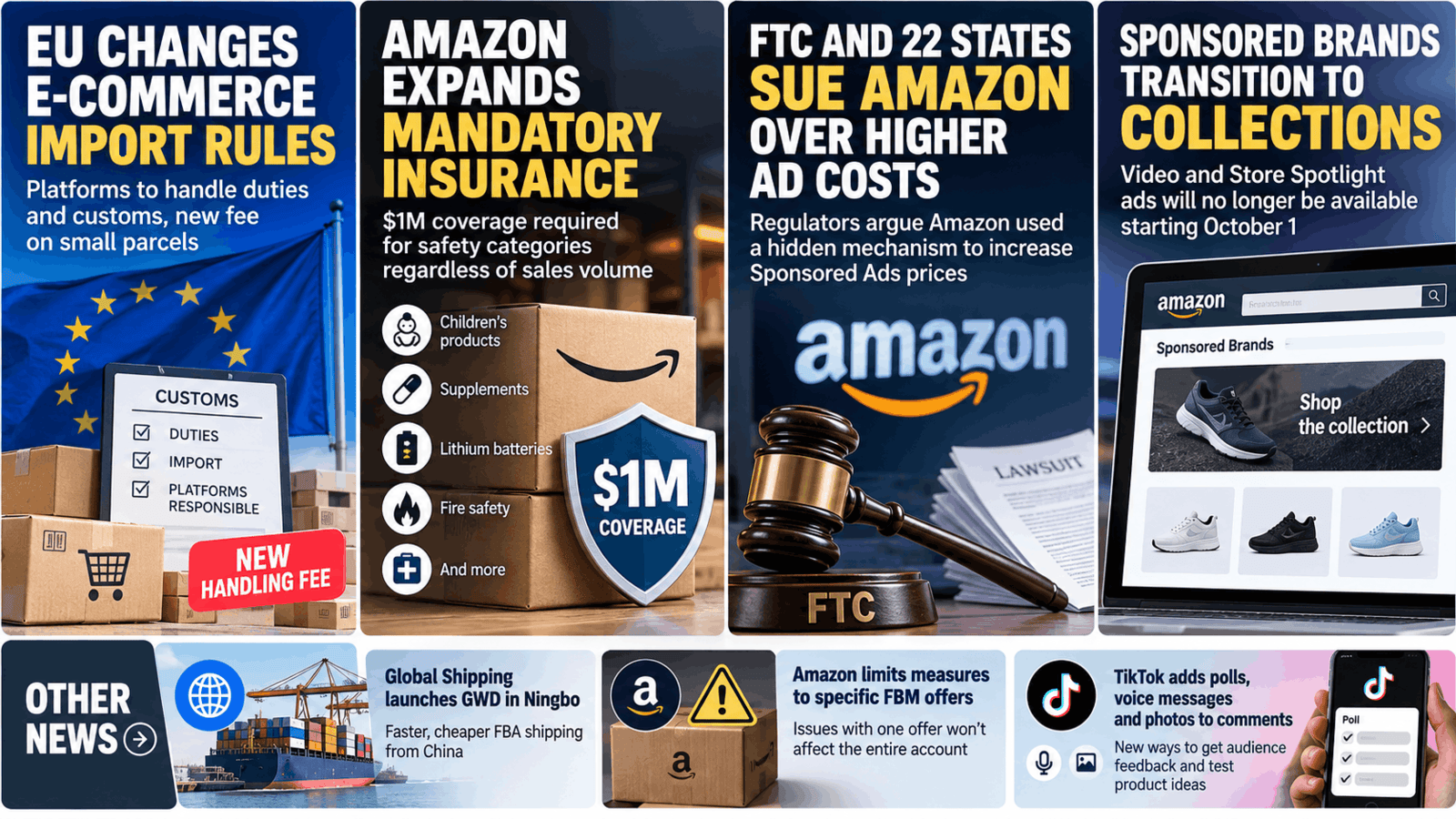
News #1. EU overhauls e-commerce imports: who will be responsible for customs clearance
The Council of the EU has approved a major customs reform. For e-commerce, it shifts more import responsibility to platforms and sellers and introduces a new fee on small parcels.
What happened
For goods sold into the EU from abroad, e-commerce platforms will be treated as importers and become responsible for customs clearance and duties instead of the end customer. Serious and systematic violations could result in fines of up to 6% of the previous year’s annual value of imported goods, loss of customs privileges and even restrictions on access to online platforms.
The EU also plans to introduce an EU-wide handling fee for small e-commerce parcels no later than November 1, 2026. The European Commission has not yet set the amount. This is separate from the customs duty on imports worth up to €150 that has applied since July 1.
Why it matters
The EU is making low-value e-commerce imports more expensive while shifting more responsibility from shoppers to platforms and sellers. The handling fee will add to landed costs, while tighter customs requirements increase operating expenses. Some of these costs may be passed on to consumers, making inexpensive goods shipped from outside the EU less competitive. The scale is significant: roughly 6 billion e-commerce parcels entered the EU in 2025, more than 90% from China.
What it means for e-commerce sellers
Non-EU sellers should review their import setup, customs data and product compliance, then factor the new handling fee into landed costs once its size is announced. The reform is not yet in force: the Council approved it on September 3, but the final text still requires approval by the European Parliament.
Source: Council of the European Union
News #2. Amazon expands mandatory insurance requirements for sellers
Starting November 2, sellers of products subject to enhanced safety requirements will need at least $1 million in liability insurance regardless of their Amazon.com sales volume. The general rule currently kicks in after monthly sales exceed $10,000.
What happened
The new rule applies to products covered by Amazon’s enhanced safety listing requirements. Amazon’s published list includes children’s products, dietary supplements and certain other health products, lithium battery products, fire-safety equipment, selected household and medical devices, personal safety products and other categories. Amazon says the list is not exhaustive and can change; sellers should check Seller Central for requirements affecting individual ASINs.
Policies must provide at least $1 million in coverage per occurrence and in aggregate. A separate change affects sellers based in Mainland China: starting November 2, new policies must be obtained through Amazon Insurance Accelerator unless Amazon agrees otherwise in writing. Qualifying third-party policies submitted before that date can remain in place until they expire.
Why it matters
Insurance becomes a mandatory operating cost for affected products even for small sellers that never reach the current $10,000 monthly threshold. Without a qualifying policy, sellers will not meet Amazon’s requirements for these products.
What it means for e-commerce sellers
Check Account Health and Amazon’s enhanced safety requirements for your ASINs. If your products are affected, price out qualifying coverage early and have your Certificate of Insurance ready before November 2.
Source: Amazon
News #3. FTC and 22 states accuse Amazon of secretly inflating advertising costs
The FTC and 22 states have sued Amazon, alleging the company used a hidden mechanism for years to raise Sponsored Ads costs. Amazon disputes the allegations.
What happened
According to the Federal Trade Commission (FTC), Amazon has used a company-calculated minimum click price, known as a soft reserve price, in its ad auctions since 2019. The regulator alleges that advertisers were still told the system operated as a second-price auction, where the winning bidder would typically pay only slightly more than the next-highest bidder.
For Sponsored Products, the share of clicks charged at the advertiser’s full bid allegedly increased from roughly 30–40% in 2021 to around 80% in 2024. The FTC says the practice affected more than one million advertisers and generated tens of billions of dollars in additional revenue for Amazon.
Why it matters
The lawsuit raises questions about Amazon Ads auction transparency because the way CPC is determined directly affects bidding strategy and advertising costs. Amazon says soft reserve prices reflect the market value of ad placements, never exceed an advertiser’s maximum bid and improve ad efficiency by accounting for relevance. It also says inflation-adjusted average Sponsored Products CPC did not increase between 2019 and 2024.
What it means for e-commerce sellers
The lawsuit does not change Amazon Ads rules today. But sellers should treat a maximum bid as a price they may actually pay for a click and review campaigns where aggressive bids and automated bid adjustments are pushing CPC close to the profitability threshold.
News #4. Amazon is replacing Product Collection Ads with Sponsored Brands Collections
Amazon is phasing out the old Product Collections format in Sponsored Brands, a placement shown at the top of Amazon search results. Support ends in February 2027 as advertisers move to Collections.
What happened
In the old Product Collections format, sellers selected up to three ASINs for an ad. Sponsored Brands Collections expands that to 3–10 products and offers two modes: Manual Collections, where advertisers control the assortment, and Automatic Collections, where Amazon AI selects products from the catalog based on campaign keywords and shopper search queries.
Since September, Amazon has been showing migration recommendations in Campaign Manager and allowing advertisers to migrate campaigns individually or in bulk. Product Collections will no longer be supported starting February 2027. Campaigns with three ASINs can be automatically migrated to Manual Collections with the same products; campaigns with fewer than three ASINs will not migrate automatically.
Why it matters
Automatic Collections changes how the ad assortment can be built: instead of relying on a fixed product set, Amazon can select products it considers most relevant to a shopper’s query. In Amazon’s U.S. internal testing, the new top-of-search format delivered 3.3x higher CTR, 14.2% higher ROAS and 81.9% more orders per search query than the previous format. These are Amazon’s test results, not a guarantee of campaign performance.
What it means for e-commerce sellers
Review existing Product Collection campaigns and Amazon’s migration recommendations, especially campaigns with fewer than three ASINs. With Automatic Collections, pay close attention to keywords and shopper search queries because Amazon uses them to select products for the ad. Monitor which ASINs appear and compare CTR, ROAS and sales against Manual Collections.
Source: Amazon
Other E-commerce News
Amazon opens its third GWD warehouse in China
Amazon has opened a third Global Warehousing and Distribution (GWD) facility in China, this time in Ningbo. Sellers can store inventory closer to manufacturing and use it to automatically replenish U.S. FBA. Storage starts at $7.91 per cubic meter per month, 10% below Shanghai and Shenzhen rates. Inventory arriving at GWD by December 31, 2026 also gets the first 30 days of storage at no additional charge.
Amazon will target problematic FBM offers instead of the entire account
Starting August 31, Amazon will take more targeted action against FBM offers with poor performance instead of applying measures at the account level. If an individual offer has problems with cancellations, shipment or delivery performance, or order defects, Amazon will first warn the seller and may then temporarily deactivate only that offer, giving sellers a chance to fix the issue without putting the entire account at risk.
TikTok adds polls, voice messages and photos to comments
TikTok is expanding comments with polls offering up to five choices, voice comments up to 60 seconds, photo carousels with up to nine images and Live Photos. Polls could be particularly useful for private label brands, giving them a fast way to test product ideas and collect feedback on features, variations and potential improvements directly under a video. Some features are already available globally, while others are rolling out.Book a call now…
Book a call now…
Up to 45-min duration video-call
Topics we'll discuss:
| The next steps — there are two options
|