Google Merchant Center adds AI visibility benchmarking, 58% of shoppers verify AI recommendations, and Amazon sets Prime Big Deal Days for October 6–7
News #1. Google Merchant Center Adds Competitive AI Visibility Insights
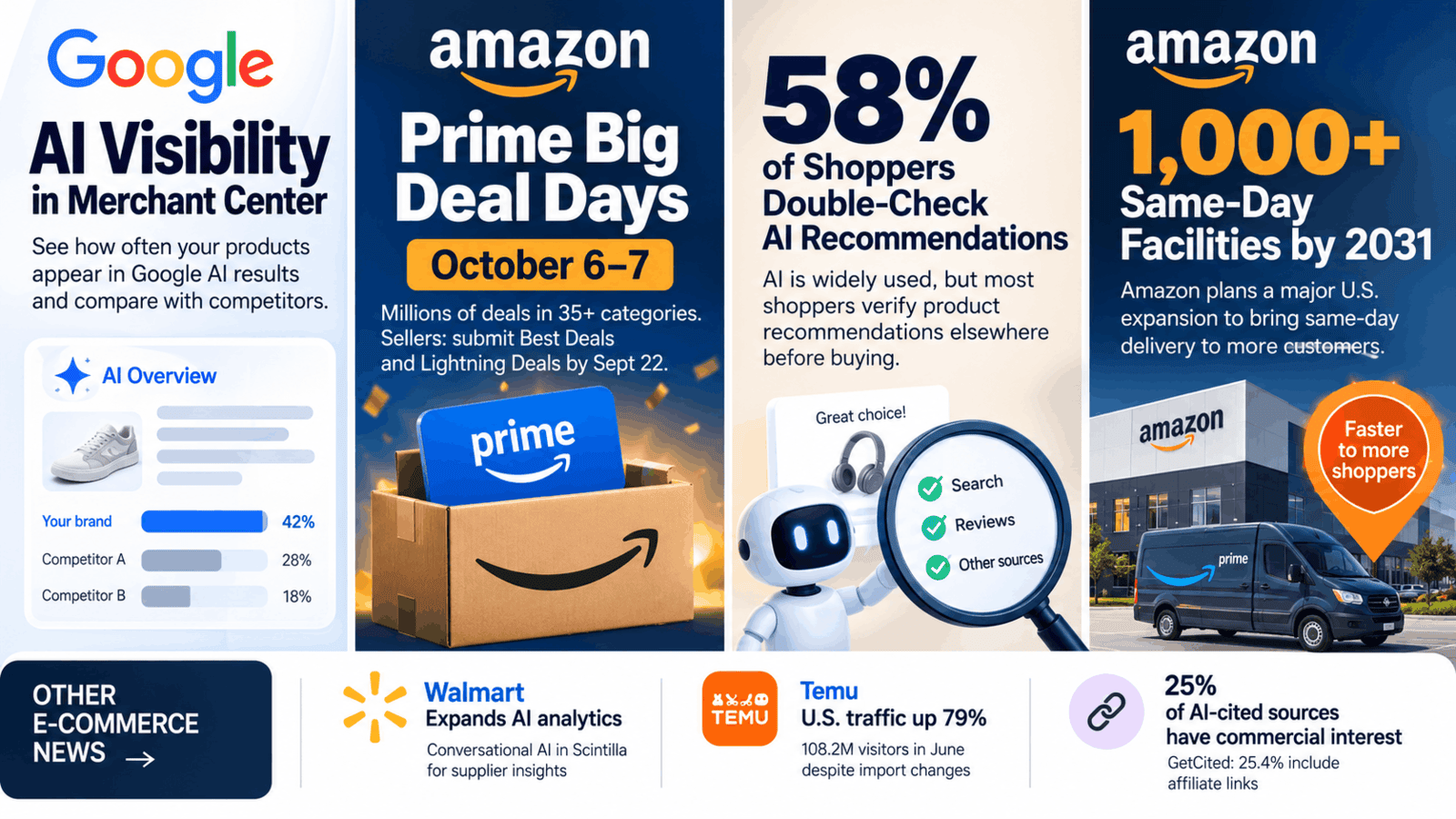
Google has made AI Performance Insights generally available in Merchant Center, giving brands a way to measure how often their products appear in AI Mode and AI Overviews and benchmark that visibility against competitors.
What happened
Why it matters
AI visibility is becoming a measurable performance metric inside Merchant Center. Product data quality also affects what information AI systems can use. In a test with lululemon, additional descriptive product attributes appeared in 50% of relevant AI Mode recommendations.
What it means for e-commerce sellers
This is most relevant for brands and merchants that feed product catalogs into Google Merchant Center. Compare your AI visibility with competitors and audit the completeness of product attributes. For Amazon brands, it adds another visibility tool when products are also marketed through Google or a DTC site.
Want Your Products to Stand Out in Amazon Search & AI?
We optimize Amazon listings - titles, bullet points, descriptions, and product attributes - to help Amazon better understand your products and match them with relevant searches and AI-driven recommendations.
News #2. Amazon Sets Prime Big Deal Days for October 6–7
Amazon will hold Prime Big Deal Days 2026 on October 6–7. For sellers, a key update is the September 22 deadline for Best Deals and Lightning Deals, along with clarified rules for other event promotions.
What happened
Why it matters
What it means for e-commerce sellers
Review eligible ASINs and promotion margins by September 22. Inventory should already be received by Amazon or on its way ahead of the event. For priority products, plan advertising budgets for October 6–7 in advance.
Source: Amazon
News #3. 58% of Shoppers Double-Check AI Product Recommendations
AI is already widely used by shoppers, but trust remains limited. According to VML, 58% of consumers verify AI-generated product recommendations elsewhere before making a purchase.
What happened
Why it matters
What it means for e-commerce sellers
Getting mentioned by AI is only part of the customer journey. Product specifications, materials, dimensions, compatibility and use cases should be accurate and consistent across channels. Authentic product imagery and credible customer reviews become especially important when shoppers verify an AI recommendation before buying.
Source: VML.com
News #4. Amazon Reportedly Plans to Expand Its Same-Day Network to More Than 1,000 Facilities
Amazon is considering a major expansion of its U.S. same-day delivery infrastructure, with the number of Same-Day Fulfillment Centers potentially growing from 85 to more than 1,000 by 2031.
What happened
Why it matters
Amazon is looking to position more high-demand inventory closer to customers and reduce the time between checkout and delivery. In 2025, the company increased the number of products delivered to U.S. Prime members the same or next day by 30%.
A broader same-day network would make local inventory availability increasingly important in marketplace competition.
What it means for e-commerce sellers
For Amazon FBA sellers, delivery speed increasingly depends not just on having inventory in stock, but on how broadly Amazon can distribute that inventory across its fulfillment network.
Accurate demand forecasting and sufficient FBA inventory are particularly important for high-volume SKUs. More available inventory gives Amazon greater flexibility to position units closer to customers, while insufficient stock can leave products farther from parts of the customer base and limit access to the fastest delivery options.
Source: Business Insider
Other E-commerce News
Temu reached 108.2 million unique U.S. visitors in June, up 79% year over year, according to Comscore data cited by EMARKETER. Traffic had previously fallen sharply after the U.S. ended de minimis treatment for China-origin shipments. The rebound puts Temu back in stronger competition for price-sensitive U.S. shoppers.
One in Four AI-Cited Shopping Sources Has a Disclosed Commercial Interest
GetCited analyzed 106,758 sources cited by ChatGPT, Google AI Overviews and Perplexity for shopping queries such as “best laptop” and “best running shoes.” In its English-language sample, 25.4% pointed to pages with disclosed commercial interests, most commonly affiliate links. The study does not show that affiliate links improve AI rankings, but it highlights reviews and comparison content as another potential source of brand visibility in AI shopping discovery.Book a call now…
Book a call now…
Up to 45-min duration video-call
Topics we'll discuss:
| The next steps — there are two options
|