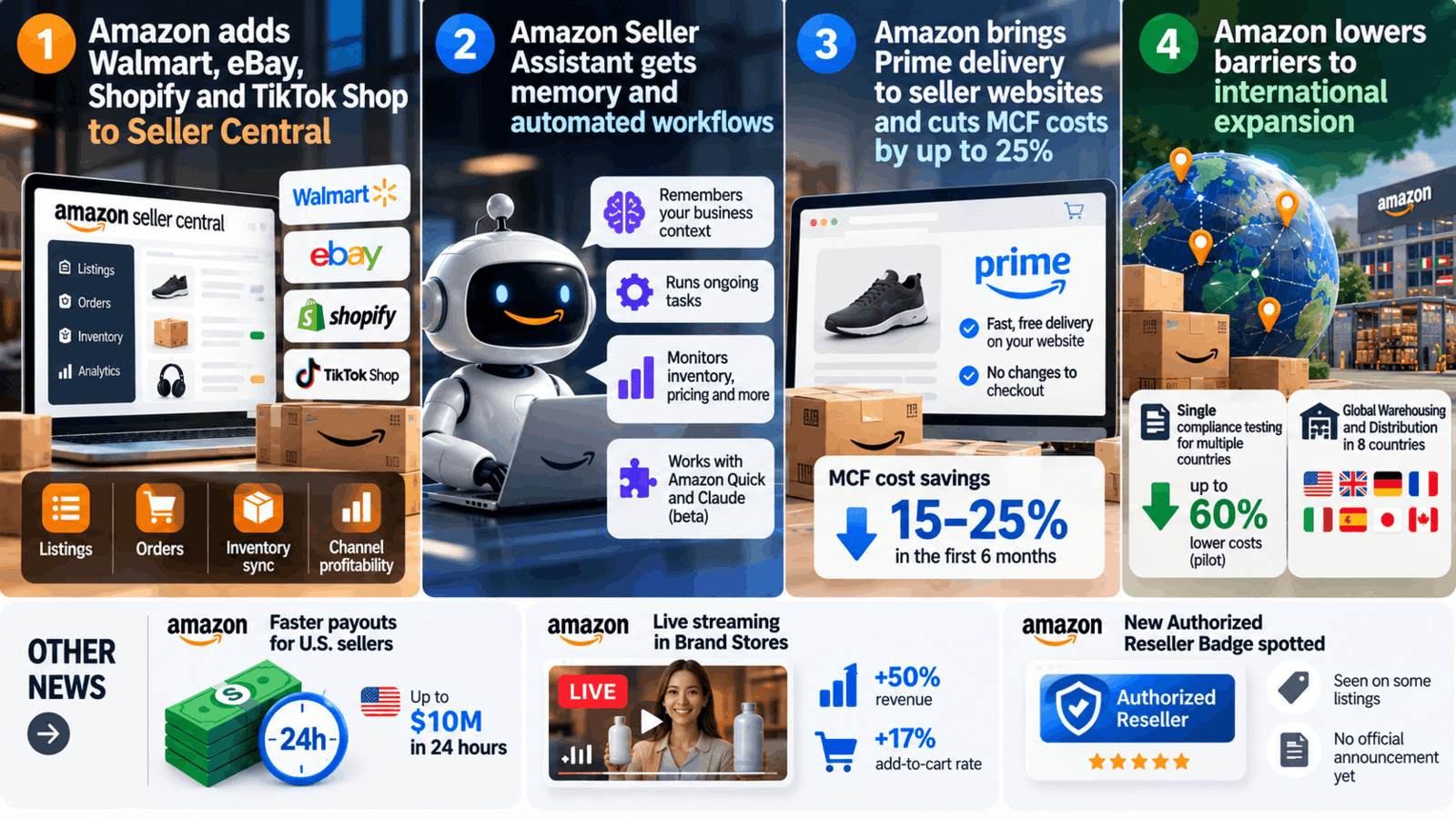
Amazon brings Walmart, eBay, Shopify and TikTok Shop into Seller Central while expanding Seller Assistant, Prime delivery and global selling tools
News #1. Amazon brings Walmart, eBay, Shopify and TikTok Shop management into Seller Central
What happened
Amazon announced new multichannel tools in Seller Central for U.S. sellers. The workspace connects eBay, Walmart, Shopify and TikTok Shop, allowing merchants to manage listings and orders, sync inventory and track profitability across channels from one interface. The integrations will roll out gradually, with no additional fee announced for using the new workspace.
The tools also connect with Amazon Multi-Channel Fulfillment (MCF), allowing sellers to use inventory stored with Amazon to fulfill orders placed through other sales channels.
Why it matters
Seller Central is expanding beyond Amazon’s own marketplace. For merchants operating across several platforms, centralized catalog, inventory, order and performance management could reduce manual work and operational errors.
It also puts Amazon deeper into the infrastructure behind multichannel commerce, even when the actual transaction takes place outside Amazon.
What it means for e-commerce sellers
Sellers will be able to manage Amazon and external channels from one Seller Central workspace, including listings, orders, inventory and channel-level profitability. For multichannel brands, this could reduce the number of separate systems required to run day-to-day operations.
Source: Amazon
Want Your Products to Stand Out in Amazon Search & AI?
We optimize Amazon listings - titles, bullet points, descriptions, and product attributes - to help Amazon better understand your products and match them with relevant searches and AI-driven recommendations.
News #2. Amazon Seller Assistant gets persistent memory and automated workflows
Amazon is expanding Seller Assistant from an on-demand AI tool into a more persistent operational assistant that can retain business context, monitor activity and carry out seller-defined tasks.
What happened
At Amazon Accelerate in Seattle on September 22–24, Amazon introduced new capabilities for Seller Assistant, its AI-powered seller tool first launched in 2023.
A key addition is persistent automated workflows. Sellers can assign ongoing tasks such as monitoring inventory or pricing and define the AI’s role - whether it should provide recommendations or prepare and execute actions within seller-defined boundaries.
Seller Assistant is also getting persistent memory. It can retain business context across conversations, including seller goals, preferences and previous decisions, and use that context in future recommendations and actions.
A separate plugin will make Seller Central data - including listings, analytics and business performance - available in Amazon Quick and Anthropic’s Claude. Those integrations are currently in beta.
Why it matters
What it means for e-commerce sellers
Inventory, pricing and performance monitoring are logical starting points. Sellers can initially use AI for alerts and recommendations, then gradually allow specific actions to be automated once the workflows have been tested.
Source: Amazon
News #3. Amazon brings Prime delivery to merchant websites and cuts MCF costs by up to 25%
U.S. merchants can now offer Prime delivery on their own websites through Amazon Multi-Channel Fulfillment. A new pricing program can also reduce external-order fulfillment costs by 15–25%.
What happened
Amazon is allowing U.S. merchants using MCF to display the Prime badge and offer fast, free Prime delivery on their own websites without additional charges beyond standard MCF fees.
Merchants do not need to change their checkout, payment processing or order management systems. A customer’s Prime membership is verified after checkout.
Amazon is also launching the MCF Preferred Pricing Program. FBA sellers can achieve 15–25% savings on fulfillment for orders originating from their own websites, marketplaces and social commerce channels during the first six months of participation.
Why it matters
MCF already allowed brands to use Amazon inventory to fulfill external orders. Amazon is now combining lower fulfillment costs with one of its strongest consumer benefits - Prime delivery - on merchants’ own websites.
That makes a shared inventory pool across Amazon, DTC and other channels more competitive with maintaining a separate 3PL operation. According to Amazon’s internal data, sellers using shared FBA and MCF inventory reduced out-of-stock incidents by an average of 19% and improved inventory turnover by 12%.
What it means for e-commerce sellers
Brands selling on both Amazon and their own websites should recalculate the economics of maintaining separate inventory pools. A shared FBA/MCF inventory model may become more attractive once storage, delivery costs and stockout risk are included.
For DTC stores, Prime delivery is also worth testing as a potential conversion driver.
Source: Amazon
News #4. Amazon lowers barriers to international expansion for sellers
Amazon is simplifying product compliance across countries while expanding its international warehousing infrastructure, aiming to reduce the cost and operational complexity of entering additional Amazon marketplaces.
What happened
At Amazon Accelerate, the company announced new tools designed to make international expansion easier.
Amazon is introducing a unified approach to compliance testing that will allow sellers to submit product test results once and use them to meet requirements across multiple countries. The rollout starts with toys, with electronics and baby products expected by the end of 2026 and additional categories planned for 2027. Sellers participating in the pilot reported compliance cost savings of up to 60%.
Amazon is also expanding Global Warehousing and Distribution (GWD) to eight countries: the U.S., UK, Germany, France, Italy, Spain, Japan and Canada.
GWD lets sellers store inventory closer to international markets and replenish local FBA networks. According to Amazon, international GWD storage can cost up to 45% less than U.S. AWD, while FBA replenishment can be up to five days faster.
Why it matters
Only about 30% of Amazon sellers currently operate in more than one country. Entering another marketplace requires sellers to navigate local product requirements, certification and international logistics.
Amazon is targeting those specific barriers. According to the company, sellers operating in more than one country generate 70% more revenue on average.
What it means for e-commerce sellers
Brands considering additional Amazon marketplaces should revisit their international expansion economics as the new compliance and GWD capabilities roll out.
The changes are particularly relevant for products where mandatory testing, certification and cross-border logistics previously made smaller international markets too expensive to enter.
Source: Amazon
Other E-commerce News
Amazon speeds up payouts for U.S. sellers
Starting September 21, Amazon is making Express Payout free for eligible sellers with a U.S. business address and a bank account that supports instant transfers. Once Amazon initiates a payout, transfers of up to $10 million can arrive within 24 hours, including weekends, instead of 3–5 business days. Express Payout does not change when sales proceeds become eligible for disbursement.
Amazon adds livestreams to Brand Stores
Brand Registry sellers can now add Amazon Live directly to their Brand Stores through the new Live Tile. According to Amazon internal data from June 2025 through June 2026, Stores with Live Tile generated 50% more revenue and had a 17% higher add-to-cart rate than a comparable control group.
New Authorized Reseller Badge spotted on Amazon
According to observations from an Amazon Marketplace expert, an Authorized Reseller badge has begun appearing on some seller offers, indicating a relationship with the brand. Amazon has not officially announced the feature, and its rollout scope and display criteria remain unclear. Amazon has also made no claims that the badge affects Buy Box eligibility or search ranking.Source: Amazon, Amazon, My Amazon Guy
Book a call now…
Book a call now…
Up to 45-min duration video-call
Topics we'll discuss:
| The next steps — there are two options
|