
TikTok Shop reshapes online shopping, AWS expands AI infrastructure, impulse buying keeps growing, and New York introduces new rules for AI-generated advertising
News #1. TikTok Shop Is Dominated by Beauty, Wellness, and Fashion
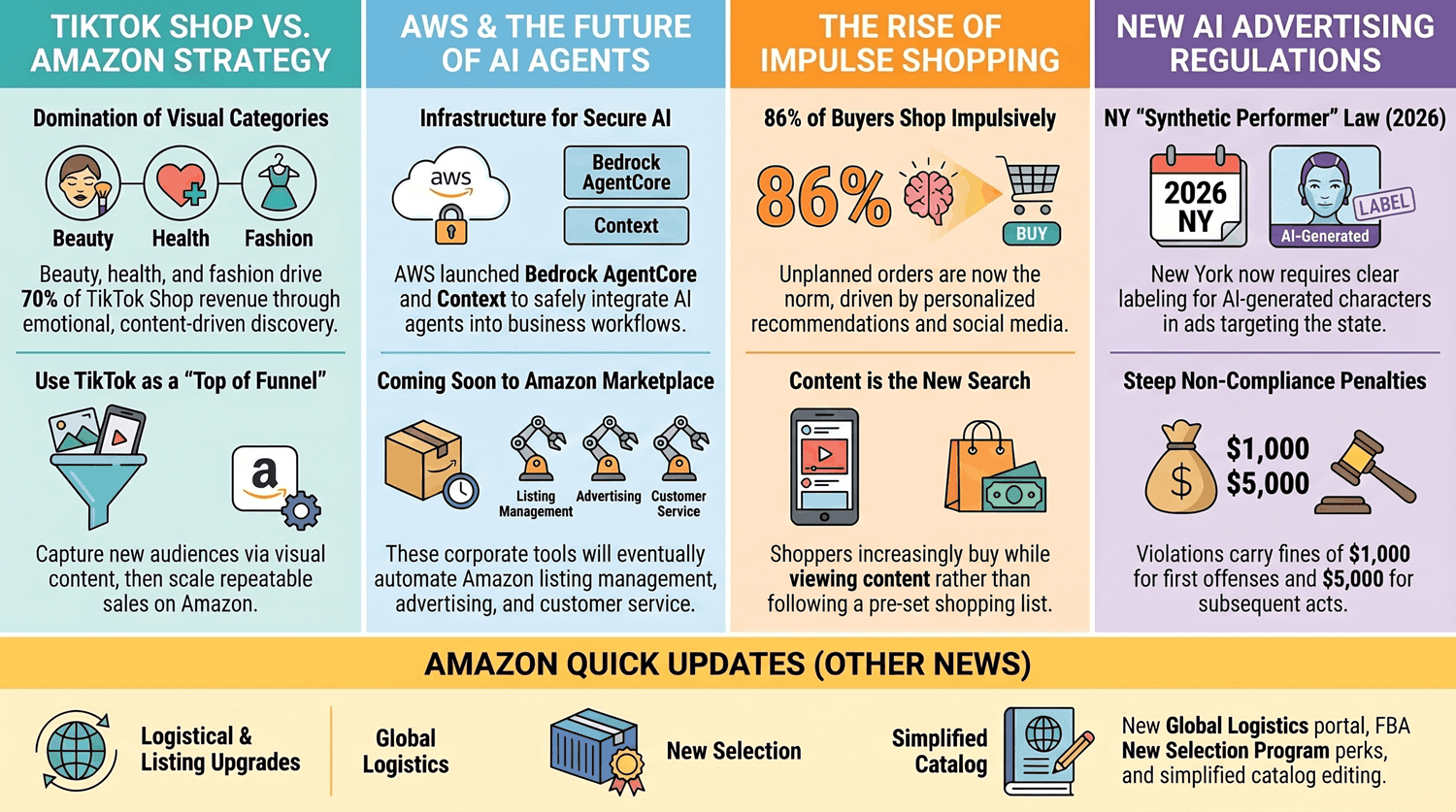
New marketplace data shows that TikTok Shop has evolved into a very different type of e-commerce platform. Instead of functioning as a broad online marketplace, it generates most of its revenue from beauty, wellness, and fashion-related products.
What happened
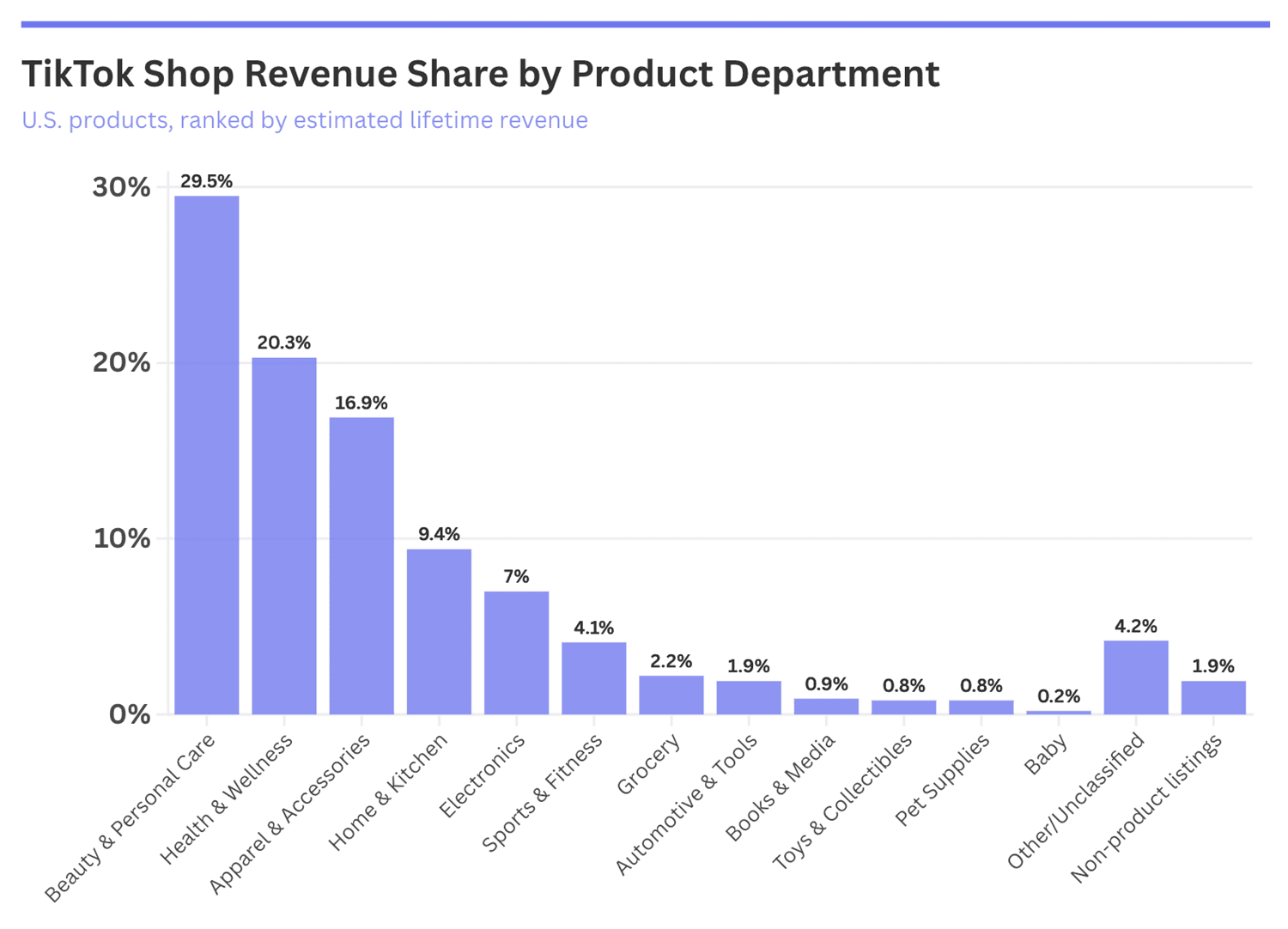
A new analysis of more than two million TikTok Shop listings in the U.S. reveals that roughly one-third of all sales come from Beauty & Personal Care products. Health and Wellness accounts for nearly 20% of revenue, while Apparel, Footwear & Accessories contributes another 17%. Categories such as electronics, home goods, tools, books, and pet supplies collectively make up only about one-third of total sales.
The findings suggest that TikTok Shop is not competing as a traditional marketplace. Instead, it is building a commerce model where purchase decisions are driven by content discovery rather than product search.Why it matters
Amazon Marketplace is built around search intent, broad product selection, and shoppers who already know what they want to buy. TikTok Shop follows a different path. Products that deliver a clear visual transformation or can be demonstrated in a short video naturally perform better. Beauty products, supplements, skincare, and fashion accessories fit this model particularly well because creators can quickly showcase results and inspire impulse purchases.
What it means for e-commerce sellers
For brands in beauty, wellness, and fashion, the data reinforces TikTok Shop's role as a demand-generation channel rather than a replacement for Amazon. Short-form video can introduce products to new audiences, while Amazon remains the preferred destination where customers compare options, read reviews, and make repeat purchases. For many brands, the strongest growth strategy is using both platforms together rather than choosing one over the other.
News #2. AWS Expands Its AI Agent Infrastructure
At AWS Summit New York, Amazon introduced several new services designed to simplify the deployment, management, and scaling of AI agents. The company is investing heavily in the infrastructure businesses need to adopt AI securely and at scale.
What happened
Amazon Web Services unveiled several new AI-focused services, including Amazon Bedrock AgentCore, a platform for deploying and managing AI agents in enterprise environments. AWS also introduced AWS Context, which enables AI agents to securely access enterprise data, and expanded Amazon Q Business with more advanced autonomous capabilities. In addition, AWS announced Continuum for automated code vulnerability detection and released a mobile version of Kiro, its AI-powered development assistant.
Together, these launches move AI agents beyond experimentation and into day-to-day business operations.Why it matters
The AI market is shifting from building increasingly powerful models to creating reliable infrastructure that organizations can actually deploy. Businesses now expect secure data access, governance, scalability, and integration with existing workflows. By expanding its AI ecosystem, AWS strengthens Amazon's position in enterprise AI while laying the foundation for future AI-powered services across its broader product portfolio.
What it means for Amazon sellers
Most of these services are currently aimed at enterprise AWS customers. However, the same infrastructure is likely to power future automation across Amazon Marketplace—from catalog management and advertising to analytics and customer support. Until then, effective account management still depends on experienced specialists, which is why many brands rely on external teams to access specialized expertise without expanding their in-house operations.
News #3. Impulse Buying Has Become the New Normal
According to Adobe, impulse purchases are no longer limited to a specific type of shopper. Today, 86% of consumers have made unplanned online purchases, with personalized recommendations and digital content playing an increasingly important role in purchasing decisions.
What happened
Adobe's latest research found that 86% of consumers have made at least one impulse purchase online. Personalized recommendations, limited-time offers, customer reviews, and social media content are the biggest purchase triggers. While impulse buying spans every age group, motivations differ: younger shoppers are more influenced by creators and short-form video, while older consumers respond more to discounts, reviews, and algorithm-driven recommendations.
Researchers conclude that impulse purchasing has become a defining characteristic of the U.S. e-commerce market.Why it matters
Online shoppers are increasingly making purchase decisions while browsing rather than arriving with a predefined shopping list. As a result, product pages, advertising, recommendations, and personalization algorithms play a much larger role in driving conversions. Platforms like TikTok Shop, which excel at surfacing relevant products at the right moment, are particularly well positioned to benefit from this shift.
What it means for e-commerce sellers
Ranking well in search is no longer enough. High-quality visuals, compelling product content, customer reviews, advertising, and a well-designed Brand Store all contribute to higher conversion rates. Just as importantly, sellers need a deep understanding of their target audience—what motivates them, which messages build trust, and what type of content drives action. That insight forms the foundation of a successful long-term growth strategy.
News #4. New York Requires AI-Generated Ads to Be Clearly Labeled
What happened
The new law requires advertisers to clearly disclose the use of "synthetic performers"—AI-generated or AI-modified digital humans that imitate real people. Exceptions apply to films, television productions, and other creative works where synthetic performers are part of the content itself, as well as certain audio translations created with AI. Violations carry fines of $1,000 for a first offense and $5,000 for each subsequent violation.
Why it matters
New York has become the first U.S. state to introduce dedicated disclosure requirements for AI-generated advertising. The move reflects a broader shift toward regulating the commercial use of artificial intelligence rather than the technology itself. Brands should expect similar rules to emerge in other jurisdictions and begin incorporating compliance into their creative workflows.
What it means for e-commerce sellers
For e-commerce businesses, state-level regulation matters because marketplace sellers rarely control where individual orders are shipped. If advertising reaches consumers in New York, these disclosure requirements may apply regardless of where the seller or brand is based.
Other Amazon News
Amazon Global Logistics launches a redesigned portal
Amazon introduced a new Amazon Global Logistics portal that streamlines international shipments into FBA and Amazon Warehousing & Distribution. Sellers can now receive instant freight quotes, compare delivery options, and book shipments from a single interface while accessing shipping guides and logistics updates.
New Selection Program offers expanded benefits
Starting July 30, Amazon's updated New Selection Program (2026) provides larger fee credits, Vine incentives, free storage, returns, liquidation benefits, and additional inventory fee exemptions for eligible new FBA products. Existing participants will transition automatically during the launch period.
Amazon redesigned the Add Products tool with a guided workflow, bulk editing for variations, integrated Seller Assistant search, and simplified variation creation. Image Manager now also supports direct uploads of country-specific product images, making localized catalog management much easier across multiple marketplaces.
Book a call now…
Book a call now…
Up to 45-min duration video-call
Topics we'll discuss:
| The next steps — there are two options
|