Introduction
Every seller planning to launch a private-label product on Amazon eventually faces the same questions: how do you protect your brand from hijackers and counterfeiters? Can this be done if you don’t live in the US? And most importantly—do you actually need it?
The short answer is yes: brand protection is absolutely possible even if you are based outside the United States. The process follows clear, structured steps. At first glance, it may look complex and intimidating, but in practice it is manageable if you understand how the system works.
In this guide, we’ll break down who really needs a trademark, how the USPTO registration process works, what benefits Amazon Brand Registry provides, which requirements Amazon applies to brand applications, and which mistakes most often lead to rejection.Trademark vs. Brand Registry: Two Levels of Brand Protection
To fully protect your brand and unlock Amazon’s brand tools, you need to complete two separate but connected steps:
Register a trademark with the USPTO (United States Patent and Trademark Office)
Enroll that trademark in Amazon Brand Registry
Trademark: Legal Protection at the National Level
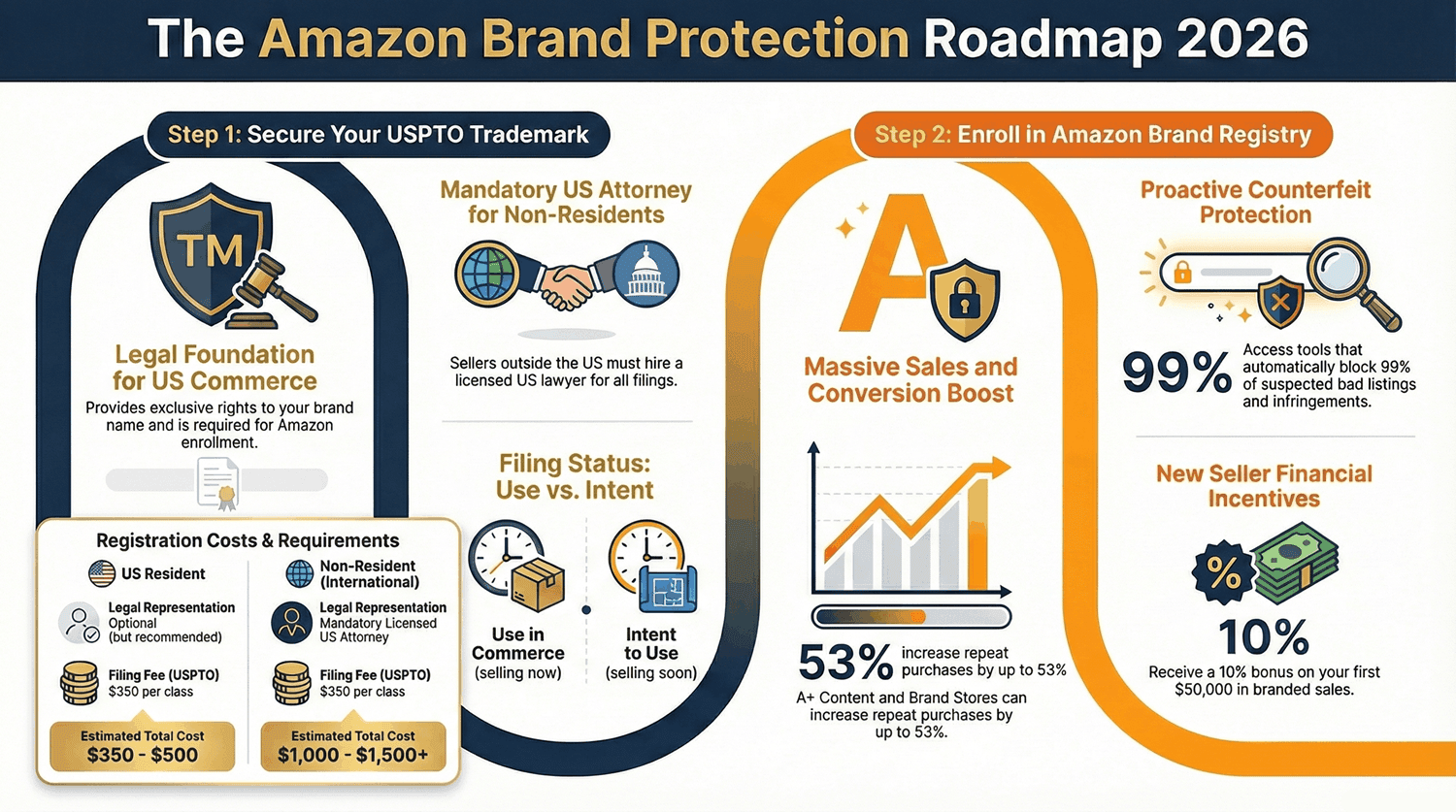
A USPTO trademark is a legal asset that grants exclusive rights to use your brand name or logo in US commerce. Without it, you cannot sue for infringement, reclaim hijacked domains, or protect brand social media accounts. Most importantly, Amazon will not allow Brand Registry enrollment without a trademark.
Brand Registry: Amazon’s Brand Protection Ecosystem
Brand Registry is a free Amazon program for trademark owners. A trademark provides national legal rights, but those rights do not automatically apply on Amazon. Brand Registry verifies ownership within the platform and unlocks protection, marketing, and analytics tools.
Trademark Registration with the USPTO
Who Really Needs a Trademark
A trademark is essential for private-label sellers building a long-term business on Amazon. If you are a reseller or sell unbranded generic products, trademark registration is unnecessary. However, if you are creating your own brand, developing a differentiated product, and planning to scale, a trademark is mandatory.
What USPTO Registration Gives You
Nationwide legal protection: no one can sell similar products under your brand name in the US
Right to sue: only trademark owners can file infringement lawsuits
Domain and social media recovery: trademarks provide the legal basis to reclaim stolen assets
Mandatory requirement for Brand Registry
Higher business valuation: a registered trademark is a standalone asset that can increase valuation by 30–50% during an exit
Residents vs. Non-Residents: Key Differences
Getting Started
First, you must choose a brand name and check availability using the USPTO database. As an alternative, Amazon recently launched its own Brand Name Generator, an AI-powered tool that suggests brand names and provides an initial assessment of trademark availability based on USPTO data.
Critical Rule for Non-US Residents
Since August 2019, the USPTO requires all applicants whose permanent residence or principal place of business is outside the US to work with a licensed US trademark attorney.
Non-residents cannot file applications, respond to Office Actions, renew trademarks, or participate in disputes on their own.
Why this rule exists: between 2017 and 2019, fraudulent foreign filings increased dramatically, often involving mock-up images and false use claims.How to Find a Reliable Attorney
USPTO Filing Firms Tool — checks firms with sanctions
Amazon IP Accelerator — connects sellers with vetted law firms
State Bar Associations — verify licensing and disciplinary history
Trademark Registration for US Residents
US residents may file independently through the Trademark Electronic Application System (TEAS). The government filing fee is $350 per class.
That said, even for residents, the USPTO recommends legal assistance. Roughly 60% of self-filed applications are rejected, most often due to technical errors.Application Types: Section 1(a) vs. Section 1(b)
Section 1(a): Use in Commerce
You are already selling the product in the US and submit proof of use (specimen) with the application.
Filing fee: $350 per class
Attorney fees (non-residents): from $1,000
Section 1(b): Intent to Use
You are not selling yet but plan to launch. The brand name is reserved until sales begin.
Filing fee: $350
Statement of Use fee: $150
Attorney fees (non-residents): from $1,000 + $500 for Statement of Use
Timeline: 8–16 months
Important note: pricing and timelines vary depending on attorney rates, USPTO workload, and case complexity. Be cautious of anyone promising trademark registration in 1–2 months—this is a common scam.
USPTO Trademark Requirements
Accepted formats:
Word Mark — text only
Design Mark — stylized text and/or logo
Not accepted:
sound, scent, or color-only marks
image-only marks without text
Amazon Brand Registry
Who Needs Brand Registry
Key Benefits of Brand Registry
Advertising and External Traffic
Amazon Attribution — track sales from Google Ads, Facebook, TikTok, Instagram
Brand Referral Bonus — up to 10% commission refund for external traffic
Sponsored Brands — premium placements with logo and multiple ASINs
Sponsored Display — automated retargeting on and off Amazon
A+ Content — +8% (Basic) to +20% (Premium) conversion uplift
Brand Stores — shoppers buy 53.9% more often, with 71.3% higher AOV
Together, these tools enable true omnichannel strategies while improving organic rankings.
Counterfeit Protection
Report a Violation — takedowns in 24–48 hours
Automated Brand Protection — blocks 99% of counterfeits before listing
Transparency — over 2.5B units verified via unique codes
Reviews and Sales Growth
Amazon Vine — verified reviews before launch
Subscribe & Save — up to 1.8× conversion increase
Virtual Bundles — higher average order value
Analytics and Testing
Brand Analytics — search terms, market basket data, demographics
Manage Your Experiments — A/B testing with up to 25% sales lift
Financial Incentives (New Seller Incentives)
10% rebate on first $50,000, then 5% up to $1,000,000 in year one
$200 Vine credit for new brands
What You Lose Without Brand Registry
❌ Control over listings
❌ A+ Content (-8–20% conversion)
❌ Brand Store (-53.9% repeat purchases)
❌ Sponsored Brands, analytics, Vine
❌ External traffic rebates
❌ 30–50% lower business valuation
Brand Registry Enrollment Process
What You Need
Trademark Registration or Serial Number
Product photos with permanently affixed branding (printed, engraved, embroidered)
Invoices (issued within the last 6 months)
Application Steps
- brandregistry.amazon.com → Manage → Enroll a brand
- Enter the brand name exactly as registered with the USPTO
- Upload ownership documents
- Submit product photos with permanent branding
- Link Seller or Vendor Central account
- Provide manufacturing details
- Submit and receive a Case ID
Identity Verification
Amazon may request:
Automated biometric verification (QR code, passport, selfie) — ~15 minutes
Manual video call — documents + call, 1–3 days
Biometrics are optional.
Timeline: up to 10 business days
Common Mistakes That Lead to Rejection
Mock-up images — only real products are accepted
Non-permanent branding — stickers do not qualify
Name mismatch — even minor spelling differences matter
Unverified attorneys — always check credentials
Readiness Checklist
✅ Unique brand name (USPTO search completed)
✅ Physical product with permanent branding
✅ US attorney for non-residents
✅ Manufacturing documents or invoices
✅ Healthy Seller or Vendor account
✅ Budget: $350–500 (US residents), $1,000–1,500+ (non-residents)
Conclusion
In 2026, trademark registration and Amazon Brand Registry are no longer optional—they are the foundation of a sustainable private-label business. Yes, the process requires time and investment, especially for non-US sellers. But the alternative—constant hijacking, counterfeit battles, and lost revenue—is far more expensive.
Start by checking your brand in the USPTO database. Find a vetted attorney through Amazon IP Accelerator. Produce a properly branded product. File with the USPTO. Obtain your Serial Number and enroll in Brand Registry immediately. The earlier you secure your brand, the lower your long-term risk.Book a call now…
Book a call now…
Up to 45-min duration video-call
Topics we'll discuss:
| The next steps — there are two options
|