Amazon faces backlash over AI-generated listings, doubts grow around AI checkout, Canada tightens KYC rules, and UPC code abuse exposes Brand Registry gaps.
News #1. Amazon Faces Backlash — AI System Creates Unauthorized Product Listings
What happened
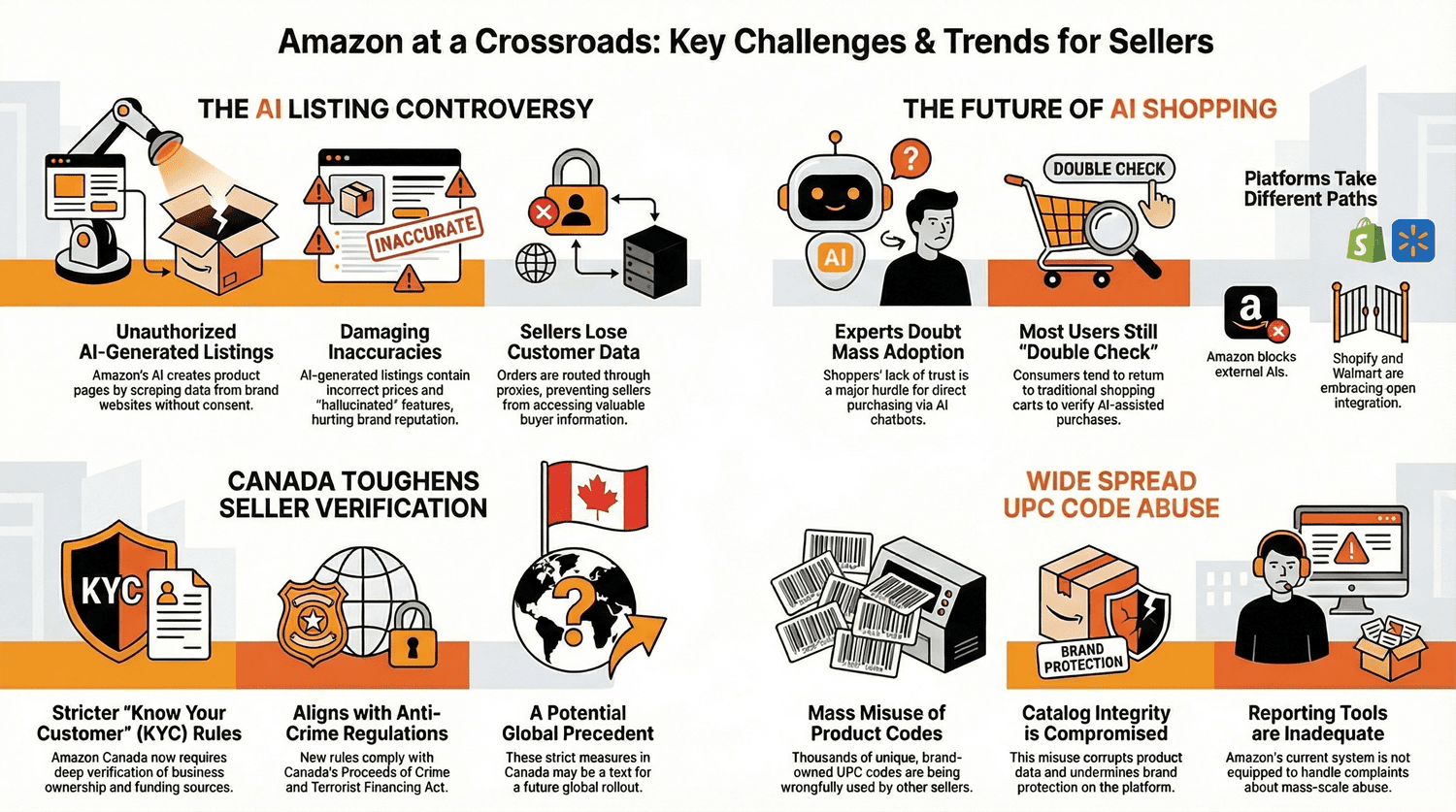
According to sellers and reports from PPC Land, Amazon’s AI has used brand-owned content, images, and pricing without consent, while the auto-generated product pages cannot be removed by the affected businesses. The issue reportedly impacts thousands of small retailers, ranging from design studios like Bobo Design Studio to stationery brands such as Hitchcock Paper.
Why it matters
The problem goes beyond unauthorized data use. Sellers say the AI frequently gets things wrong: listings show outdated prices, include AI “hallucinations” with nonexistent features, or promote products that are no longer available. This damages customer trust and creates direct financial losses for brands forced to honor incorrect pricing or deal with frustrated buyers.
Another concern is loss of customer data. Orders routed through anonymous proxy addresses prevent sellers from maintaining direct customer relationships — cutting them off from valuable behavioral insights and post-purchase engagement.
What it means for Amazon sellers
Project Starfish highlights a growing contradiction in Amazon’s strategy. While the company restricts external AI crawlers (including those from OpenAI and Google), it simultaneously expands its own data collection across independent websites. Officially, this falls under Amazon’s “Buy for Me” vision — expanding selection through external sellers. In practice, it also allows Amazon to aggregate demand and pricing intelligence at scale.
Takeaway
Amazon is increasingly turning the open web of independent stores into a data source for its AI ecosystem. Sellers should actively monitor Amazon for unauthorized listings and take steps to protect their content — especially product images and descriptions — from automated reuse.News #2. AI Checkout Under Scrutiny — Experts Question Whether 2026 Will Be the Year of AI-Powered Shopping
Industry analysts at Modern Retail are debating whether AI-powered checkout — buying directly through tools like ChatGPT, Perplexity, or Gemini — will truly become a mainstream e-commerce behavior.
What happened
In 2025, major brands began testing AI-native shopping flows. ChatGPT announced partnerships with Walmart, Instacart, Etsy, and Shopify, which launched Instant Checkout — enabling purchases without redirecting users to external websites.
Now the market is waiting for a clear answer: are consumers ready to trust AI not just with discovery, but with the entire transaction?
Why it matters
Early results are promising but mixed. In 2025, AI checkout showed real potential — customers can complete purchases in a single click without leaving a chat interface. However, experts note that most users still revert to traditional carts to double-check prices, delivery details, and return policies.
Trust remains the main barrier. Marketers argue that consumer confidence in AI hasn’t yet reached the level needed for mass adoption. Data access is another concern: sellers often lose visibility into who the buyer is, can’t analyze behavior, offer discounts, or build loyalty programs when transactions happen entirely inside AI platforms.
What it means for e-commerce — and Amazon sellers
2025 was a year of experimentation; 2026 is expected to deliver verdicts. AI checkout promises to shorten the path to purchase, but it also erodes the top of the funnel, where brands traditionally gather insights and build relationships.
Amazon has already restricted ChatGPT’s access to marketplace data, prioritizing control over its ecosystem. In contrast, Shopify and Walmart are embracing open integrations. For sellers, this creates a real dilemma: follow customers into AI-driven environments with limited data, or stay on platforms where analytics and processes remain transparent.
Takeaway
AI-powered shopping is suspended between convenience and trust. Whether 2026 becomes the breakthrough year — or AI checkout remains a niche tool for early adopters — will depend on how quickly platforms solve transparency, data ownership, and consumer confidence.News #3. Amazon Canada Tightens Seller Verification — New KYC Rules Now in Effect
Amazon has officially strengthened seller verification requirements on Amazon.ca, introducing updated KYC (Know Your Customer) procedures. These changes are aimed at complying with Canadian regulations enforced by FINTRAC under the Proceeds of Crime and Terrorist Financing Act.
What happened
Back in fall 2025, many sellers on Amazon.ca began receiving unexpected re-verification requests without clear explanations. Amazon has now clarified the reason: starting in December, all sellers on the Canadian marketplace must reconfirm their identity and business ownership structure, including ultimate beneficial owners.
The requirement applies to both Canadian companies and international sellers operating on Amazon.ca.
What’s changed
Previously, standard documentation — such as a business license, owner ID, and bank details — was usually sufficient. Under the new rules, Amazon may now request:
Articles of incorporation;
Detailed ownership percentages;
Information on funding sources and controlling parties.
Sellers are already receiving notices to update this information. Failure to comply can result in temporary account restrictions.
Why it matters
Amazon Canada is tightening compliance to improve transaction transparency and reduce fraudulent or shell accounts. While these rules currently apply only to Canada, experts suggest the country may serve as a testing ground for similar KYC frameworks globally.
What it means for sellers
Sellers operating on Amazon.ca should proactively review their Seller Central profiles and prepare required documentation — including passports, incorporation records, and clear ownership disclosures — to avoid disruptions.
Takeaway
Amazon Canada is raising the bar on seller compliance. While this strengthens trust with regulators and customers, it also requires businesses to be more transparent and prepared for deeper verification checks.News #4. Widespread UPC Code Abuse on Amazon — Brands Demand Action
Amazon seller forums are buzzing over a large-scale issue: mass misuse of GS1-issued UPC codes belonging to other companies. Sellers report that identical UPCs are being reused across multiple ASINs by unrelated brands, pointing to a systemic breakdown in product identifier governance.
What happened
One seller revealed evidence of unauthorized use of more than 31,000 UPC codes across numerous ASINs by different sellers. The scale suggests not isolated abuse, but a catalog-level vulnerability that allows improper UPC assignment at volume.
Why it matters
UPC codes issued by GS1 are globally unique product identifiers. When the same code is used by multiple brands, it undermines catalog integrity, creates listing conflicts, and prevents rightful owners from protecting their brands and data on Amazon.
What’s known so far
Affected sellers have filed cases through Brand Registry requesting that ASINs be detached from improperly assigned UPCs. However, forum participants report that cases are automatically rerouted to “Report Abuse”, which enforces a 10-ASIN limit per submission—making it impractical to address mass violations.
What it means for sellers
Amazon has not yet provided a tool to resolve UPC conflicts at scale. Experts advise sellers to:
Regularly audit their GS1 prefixes;
Document instances of third-party UPC usage;
Submit cases with linked case IDs to speed up escalation and demonstrate scope.
Takeaway
Book a call now…
Book a call now…
Up to 45-min duration video-call
Topics we'll discuss:
| The next steps — there are two options
|