
Amazon simplifies access to Shop Direct, Helium 10 releases guidance on advertising budgets, AI tool incidents raise concerns, and a court restricts Perplexity’s AI browser
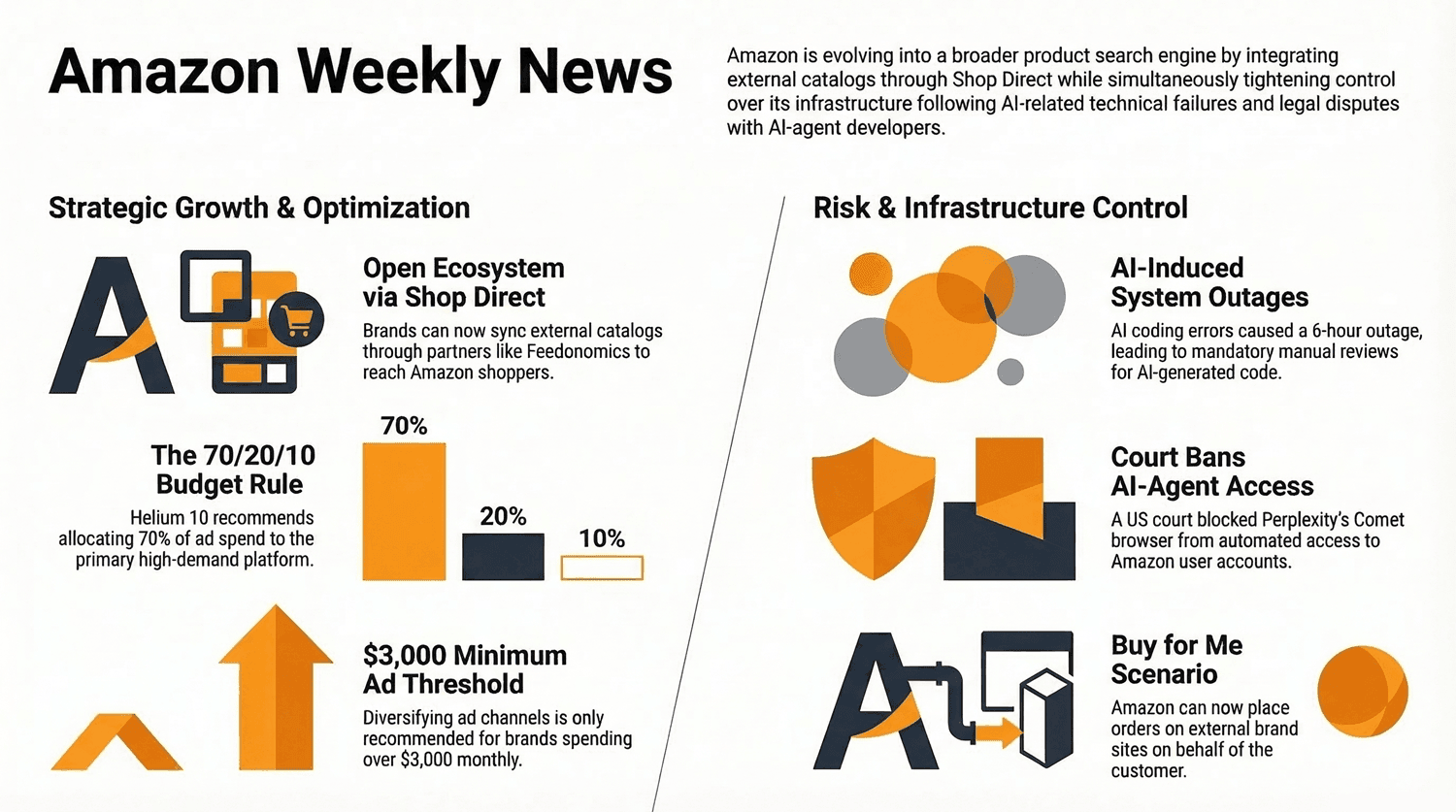
News #1. Amazon opens Shop Direct to partner product catalogs
Amazon has simplified access to Shop Direct — brands and retailers can now submit their product catalogs not only through direct integrations but also through partners such as Feedonomics, Salsify, and CEDCommerce. The change expands product exposure beyond the traditional Amazon Marketplace.
What happened
Amazon added support in Shop Direct (a storefront that displays products from external online stores inside Amazon) for submitting digital product catalogs through partner services. Sellers can automatically transmit product data — assortment, prices, and availability — and receive visibility in Amazon Shopping, the mobile site, and Rufus, Amazon’s AI shopping assistant.
For some products, the Buy for Me scenario is available, where Amazon places an order on the seller’s website on behalf of the customer. In other cases, users are redirected directly to the brand’s website. The store name is displayed throughout the purchasing journey.Why it matters
Amazon is expanding its product discovery system. The platform is no longer only a place where purchases happen inside Amazon Marketplace, but also a traffic channel for products sold on external websites.
For the U.S. e-commerce market, this reinforces Amazon’s role as a primary starting point for product search. At the same time, the technical barrier to participation is lower: instead of building a separate integration, brands can submit their product catalogs through partner services.What it means for Amazon sellers
For brands, this provides another way to expand reach without abandoning their own online storefront. In practice, two operational layers are emerging: Amazon Marketplace remains the center of conversion and repeat purchases, while Shop Direct can serve as an additional traffic channel — for example for products not listed in Marketplace or for testing demand.
The accuracy of the product catalog, pricing, and inventory data becomes critical.News #2. Helium 10 proposes a model for allocating advertising budgets across platforms
Helium 10 analysts presented a practical framework for distributing advertising budgets for e-commerce brands. The approach assumes gradual expansion across platforms while keeping Amazon as the primary sales channel.
What happened
In a new analytical report, Helium 10 proposed guidelines for allocating advertising spending across sales channels. If a brand already operates on multiple platforms, the recommendation is to allocate about 70% of the advertising budget to the platform generating the main organic demand, around 20% to the second-largest channel, and 10% for testing new platforms.
However, the strategy is recommended only for advertising budgets above $3,000 per month. If the budget is smaller, analysts suggest focusing advertising on a single platform until a stable return on ad spend is achieved — roughly 3.5× return within 60 days.Why it matters
According to analysts, many brands lose advertising efficiency when they try to promote products simultaneously across several platforms. Budget fragmentation reduces the amount of data available for optimization and lowers advertising performance.
For the U.S. e-commerce market, this confirms a broader pattern: multi-channel sales continue to grow, but advertising strategy is increasingly centered around one primary platform that generates the majority of orders and optimization data.What it means for Amazon sellers
For Amazon sellers, this reinforces the role of Amazon Marketplace as the main environment for scaling advertising and gathering demand data, where most search traffic and conversions occur.
Other platforms — such as Walmart Marketplace, TikTok Shop, or brand-owned websites — can be added gradually, with advertising budgets expanding only after the primary channel demonstrates stable profitability.News #3. Amazon faces challenges in deploying AI tools
A series of technical outages and internal incidents has pushed Amazon to review how artificial intelligence tools are used in development and platform operations. The company is strengthening oversight of AI-assisted workflows.
What happened
In early March, Amazon’s website and mobile app experienced a major outage, leaving users unable to browse products or place orders for nearly six hours. The issue was linked to an error introduced during a software update.
At the same time, additional incidents occurred within Amazon’s infrastructure related to the use of generative AI tools in software development. In one case, an internal AI coding assistant removed and recreated an entire development environment, which delayed system recovery for approximately 13 hours.
Following these incidents, Amazon held an internal engineering review and acknowledged that some of the problems were linked to AI-assisted changes introduced without sufficient safeguards. As a result, any code modifications prepared with AI tools must now undergo additional review by senior engineers.Why it matters
Amazon is rapidly integrating artificial intelligence into both its internal systems and customer-facing services, including tools such as Rufus.
However, the recent incidents show that AI tools can scale errors just as quickly as they accelerate development. For the infrastructure supporting Amazon Marketplace, this increases the importance of strict validation and oversight of automated changes.What it means for Amazon sellers
For sellers, platform outages have a direct impact on revenue. During disruptions, customers cannot place orders while advertising campaigns may continue spending budget without generating conversions.
This makes platform stability increasingly important for businesses operating on Amazon and highlights the need to use third-party AI tools carefully — especially tools that directly access seller accounts to manage ads, pricing, or listings.News #4. Court blocks Perplexity’s AI browser from accessing Amazon accounts
What happened
A federal court granted Amazon’s request and blocked the automatic login function for Amazon accounts within the Comet browser developed by Perplexity.
The browser uses AI agents — software programs that can perform actions on websites on behalf of users. These agents can log into accounts, search for products, and potentially place orders.
The court concluded that this mechanism violates Amazon’s platform rules because it allows automated account access without authorization from Amazon itself, even if the user provides permission. Perplexity has seven days to appeal the decision.
We first wrote about the beginning of this conflict in autumn 2025 and promised to keep readers informed as the situation develops.Why it matters
The dispute illustrates how major platforms are beginning to limit the operation of AI agents inside their ecosystems.
If such tools gain full access to user accounts, they could automatically interact with Amazon Marketplace — from product search to purchase. For Amazon, this creates risks related to control over traffic flows, user data, and the platform’s advertising ecosystem.What it means for Amazon sellers
For sellers, the case confirms that Amazon intends to maintain control over buyer traffic and account access.
Even if external AI tools participate in product discovery or recommendation, the infrastructure for transactions and conversions is expected to remain inside Amazon Marketplace. The use of automated tools interacting with accounts will likely continue to be regulated by platform policies.Book a call now…
Book a call now…
Up to 45-min duration video-call
Topics we'll discuss:
| The next steps — there are two options
|