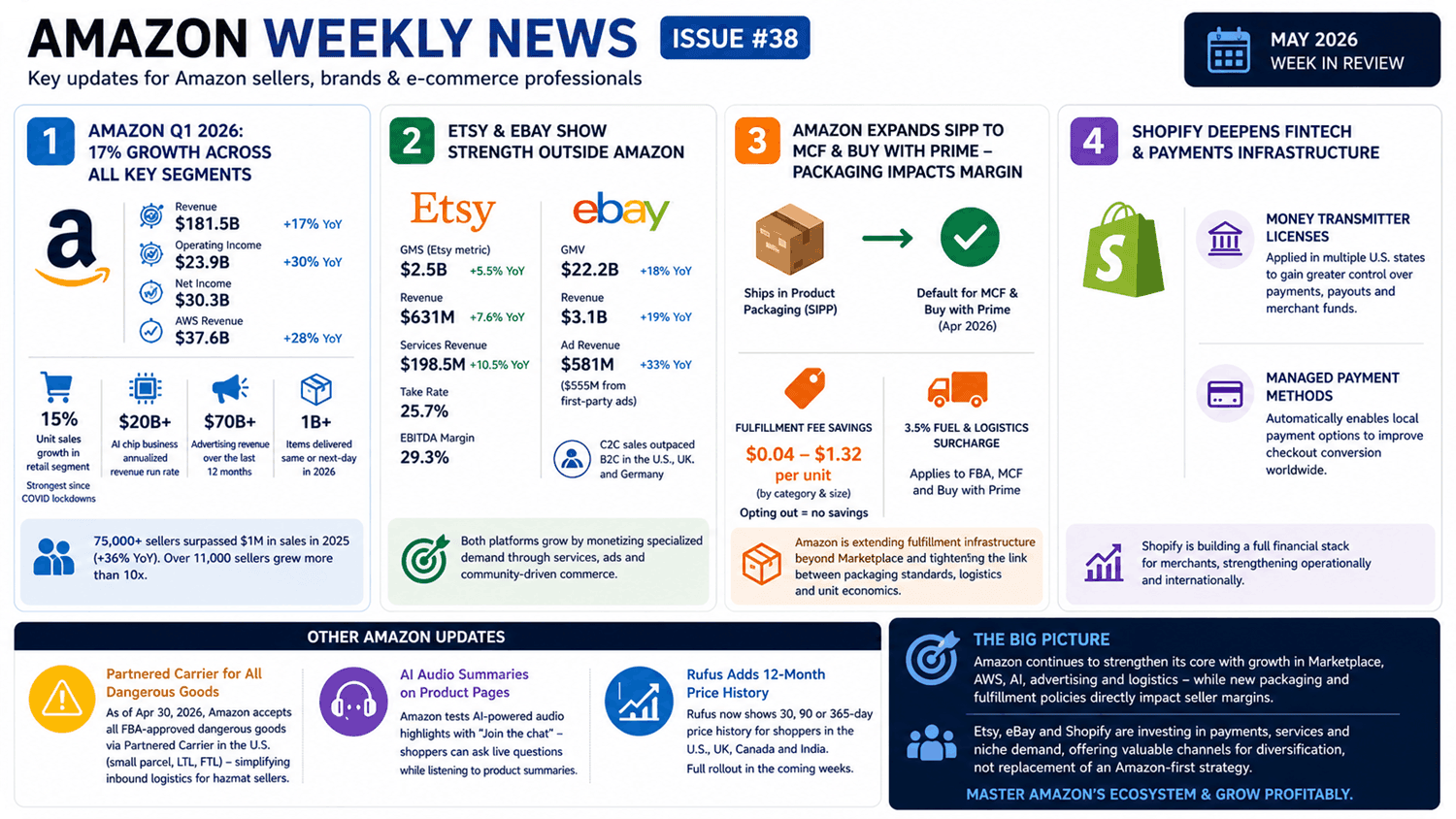
Amazon surges in Q1 through Marketplace, AWS, AI, logistics, and packaging; Shopify deepens fintech; while Etsy and eBay strengthen alternative e-commerce channels.
News #1. Amazon grew 17% in Q1 2026 as Marketplace, AWS, advertising, and AI accelerated together
Amazon closed Q1 2026 with $181.5 billion in revenue and broad-based expansion across every major segment. The quarter showed how Amazon Marketplace, AWS, advertising, and seller infrastructure are increasingly reinforcing each other inside one commercial ecosystem.
What happened
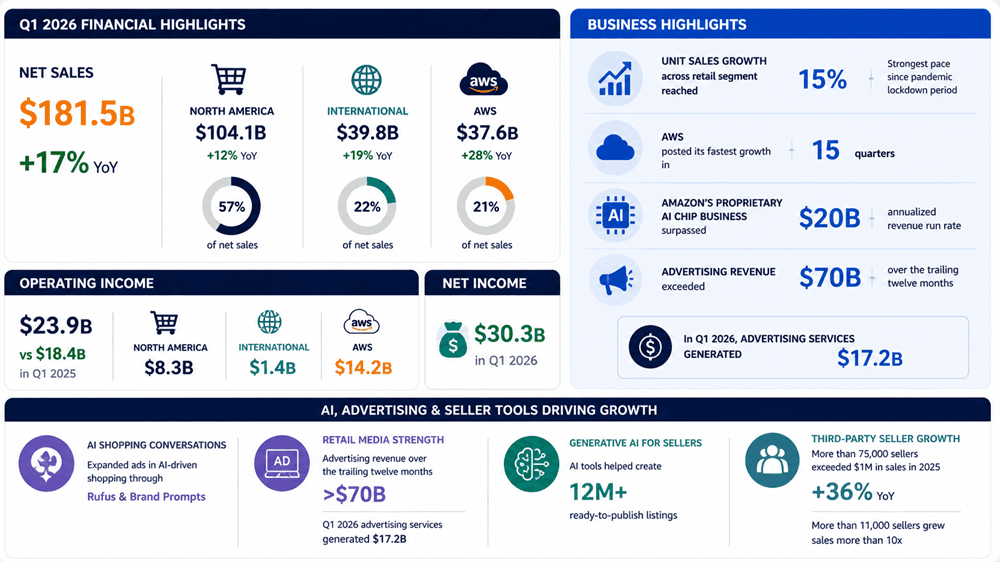
Amazon’s net sales rose 17% year over year in Q1 2026 to $181.5 billion. North America generated $104.1 billion, up 12%; International reached $39.8 billion, growing 19%; AWS climbed 28% to $37.6 billion. Operating income increased from $18.4 billion to $23.9 billion, with North America contributing $8.3 billion, International $1.4 billion, and AWS $14.2 billion. Net income reached $30.3 billion.
According to CEO Andy Jassy, unit sales growth across Amazon’s retail segment hit 15%—its strongest pace since the pandemic lockdown period. AWS posted its fastest growth in 15 quarters, Amazon’s proprietary AI chip business surpassed a $20 billion annualized revenue run rate, and advertising revenue exceeded $70 billion over the trailing twelve months. In Q1 alone, advertising services generated $17.2 billion. Amazon also expanded ads inside AI shopping conversations through Rufus and Brand Prompts, while generative AI tools helped sellers create more than 12 million ready-to-publish listings.Why it matters
Amazon is no longer scaling primarily through traffic alone. Growth is increasingly driven by the integration of Marketplace, logistics, data infrastructure, advertising, and cloud. For the broader U.S. e-commerce market, this means deeper concentration of buyer demand inside one platform where sellers can access customers, fulfillment, retail media, and AI tools simultaneously.
Amazon’s physical infrastructure also continues to accelerate. More than 1 billion items were delivered same-day or next-day in 2026 so far, while 1-hour and 3-hour delivery options now cover over 90,000 products in the U.S.
Third-party seller growth remains a critical signal: more than 75,000 independent sellers surpassed $1 million in annual sales in 2025, up 36% year over year, while over 11,000 sellers grew sales more than tenfold.What it means for Amazon sellers
Amazon remains the central infrastructure for both launching and scaling an e-commerce business: conversion, repeat purchases, FBA, advertising, and AI tools are increasingly concentrated inside one system. But complexity is rising alongside opportunity. Sellers now need more structured operational knowledge to fully leverage Amazon’s expanding ecosystem and sustain profitable growth.
News #2. Etsy and eBay show where e-commerce demand outside Amazon is holding
Alongside Amazon, Etsy and eBay also posted quarterly results—both growing, but through very different models. Etsy is expanding profitability through seller services, while eBay is scaling Marketplace, advertising, and C2C demand.
What happened
Etsy increased Gross Merchandise Sales (GMS, Etsy’s internal sales metric) by 5.5% in Q1 2026 to $2.5 billion on its core Marketplace. Revenue rose 7.6% to $631 million, while services revenue—including ads, payments, and shipping tools—grew 10.5% to $198.5 million. Etsy’s take rate reached 25.7%, while EBITDA profitability came in at 29.3%. The company is focusing resources more aggressively on its core Marketplace after strategic divestitures.
eBay posted faster acceleration: Gross Merchandise Volume (GMV) rose 18% to $22.2 billion, while revenue increased 19% to $3.1 billion. U.S. operations accounted for 52% of volume, international markets 48%. Consumer-to-consumer sales outpaced business-to-consumer in several major markets, while eBay’s advertising business generated $581 million, including $555 million from first-party ads.Why it matters
Both companies demonstrate that non-Amazon e-commerce growth increasingly depends on monetizing specialized demand more efficiently—not just transaction volume. Etsy is leaning into niche seller services and marketplace economics, while eBay is strengthening resale, collectibles, and retail media. Marketplace competition is increasingly infrastructure-led.
What it means for Amazon sellers
For Amazon sellers, this reinforces multi-channel strategy: Amazon remains the primary scaling engine, while Etsy and eBay can serve as complementary channels for niche categories, secondary inventory, or specialized audiences.
News #3. Amazon’s MCF and Buy with Prime packaging shift makes logistics a direct margin factor
Amazon expanded Ships in Product Packaging (SIPP) across Multi-Channel Fulfillment and Buy with Prime, turning packaging standards into a more direct part of seller cost structure.
What happened
Starting April 2026, Amazon began defaulting eligible MCF and Buy with Prime orders to ship in original brand packaging without Amazon overboxing. Sellers can receive fulfillment discounts ranging from $0.04 to $1.32 per unit depending on product size and category, but opting out removes savings.
At the same time, Amazon introduced a 3.5% fuel and logistics surcharge across FBA, MCF, and Buy with Prime, making packaging and logistics standards more tightly connected to landed cost.Why it matters
Amazon is extending fulfillment infrastructure beyond Marketplace into broader commerce operations, including Shopify and DTC channels. This can lower costs for some sellers while also increasing dependency on Amazon-defined logistics standards.
What it means for Amazon sellers
For sellers using multi-channel fulfillment, SKU-level profitability increasingly depends on packaging compliance, logistics fees, and Amazon operational rules—not just sales performance.
News #4. Shopify deepens fintech as payments become core merchant infrastructure
What happened
Shopify applied for Money Transmitter Licenses across multiple U.S. states, allowing greater control over merchant payments, payouts, and transaction infrastructure. Simultaneously, Shopify launched Managed Payment Methods, automatically enabling localized payment options across Shopify Payments stores to improve international checkout conversion.
Why it matters
Shopify is increasingly monetizing payment infrastructure itself—not just subscriptions. This positions Shopify more deeply in merchant cash flow, checkout optimization, and fintech.
What it means for Amazon sellers
For Amazon-first brands, Shopify becomes a stronger DTC expansion channel, particularly for international brand control. But Amazon still remains the primary Marketplace and fulfillment scaling engine.
Other Amazon News
Amazon expands Partnered Carrier to all eligible dangerous goods
Amazon now allows all FBA-approved hazardous goods in the U.S. through Partnered Carrier, simplifying inbound logistics for hazmat sellers and making complex categories easier to scale.
Amazon tests AI audio product summaries with live Q&A
Amazon’s AI-powered audio shopping highlights now include interactive “Join the chat” functionality, allowing shoppers to ask live product questions while listening—raising the importance of listing quality even further.
Amazon’s Rufus now shows price history across 30, 90, and 365-day periods, increasing pricing transparency and putting more pressure on long-term pricing strategy over short-term discount tactics.
Book a call now…
Book a call now…
Up to 45-min duration video-call
Topics we'll discuss:
| The next steps — there are two options
|