
Amazon scales globally and replaces Rufus with Alexa, TikTok expands content commerce, and Shopify prepares brands for AI search competition
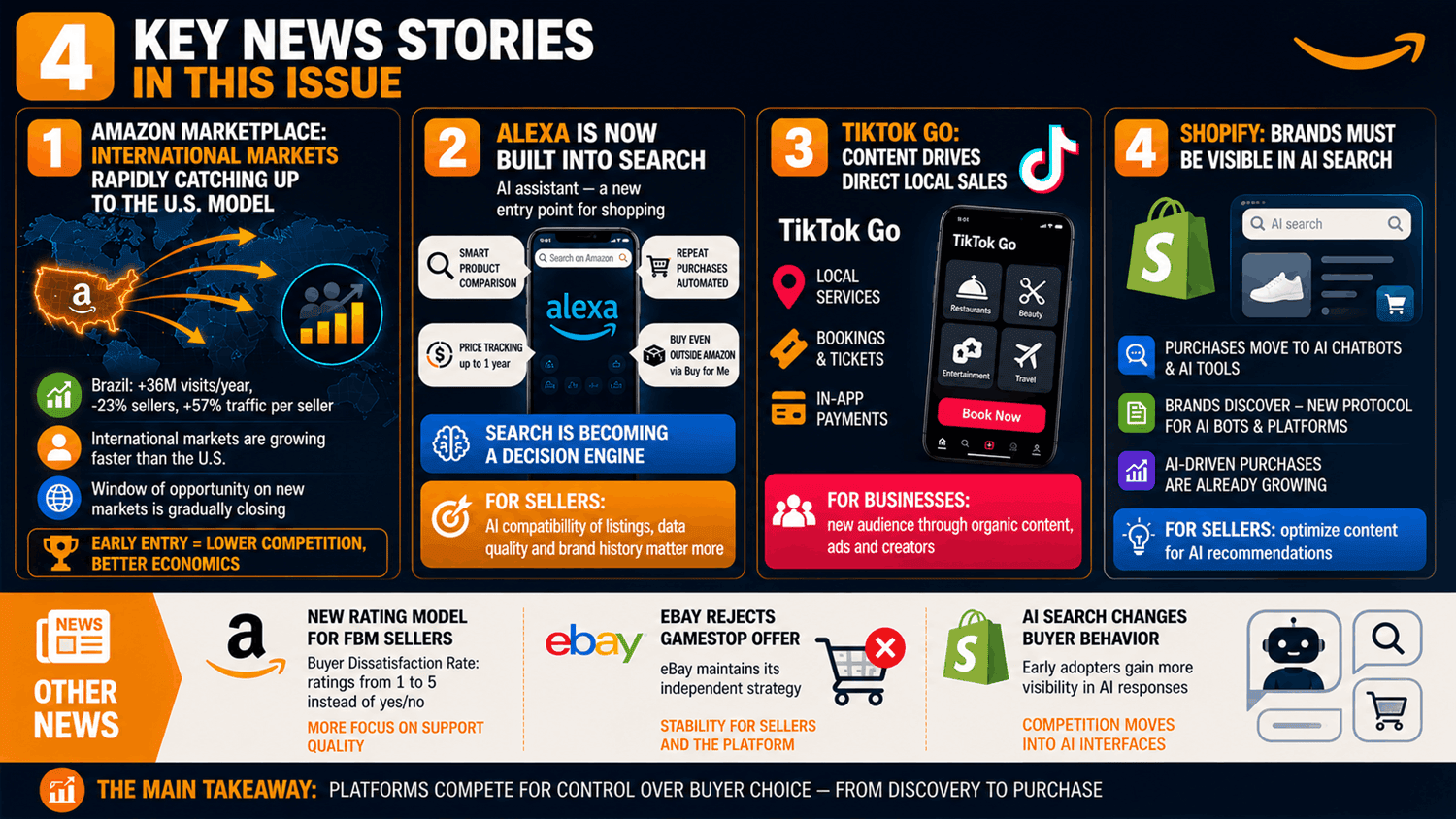
News #1. Amazon Marketplace: Less Competitive International Markets Are Rapidly Moving Toward the U.S. Model
Amazon is redistributing seller growth across countries: international marketplaces still offer sellers a stronger balance of buyer traffic and competition, but as they scale, they are increasingly replicating the structure of the mature U.S. Amazon Marketplace.
What happened
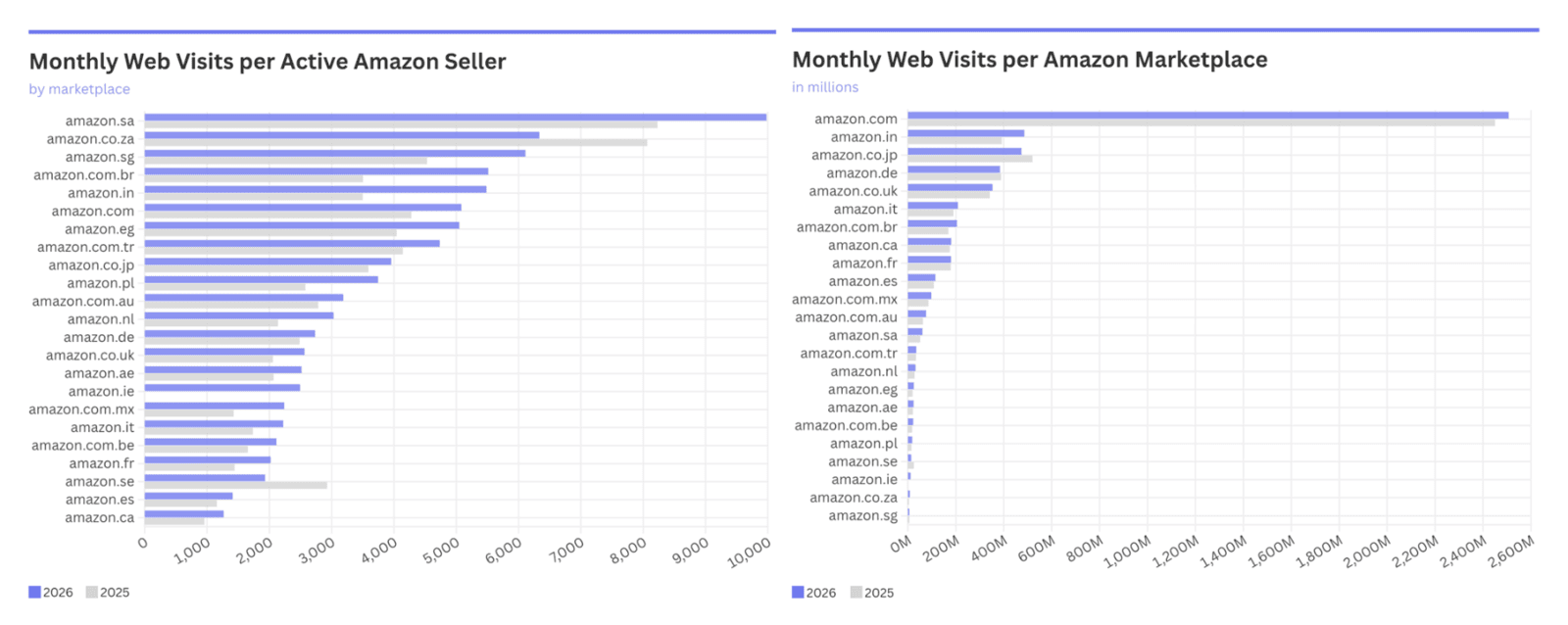
According to Marketplace Pulse, Amazon Brazil increased monthly traffic by 36 million visits over the past year while active seller count fell by 23%. This drove a 57% increase in visits per seller — one of the highest growth rates across Amazon’s global Marketplace network. Similar patterns are emerging in Mexico, India, France, the Netherlands, and Poland, where international marketplaces are seeing faster buyer-per-seller growth than the U.S. The U.S. Amazon Marketplace remains the largest by volume, but it is also far more concentrated: fewer than 8,000 sellers control roughly 50% of third-party gross merchandise volume (GMV). At the same time, the U.S. share of Amazon’s total buyer visits is declining not because demand is shrinking, but because international marketplaces are expanding faster.
Why it matters
Amazon is effectively exporting the early-market model beyond the U.S.: lower competition and cheaper entry first, followed by rapid seller density, higher internal advertising costs, and margin pressure. For sellers, this means international Amazon Marketplace expansion still offers better launch economics, but the lower-competition window is gradually narrowing. As buyer traffic scales, market structure increasingly resembles the U.S., where advantages are more concentrated among larger operators.
What it means for Amazon sellers
The U.S. remains Amazon’s core scaling engine, but international marketplaces are becoming the next logical growth layer. Early entry into markets like Brazil or Mexico may allow sellers to capture stronger buyer-per-seller economics before competition, advertising costs, and margin compression intensify.
News #2. Alexa Is Now Embedded in Amazon Search: AI Becomes the New Entry Point to Shopping
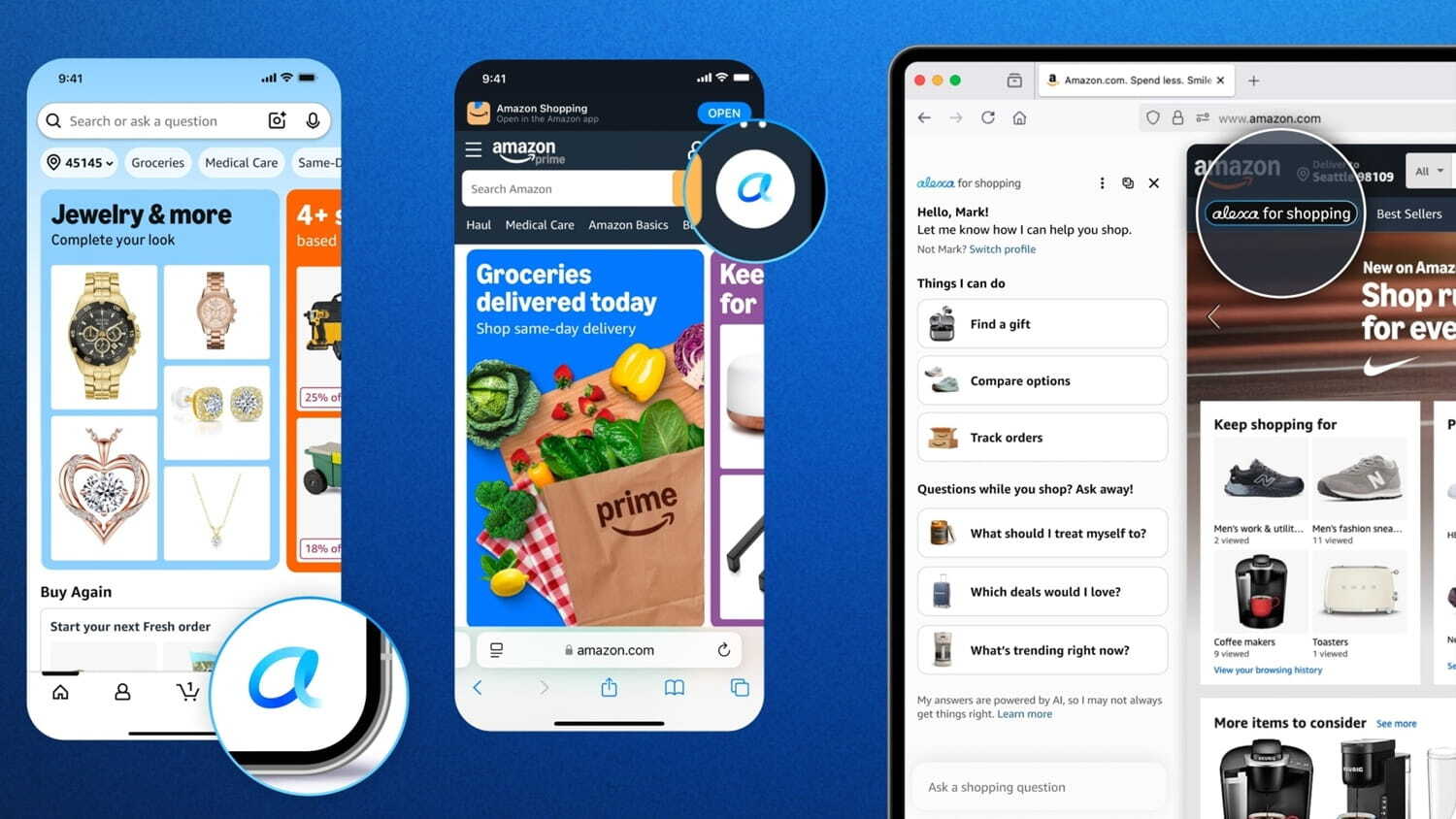
Amazon has replaced Rufus with Alexa for Shopping, integrating AI directly into Amazon.com, the mobile app, and Echo devices. The company is shifting shopping from product search to an AI-managed decision system where recommendations, comparisons, price tracking, and repeat purchases operate inside one ecosystem.
What happened
Beginning May 13, Amazon launched Alexa for Shopping for U.S. customers across Amazon.com, its app, and Echo devices. Rufus, used by more than 300 million customers in 2025, grew active usage by 115% in Q1, but Amazon moved beyond the standalone chatbot model. Alexa+ now functions as a shopping assistant within Amazon search: comparing products, analyzing purchase history, tracking prices for up to a year, automating recurring purchases, and even purchasing off-Amazon products through Buy for Me. Amazon is transforming search from a catalog into a purchase decision and execution engine.
Why it matters
Amazon is tightening control over the search and product selection stage: buyers increasingly rely on AI-generated shopping paths instead of manual comparison. This directly affects Marketplace traffic structure, as product visibility depends not only on Amazon SEO and advertising, but also on how effectively listings communicate with AI systems. Advertising in AI conversations, personalization, and agentic commerce push Amazon closer to full-spectrum demand control — from discovery to purchase choice.
What it means for Amazon sellers
Optimization is shifting from classic ranking toward AI-compatible listing structure. Product detail pages, data completeness, brand history, and pricing logic are becoming more critical as sellers compete not only for Marketplace placement, but for Alexa recommendation visibility.
News #3. TikTok Go: TikTok Moves Local Demand from Content Into Direct Service Commerce
TikTok launched TikTok Go, a new local commerce model that allows users to discover, book, and pay for offline services directly within the platform. TikTok is expanding beyond products and strengthening its role as a demand-generation channel for local commerce.
What happened
TikTok Go launched in the U.S. as a platform for discovering and booking local services, including restaurants, entertainment, beauty, and travel activities. Users can search, book, and pay without leaving the app. TikTok combines short-form video, creator recommendations, and direct commerce into one ecosystem where content becomes the purchase entry point. For businesses, this creates access to new audiences through organic video, advertising, and creator-led promotion. TikTok is effectively extending its TikTok Shop model into local commerce, broadening social commerce into a larger demand infrastructure.
Why it matters
TikTok is competing less with marketplaces directly and more for the earliest stage of consumer decision-making. The platform is increasingly positioning itself to influence purchase intent before users ever move to Amazon, Google, or traditional booking platforms. This raises the role of video as a commercial discovery engine and shifts portions of buyer attention from search toward algorithmic recommendation feeds.
What it means for e-commerce sellers
For e-commerce brands, TikTok Go reinforces short-form video as both a promotion and direct demand channel. Brands gain broader tools for category testing, audience validation, and external traffic generation beyond traditional search ecosystems. In practice, TikTok is expanding growth opportunities through early demand formation and content commerce.
News #4. Shopify Launches AI Search Insights: AI Discovery Becomes a New External Demand Layer
Shopify introduced AI Search Insights, giving brands visibility into how their products and content appear inside AI search responses. Shopify is helping merchants adapt to a model where part of buyer demand is increasingly shaped not through Google, but through ChatGPT, Perplexity, and other AI interfaces.
What happened
Shopify added AI Search Insights to its dashboard, allowing merchants to track brand visibility in AI search, identify AI-driven queries, and evaluate product presence inside generative responses. The system helps brands understand which pages, product descriptions, and structured data are best interpreted by AI models. Shopify is effectively building merchant infrastructure for an environment where search is shifting from catalog navigation toward recommendation engines. This positions AI search as a growing source of external demand, particularly for independent brands dependent on direct traffic.
Why it matters
Shopify is among the first major platforms to formalize a new e-commerce battleground: visibility not just in search engines, but in AI-generated answers. As buyer behavior shifts from manual comparison to AI-assisted recommendations, machine-readable content structure, data clarity, and brand authority increasingly shape demand before website visits occur. AI search is becoming a critical top-of-funnel demand layer.
What it means for Amazon sellers
For Amazon sellers, this is a reminder that buyer competition begins earlier than Marketplace entry. Shopify highlights how brands can strengthen external demand through AI-search visibility. In practice, this reinforces multi-channel strategy, where Amazon remains a conversion engine while external ecosystems shape demand creation.
Other e-commerce News
Amazon Updates Buyer Dissatisfaction Rate: Neutral Ratings Removed from Calculation
Amazon updated Buyer Dissatisfaction Rate for FBM sellers (Fulfilled by Merchant): instead of asking whether a problem was solved, Amazon now uses a 1-to-5 satisfaction scale. Ratings of 1–2 count as dissatisfied, 4–5 as satisfied, while 3 is neutral and excluded. The metric remains structurally similar, but now measures customer service quality more precisely than a simple yes/no framework, increasing seller exposure to post-purchase support quality.
eBay Rejects GameStop Offer
Following last week’s speculation, eBay officially rejected GameStop’s acquisition proposal. The decision confirms eBay’s independent strategy and removes uncertainty around a possible ownership shift. For sellers, this signals continuity in platform governance, advertising infrastructure, and secondary-market category development.
Amazon is expanding Amazon Now 30-minute grocery delivery across more U.S. cities, intensifying competition with Walmart, Instacart, and DoorDash. By focusing on speed and frequent low-ticket orders, Amazon is strengthening daily-demand infrastructure, increasing subscription retention, repeat purchases, and long-term buyer loyalty within its broader e-commerce ecosystem.
Book a call now…
Book a call now…
Up to 45-min duration video-call
Topics we'll discuss:
| The next steps — there are two options
|