Amazon tightens product compliance and AI content rules. Amazon Business surpasses $60B in annual sales, while TikTok Shop tests a Prime-style membership program
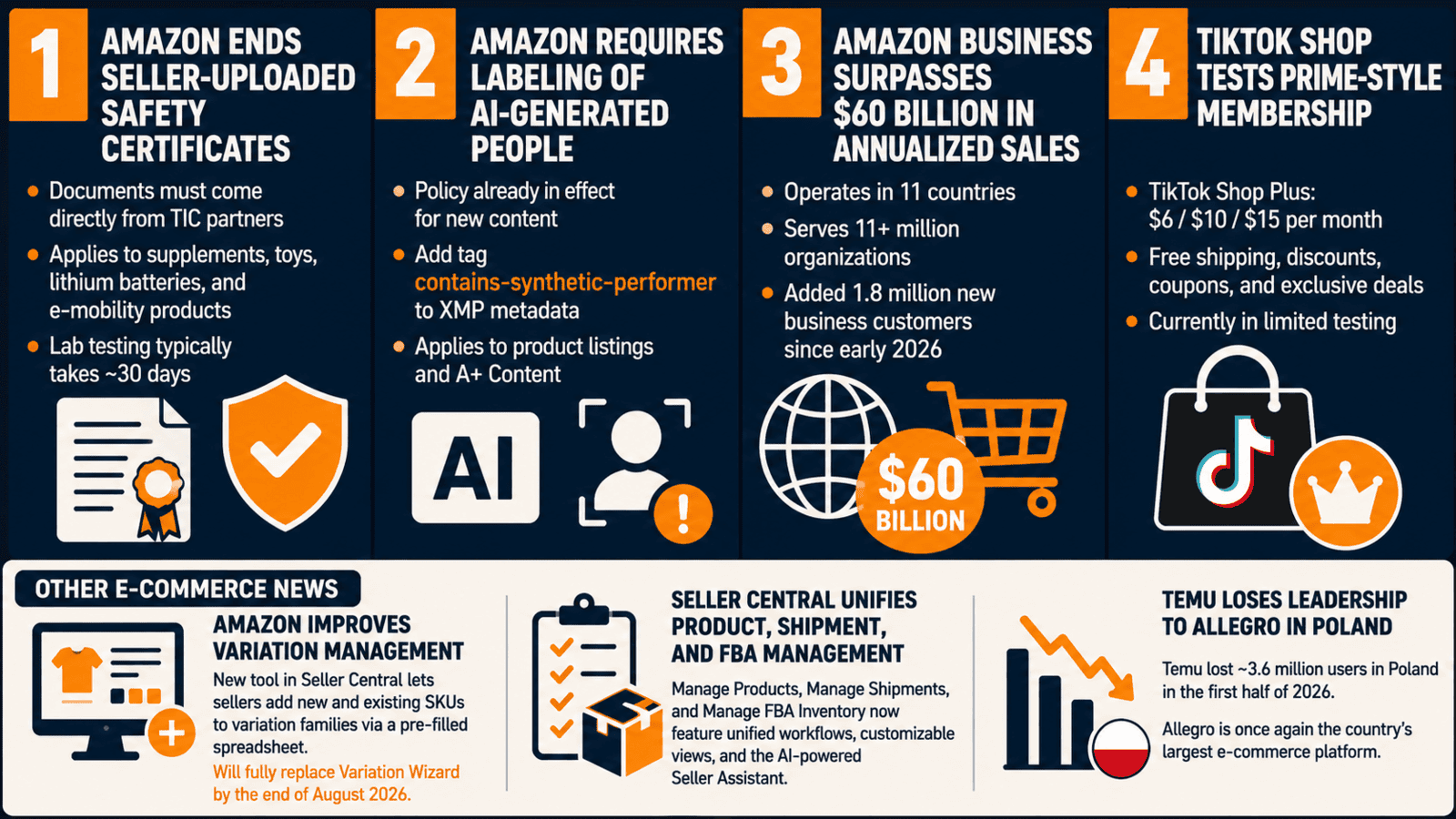
News #1. Amazon Ends Seller-Uploaded Product Safety Certificates
Amazon has changed how sellers verify compliance for regulated products. Sellers can no longer upload product safety certificates and laboratory reports directly through Seller Central.
What happened
Amazon updated its compliance process for regulated categories, including dietary supplements, children's toys, lithium battery products, and electric mobility devices. Product testing, inspection, and certification documents must now be submitted directly to Amazon by accredited third-party Testing, Inspection and Certification (TIC) providers. Seller-uploaded certificates are no longer accepted.
Amazon also notes that laboratory testing typically takes around 30 days, meaning sellers should begin the process immediately after receiving a compliance notification in Account Health.Why it matters
Amazon continues to strengthen product safety standards across its Marketplace by shifting document verification to independent certification organizations. This reduces the risk of invalid documentation while making compliance more standardized. For sellers, product compliance is increasingly becoming an operational process that requires additional planning before launching or restoring listings.
What it means for e-commerce sellers
If you sell products in regulated Amazon categories, plan product testing and certification well in advance. Delays in compliance approval may result in listing restrictions and lost sales opportunities.
Source: Amazon Seller Central
News #2. Amazon Requires Labeling of AI-Generated People in Listings and A+ Content
What happened
Amazon now requires sellers to label images and videos containing photorealistic AI-generated people across product listings and A+ Content in all Amazon stores.
To comply, sellers must add the contains-synthetic-performer tag to the file's XMP metadata. Amazon will then automatically display a disclosure to shoppers. The policy applies only to photorealistic AI-generated people. It does not apply to photographs of real people that have been edited with AI, cartoons, illustrations, or images without people.
The update continues Amazon's broader push toward greater transparency around the use of generative AI in Marketplace content.Why it matters
More Amazon sellers are using generative AI to produce listing images and marketing assets. Compliance is now becoming just as important as creative quality. Missing the required disclosure could delay publication or require content revisions before assets go live.
What it means for e-commerce sellers
If your creative workflow includes photorealistic AI-generated people, update your production process now. AI content labeling has become another required step before publishing content on Amazon.
Source: Amazon Seller Central
News #3. Amazon Business Surpasses $60 Billion in Annualized Sales
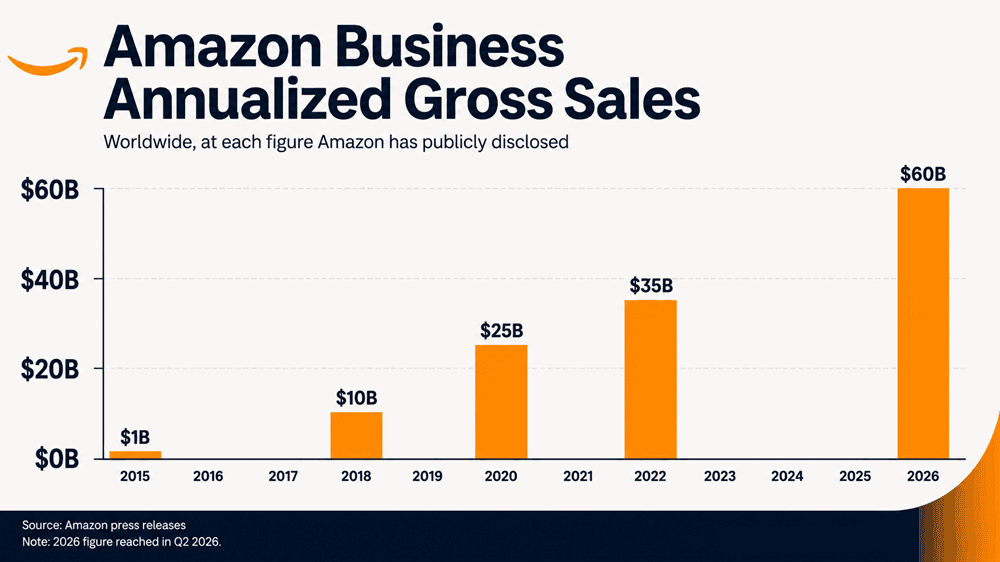
Amazon Business has exceeded $60 billion in annualized gross sales worldwide, highlighting the growing scale of Amazon's B2B marketplace.
What happened
Amazon announced that Amazon Business has surpassed $60 billion in annualized gross sales globally. This figure covers all countries where the service operates—not just the U.S. market.
Why it matters
Industry estimates suggest Amazon Business now represents roughly 7% of Amazon's total GMV, estimated at approximately $830 billion. More than half of Amazon Business sales come from third-party sellers, meaning marketplace partners generate roughly $30 billion in annual B2B sales.
For comparison, Walmart Marketplace generated an estimated $15 billion GMV in 2025, while TikTok Shop US was also estimated at around $15 billion GMV. Amazon Business alone is now roughly four times larger than each marketplace individually.What it means for e-commerce sellers
Amazon Business continues to gain traction in categories such as Office Products, Industrial & Scientific, Tools, Janitorial & Sanitation, Restaurant Supply, MRO, electronics, furniture, and business supplies. For Amazon FBA and private label sellers operating in these segments, it represents another valuable growth channel without expanding to additional marketplaces. Consumer-focused brands may see more limited B2B potential.
News #4. TikTok Shop Tests a Prime-Style Membership Program
What happened
According to Business Insider, TikTok is testing TikTok Shop Plus, a paid membership program modeled after Amazon Prime.
Why it matters
Membership programs have become a proven customer acquisition and retention strategy across e-commerce. Amazon Prime remains one of Amazon's strongest drivers of purchase frequency and customer loyalty. By introducing a similar model, TikTok Shop is looking to increase repeat purchases and keep shoppers within its own ecosystem.
The move points to a broader trend: marketplace competition is increasingly shifting from customer acquisition toward maximizing customer lifetime value (LTV).What it means for e-commerce sellers
If TikTok Shop Plus expands beyond testing, sellers could benefit from stronger repeat purchase rates and higher conversion. At the same time, Amazon continues to operate the industry's most mature loyalty ecosystem, with Prime remaining a key long-term growth driver for Marketplace sellers.
Source: Business Insider
Other E-commerce News
Amazon Improves Variation Management
Seller Central now includes a new tool that allows sellers to add both new and existing SKUs to variation families using a pre-filled spreadsheet. The feature will fully replace Variation Wizard by the end of August 2026.
Seller Central Unifies Product, Shipment, and FBA Management
Amazon continues redesigning Seller Central by bringing together Manage Products, Manage Shipments, and Manage FBA Inventory into a unified workflow with customizable views and the AI-powered Seller Assistant.
Temu Loses Leadership to Allegro in Poland
Temu lost approximately 3.6 million users in Poland during the first half of 2026, allowing Allegro to reclaim its position as the country's largest e-commerce platform. While it is too early to establish direct causation, the decline coincided with new EU import charges and may indicate how tighter import regulations could reshape competition between Chinese and European marketplaces.Book a call now…
Book a call now…
Up to 45-min duration video-call
Topics we'll discuss:
| The next steps — there are two options
|