Amazon FBA adds custom return grading, Walmart prepares AI agents for shopping, PYMNTS examines marketplace preferences, and Helium 10 analyzes wasted Amazon Ads spend
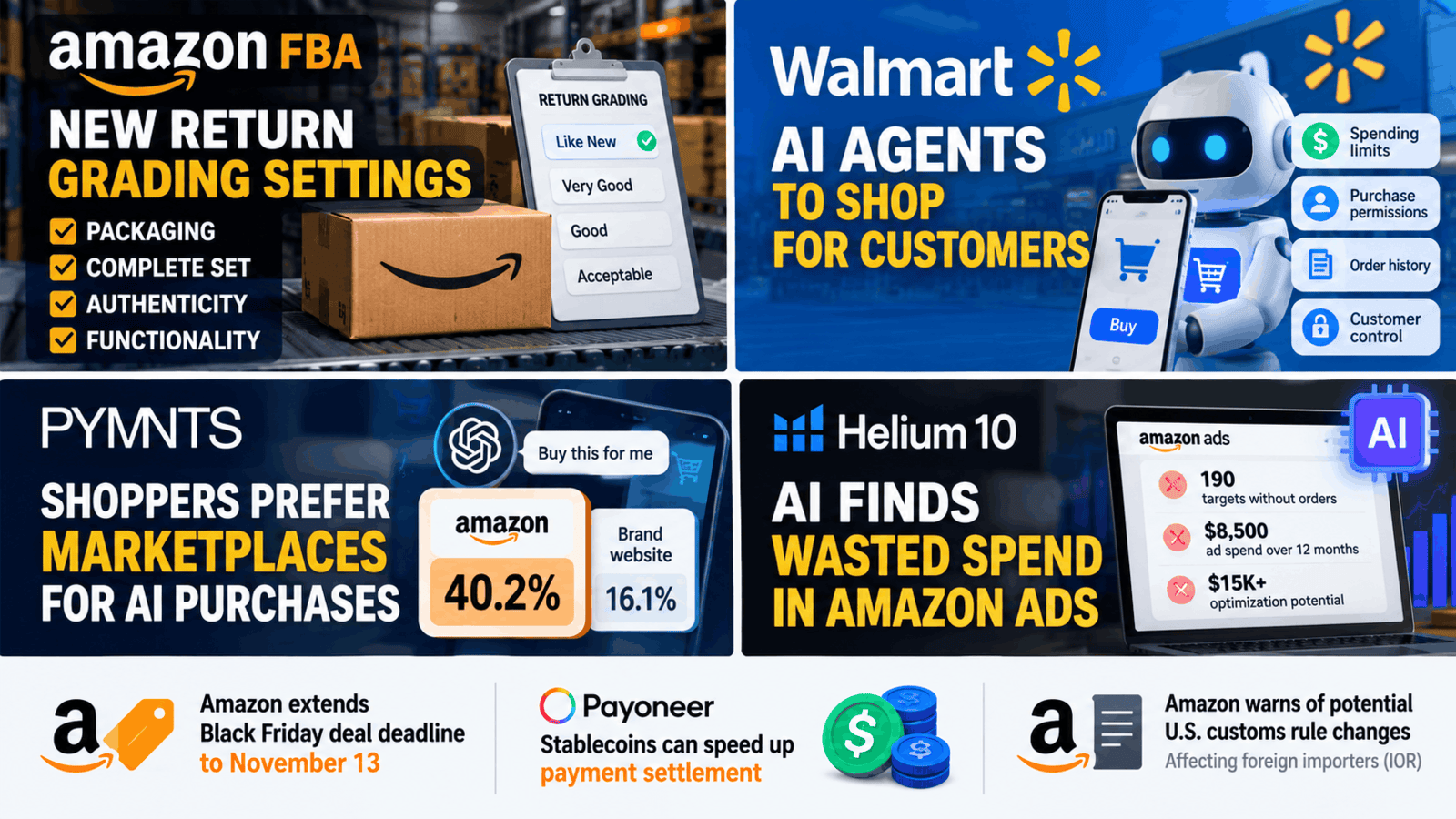
News #1. Amazon FBA Introduces Custom Return Grading Settings
Amazon has introduced Customized Grading, giving sellers more control over the criteria used to evaluate returned products for resale.
What happened
Sellers can now define return grading requirements covering packaging condition, factory seals, missing components, authenticity indicators, and product functionality. Amazon uses these criteria to help determine whether returned inventory can be resold as new or should be classified as used. Sellers can also specify a percentage of the original price for resale in different used conditions.
Why it matters
How returned inventory is classified directly affects resale opportunities and how much value sellers can recover. Customized Grading allows brands to account for product-specific requirements, although it does not guarantee a particular grading outcome.
What it means for e-commerce sellers
Review Customized Grading settings for ASINs with high return rates. Define appropriate resale requirements and identify where product-specific grading criteria could help reduce losses.
Source: Amazon
Want Your Products to Stand Out in Amazon Search & AI?
We optimize Amazon listings - titles, bullet points, descriptions, and product attributes - to help Amazon better understand your products and match them with relevant searches and AI-driven recommendations.
News #2. Walmart Prepares AI Shopping Agents to Make Purchases Within Spending Limits
On October 21, Walmart announced Agent Profiles and Agent Gateway, two tools designed to let third-party AI agents shop on behalf of customers within defined permissions and spending limits.
What happened
Agent Profiles will allow customers to assign spending limits to individual AI agents, review order histories, and revoke access. Walmart plans to launch the feature within a month of the announcement. Agent Gateway will provide an interface for external AI agents to interact with Walmart, starting with a developer beta program.
Why it matters
Walmart is building the infrastructure for AI agents to move beyond product recommendations and participate directly in checkout. For marketplace sellers, this could become another customer acquisition channel. However, its commercial impact remains uncertain because the technology is still being introduced and tested.
What it means for e-commerce sellers
Make sure product specifications, compatibility information, pricing, availability, shipping terms, and return policies are accurate and easy to access. AI agents may compare offers against a shopper's budget and requirements, including total order costs. Sellers should also monitor how marketplaces develop rules governing AI access to product catalogs and checkout.
News #3. PYMNTS Study Finds Shoppers Prefer Marketplaces for AI-Powered Purchases
New research from PYMNTS Intelligence examines where U.S. consumers would trust AI shopping agents to complete purchases on their behalf.
What happened
PYMNTS surveyed 2,191 U.S. consumers in August 2026. Respondents were asked to imagine an AI agent purchasing a product for them, with identical prices, delivery terms, and return policies across retailers.
The researchers also examined actual AI-assisted purchases. Among respondents who reported making such a purchase, 59.7% completed their most recent one on Amazon.
Importantly, AI assistance could have involved product discovery or comparison rather than an agent independently completing checkout.Why it matters
The findings suggest that AI-powered product discovery does not necessarily drive shoppers to brand-owned websites. Even when prices, shipping, and returns are identical, consumers are more likely to choose established marketplaces.
What it means for e-commerce sellers
Do not assume AI recommendations will automatically increase direct-to-consumer sales. Build product visibility across both your own website and marketplaces. Track where customers discover products separately from where they complete purchases, as these may be different channels.
Source: PYMNTS
News #4. Helium 10 Demonstrates How AI Can Identify Wasted Amazon Ads Spend
Last week, Helium 10 (discounts available here) published a practical guide showing how AI can uncover inefficient Amazon Ads spending that may go unnoticed even with automated bid management.
What happened
Helium 10 MCP connects ChatGPT or Claude to Amazon advertising data. Sellers can ask questions in natural language, generate tables and Excel reports, and pause advertising targets after confirming the action.
Why it matters
Automated rules focused on the previous 30–60 days may overlook search terms that consistently generate small amounts of wasted spend.
What it means for e-commerce sellers
AI-powered Amazon Ads analytics tools are worth evaluating. They may reduce time spent on repetitive analysis and uncover overlooked advertising costs. Before incorporating them into regular workflows, test their effectiveness against your own campaigns and measure the actual value they deliver.
Source: Helium 10
Other E-commerce News
Amazon Extends Black Friday Deal Submission Deadline to November 13
Amazon has extended the submission deadline for Black Friday and Cyber Monday 2026 deals to November 13. Sellers should verify eligible ASINs in Seller Central and confirm FBA inventory receiving deadlines. The extended deal submission window does not change existing warehouse delivery requirements.
Payoneer: Stablecoins Can Accelerate Payment Settlement
Payoneer (discounts available here) surveyed 265 executives at large U.S. companies using, testing, or exploring stablecoins. Among companies already using or testing the technology, 50% reported faster settlement. For e-commerce businesses, stablecoins could help accelerate cross-border payments, although transaction fees and currency conversion costs may offset some benefits.
Amazon Alerts Sellers to Potential Changes in U.S. Customs Rules
Amazon has reminded sellers about proposed requirements affecting foreign Importers of Record (IOR), the parties legally responsible for importing goods into the United States. The changes could affect customs clearance and Amazon FBA shipments, but final rules have not yet been adopted. Sellers should verify who is listed as the importer in their shipping documentation. We covered the previously announced proposals in Issue #53.Book a call now…
Book a call now…
Up to 45-min duration video-call
Topics we'll discuss:
| The next steps — there are two options
|