Amazon Marketplace becomes more competitive, AI search reshapes product discovery, the U.S. tightens import compliance, and TikTok Shop cuts FBT fees
News #1. Chinese Sellers Now Account for More Than Half of Amazon's Largest Seller Accounts
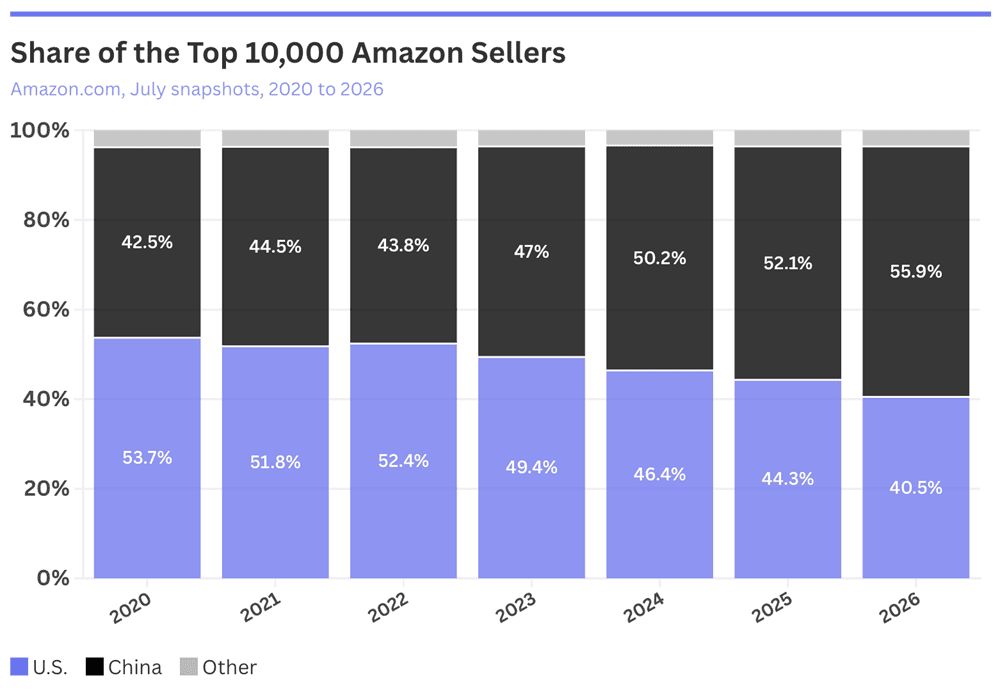
A new Marketplace Pulse report highlights how dramatically Amazon Marketplace has evolved. Chinese sellers now represent the majority of large Amazon seller accounts, while the biggest brands and the highest sales volumes remain largely concentrated among U.S. companies.
What happened
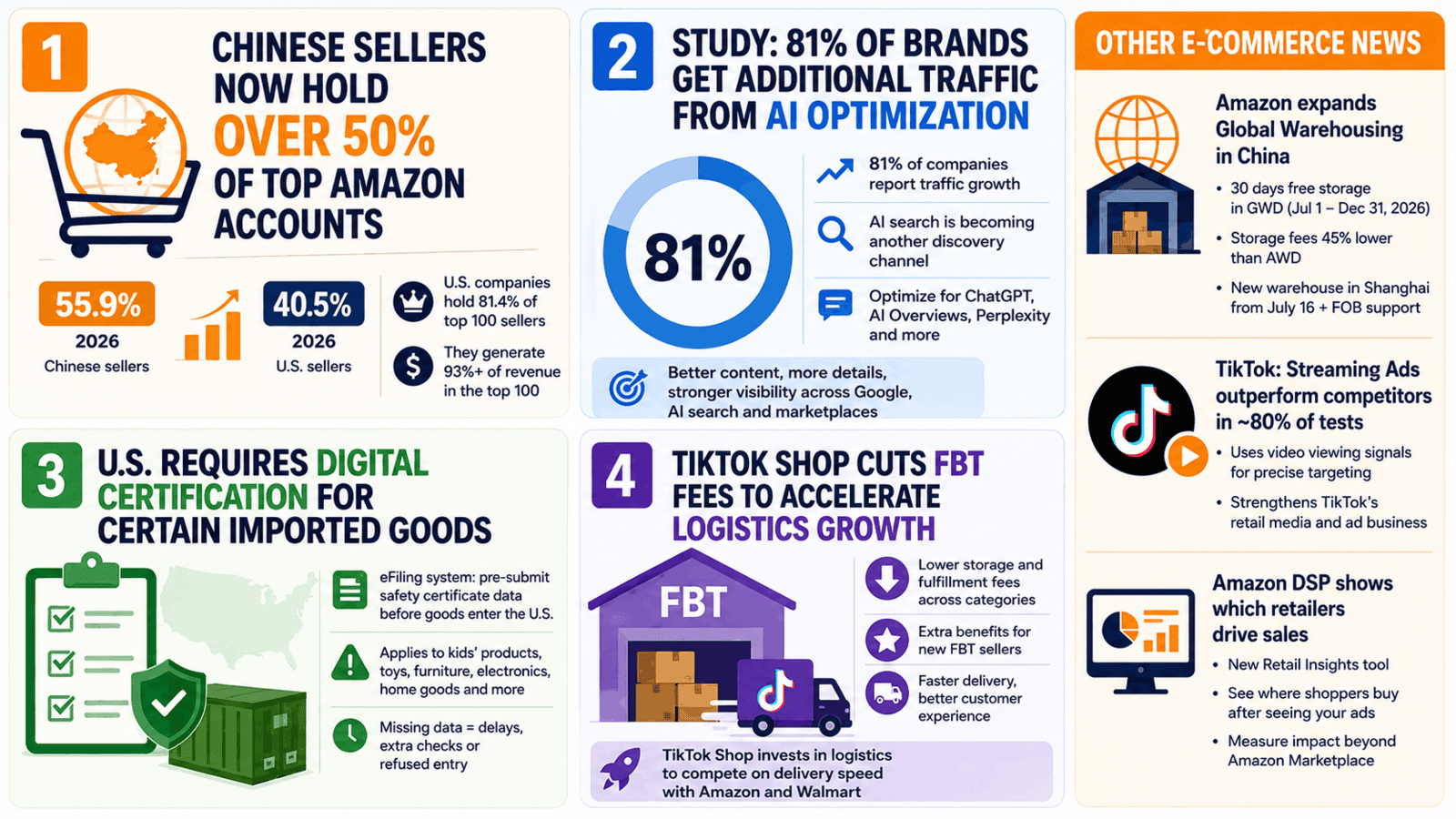
According to Marketplace Pulse, Chinese sellers now account for 55.9% of the top 10,000 Amazon sellers, up from 42.5% in 2020. Over the past six years, they added more than 1,300 positions among Amazon's largest sellers, while the share of U.S. sellers declined from 53.7% to 40.5%. The picture changes at the very top of the marketplace. Within the top 100 Amazon sellers, U.S. companies still dominate, representing 81.4% of all accounts and generating more than 93% of total sales within that group. Their average product prices are also more than twice as high as those of Chinese competitors.
Why it matters
The latest data illustrates how quickly Amazon Marketplace competition continues to evolve. Chinese manufacturers keep expanding thanks to manufacturing scale, rapid product launches, and aggressive pricing. At the same time, the dominance of leading U.S. brands points to a broader trend: long-term success on Amazon is no longer driven by price alone. Strong brand positioning, multi-channel distribution, optimized product listings, Amazon Ads, external traffic, and professional seller strategy are becoming increasingly important competitive advantages.
What it means for e-commerce sellers
For Amazon sellers, the message is clear: marketplace competition continues to intensify. High-quality listings, compelling visual assets, and multi-channel visibility are quickly becoming baseline requirements rather than optional advantages. As AI search and Amazon Ads continue to expand, long-term visibility will increasingly depend on product data quality, content optimization, and a well-executed Amazon seller strategy. Brands that invest in SEO-friendly content and AI-ready product information will be better positioned to capture both marketplace traffic and emerging AI-powered discovery channels.
News #2. Study: 81% of Brands See Additional Traffic from AI Optimization
As AI search continues to gain traction, brands are no longer optimizing content solely for Google. New research from Adobe suggests that AI optimization is already becoming an important customer acquisition channel.
What happened
According to Adobe, 81% of companies using a unified strategy for both traditional SEO and AI optimization reported measurable traffic growth. Brands are increasingly tailoring content for ChatGPT, Google AI Overviews, Perplexity, and other AI-powered discovery platforms where consumers now begin their product research. Companies are expanding product information, improving page structure, adding richer product attributes, and publishing more expert content to make information easier for both search engines and generative AI to interpret.
Why it matters
The findings highlight a broader shift in U.S. eCommerce. AI is rapidly emerging as another traffic source alongside Google, social platforms, and online marketplaces. Traditional SEO is evolving beyond search rankings. Product visibility increasingly depends on content quality, structured product data, and how effectively AI systems can understand and recommend a product.
What it means for e-commerce sellers
Product discovery is expanding beyond individual marketplaces. Well-optimized Amazon listings, branded content, and educational resources can now drive visibility across Google, AI search, and Amazon Marketplace simultaneously. As AI shopping continues to expand, content quality is becoming a long-term competitive advantage. Brands that invest in SEO-ready and AI-friendly content will be better positioned to increase visibility, attract external traffic, and grow sales on Amazon and beyond.
News #3. U.S. Introduces Mandatory Digital Certification for Selected Imported Products
The United States continues to tighten import compliance. Under new rules, importers of selected product categories must submit product safety certification data electronically before goods enter the country.
What happened
The U.S. Consumer Product Safety Commission (CPSC) has launched its new eFiling system, requiring digital submission of product compliance information for regulated goods. The new requirements apply to products subject to mandatory safety certification, including children's products, toys, furniture, consumer electronics, and selected home goods. Importers must now provide manufacturer information, certification details, and product data through U.S. customs systems before shipment arrival. Missing or inaccurate documentation may result in additional inspections, customs delays, or refusal of entry.
Why it matters
The move reflects a broader trend toward stricter compliance across U.S. eCommerce and international trade. Sellers operating cross-border supply chains—particularly those working with multiple manufacturers—may face higher operational complexity. The new rules also increase the risk of shipping delays and could raise landed costs if compliance documentation is incomplete or inaccurate.
What it means for e-commerce sellers
Amazon sellers and other importers should verify that their products fully comply with U.S. safety regulations and confirm that suppliers can provide all required certification documents before shipment. As global supply chains become more regulated, expertise in import compliance, supplier management, and logistics is becoming a critical part of long-term marketplace success. Operational mistakes increasingly cost sellers more than investing in proper processes, compliance, and professional expertise.
News #4. TikTok Shop Cuts FBT Fees to Accelerate Its Fulfillment Network
What happened
TikTok Shop has announced lower Fulfilled by TikTok (FBT) fees across selected product categories in the U.S., reducing storage and fulfillment costs while introducing additional incentives for new participants. Like Amazon FBA, FBT allows sellers to store inventory in TikTok Shop warehouses, while the platform handles storage, packing, shipping, and returns. The fee reductions come as TikTok Shop continues to invest heavily in its U.S. fulfillment network. The company is encouraging more merchants to adopt its logistics services, enabling faster delivery and a better customer experience across the TikTok ecosystem.
Why it matters
Fulfillment is becoming one of the key battlegrounds in U.S. eCommerce. While TikTok Shop initially gained traction through social commerce and low-cost customer acquisition, it is now investing aggressively in logistics to compete more directly with Amazon and Walmart. Fast delivery has become a major driver of conversion and repeat purchases. Expanding FBT signals TikTok Shop's long-term commitment to building a comprehensive commerce ecosystem around its own fulfillment services.
What it means for e-commerce sellers
For brands, FBT provides another opportunity to diversify sales channels alongside Amazon Marketplace. At the same time, the trend reinforces a broader reality: long-term marketplace success increasingly depends not only on advertising and product visibility but also on fulfillment speed, operational efficiency, and customer experience. As competition intensifies, logistics is becoming a strategic advantage rather than simply an operational function.
Other E-commerce News
Amazon Expands Global Warehousing and Distribution in China
Amazon has launched a promotion offering 30 days of free storage through its Global Warehousing and Distribution (GWD) program for sellers shipping inventory from China to the U.S. The promotion runs from July 1 through December 31, 2026. Amazon also announced a new Shanghai warehouse opening on July 16 and added FOB support, further expanding its global fulfillment network.
TikTok Reports Strong Results from Streaming Ads
TikTok says its Streaming Ads format outperformed competing advertising solutions in approximately 80% of tests conducted over the past year. The format leverages video-viewing signals to improve ad targeting, strengthening TikTok's position within the growing retail media ecosystem.
Amazon DSP Adds Retail Insights
Amazon has introduced Retail Insights for Amazon DSP, giving advertisers visibility into which online retailers generate purchases after customers view their ads. The new reporting helps brands measure campaign performance beyond Amazon Marketplace and provides deeper insights into cross-retailer customer behavior, further strengthening the Amazon Ads ecosystem.Book a call now…
Book a call now…
Up to 45-min duration video-call
Topics we'll discuss:
| The next steps — there are two options
|