
Google reshapes AI shopping, Walmart expands Sparky, while Amazon tightens control over advertising, analytics, and platform infrastructure
News #1. Google Launches Universal Cart for AI-Powered Shopping
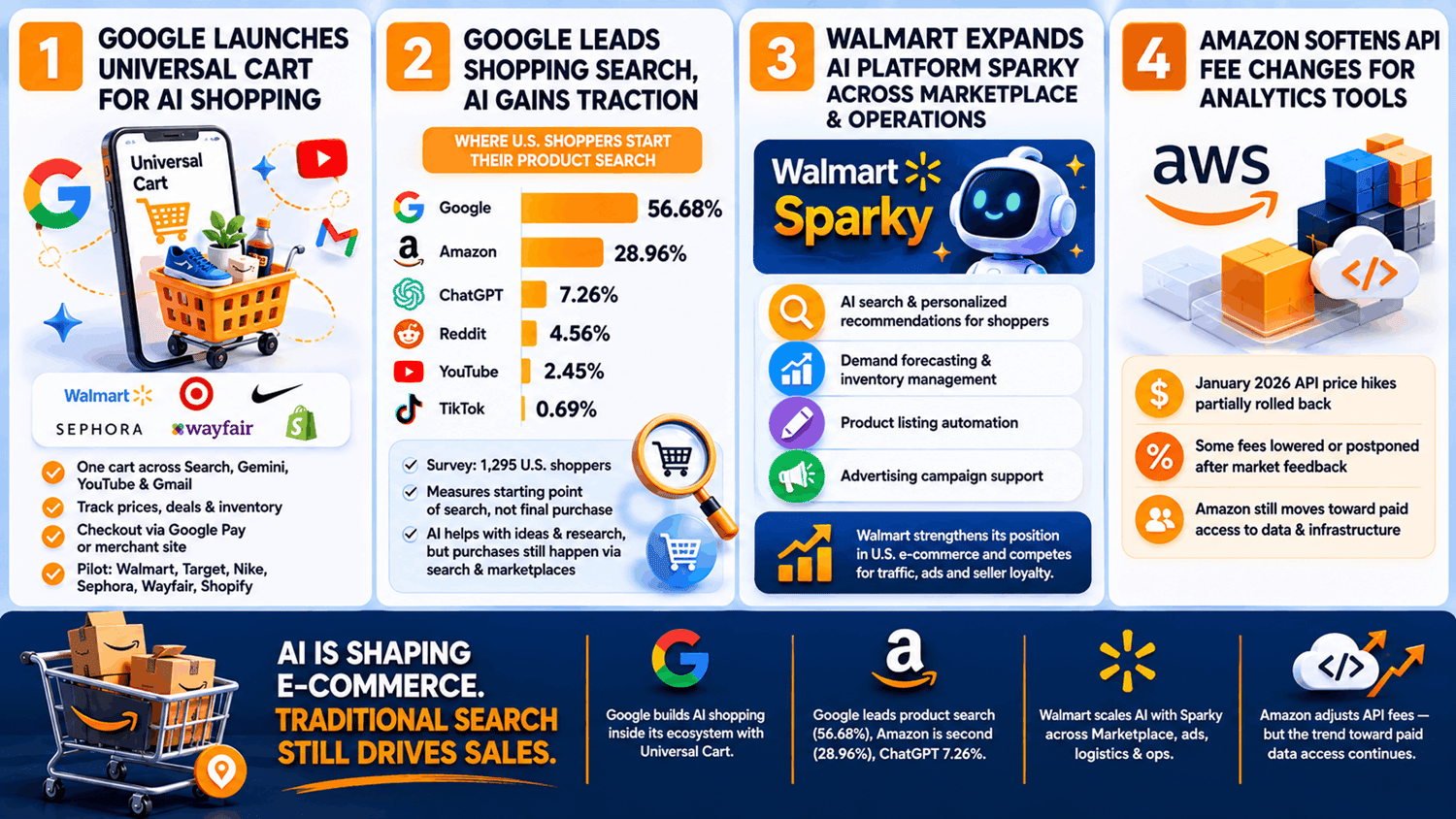
Google is connecting Search, Gemini, YouTube, and Gmail into a unified shopping experience. The company introduced Universal Cart — a cross-platform shopping cart designed to follow users across Google services and merchant websites.
What happened
At Google I/O 2026, Google officially unveiled Universal Cart, allowing users to add products from Search, Gemini, YouTube, and Gmail into a single shopping flow. Customers can track prices, discounts, and inventory availability while completing checkout either through Google Pay or directly on merchant websites. Early partners include Walmart, Target, Nike, Sephora, Wayfair, and Shopify merchants.
Why it matters
Google is gradually shifting product discovery away from the traditional “search → website → purchase” journey toward its own AI-driven ecosystem. The longer shoppers stay inside Google services, the more control Google gains over recommendations, advertising traffic, and merchant visibility. At the same time, coupon platforms and comparison aggregators may lose traffic as Google absorbs more of the shopping journey directly into AI-assisted experiences.
What it means for e-commerce sellers
Competition increasingly depends on product data quality, catalog synchronization, and multi-channel visibility. For brands, presence across Amazon, Shopify, Walmart Marketplace, and Google Shopping is becoming more important to maintain discoverability inside AI recommendations and search-driven commerce.
News #2. Google Still Dominates Shopping Search, but AI Is Starting to Capture Consumer Attention
A new Smarty.Marketing study suggests shoppers still rely primarily on Google and Amazon for product discovery rather than AI chat interfaces. However, ChatGPT already ranks ahead of Reddit, TikTok, and YouTube as a shopping search starting point.
What happened
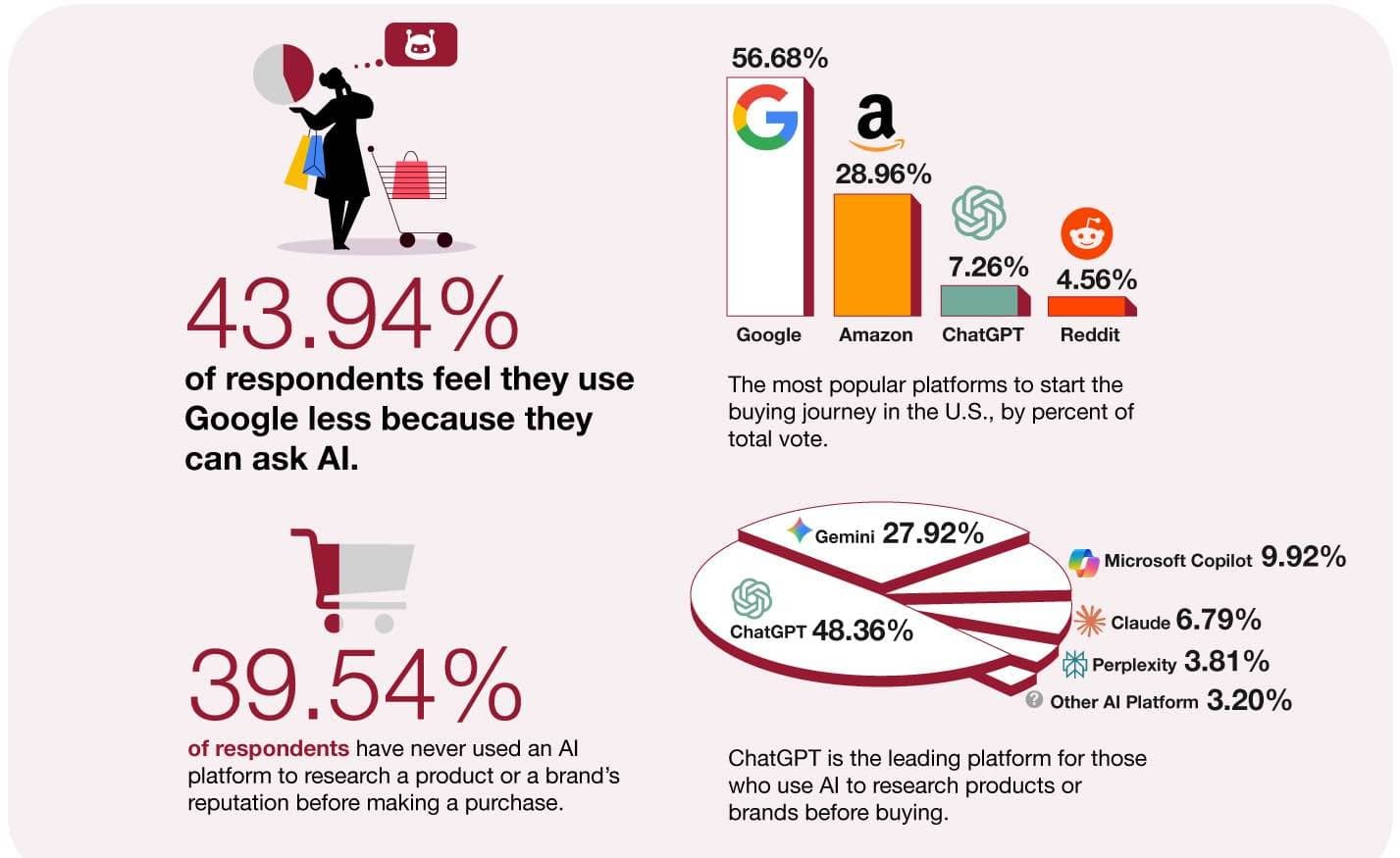
According to a survey of 1,295 U.S. shoppers conducted by Smarty.Marketing, 56.68% of consumers begin their shopping search on Google. Amazon ranks second with 28.96%, while ChatGPT reaches 7.26%.
For comparison:
Reddit: 4.56%
YouTube: 2.45%
TikTok: 0.69%
The study also highlights differences between purchase types. Consumers researching expensive products tend to rely on Google and Amazon for reviews, specifications, and price comparisons. ChatGPT is used more often for brainstorming ideas, product discovery, and early-stage research.
The report also points to growing interest in AI recommendations and conversational commerce.
At the same time, the study has important limitations. The methodology and sample structure were not fully disclosed, and the survey measured the starting point of product discovery rather than final purchases or conversion behavior.Why it matters
Despite the rapid hype surrounding AI-commerce, traditional search behavior has not fundamentally changed yet. Google and Amazon still control the majority of shopping traffic.
However, the fact that ChatGPT already outperforms TikTok, YouTube, and Reddit as a product discovery channel shows that consumer behavior is beginning to shift.
AI is not replacing marketplaces or search engines today, but it is increasingly influencing the upper part of the customer journey — idea generation, comparison shopping, and early-stage product research.What it means for Amazon sellers
Traditional search traffic remains the primary driver of conversions, especially on Amazon Marketplace. At the same time, brands increasingly need strong external content, structured product data, and visibility outside Amazon.
In practice, shoppers may first discover products through AI conversations before moving to Amazon to validate reviews, compare pricing, and complete purchases.News #3. Walmart Expands AI Platform Sparky Across Marketplace and Logistics
Following Amazon CEO Andy Jassy’s recent AI-focused comments, Walmart CEO John Furner stated that Walmart is becoming an “AI-first” retailer. The company is expanding its AI assistant Sparky beyond product search into logistics, inventory management, and advertising.
What happened
Walmart announced broader deployment of its Sparky AI platform. The assistant helps shoppers discover products through conversational search, generate shopping lists, and receive personalized recommendations.
At the same time, Walmart is introducing AI tools for Marketplace sellers and suppliers, including:
demand forecasting,
inventory management,
automated listing generation,
advertising campaign support.
Why it matters
Major marketplaces increasingly use AI not as a standalone feature but as operational infrastructure. Walmart is integrating search, advertising, logistics, and analytics into a connected AI-driven ecosystem.
This affects not only customer experience but also operational costs, inventory efficiency, delivery speed, and advertising traffic distribution.
The move also intensifies competition between retail ecosystems for seller data, advertising budgets, and customer demand.What it means for e-commerce sellers
Multi-channel operations are becoming increasingly important for brands. Walmart Marketplace continues strengthening its role as an additional growth channel in U.S. e-commerce, especially for branded sellers with their own logistics capabilities.
While Amazon remains the primary conversion and scaling platform, Walmart is investing aggressively in AI infrastructure to compete for traffic, advertising spend, and customer retention.News #4. Amazon Softens SP-API Fee Changes for Analytics Platforms
What happened
Earlier this year, Amazon announced new charges for SP-API access and reduced portions of the free request limits. Since SP-API powers analytics, PPC automation, inventory management, and seller software, the changes immediately raised concerns across the ecosystem.
After discussions with developers and SaaS providers, Amazon softened some of the planned increases, keeping certain limits unchanged and lowering several fees.Why it matters
Sellers have already experienced the effects of these API changes. Platforms like Helium 10 and Jungle Scout increased subscription prices, reduced features in lower-tier plans, and limited access to certain data.
Even after Amazon’s partial rollback, the market is unlikely to return to 2025 pricing conditions. Access to Amazon data is gradually becoming a more expensive part of the seller software ecosystem.
In practice, the SaaS market may split into two segments:
larger platforms focused on AI-driven analytics and automation,
smaller niche tools competing on specialization and lower pricing.
What it means for Amazon sellers
Major seller tools are unlikely to fully restore previous pricing models. Instead, the market may see temporary discounts, simplified plans, or feature redistribution across subscription tiers.
The broader trend remains clear: Amazon analytics and operational data are becoming a more costly component of running an Amazon business.Other e-commerce News
Amazon expands native advertising benchmarks inside Amazon Ads
Amazon rolled out Benchmarks Reporting across supported Amazon Ads markets worldwide. Sellers and agencies can now compare CPC, CTR, ACOS, and other advertising metrics directly against category averages inside Amazon Ads. The broader trend remains unchanged: Amazon continues moving advertising analytics inside its own ecosystem, reducing seller dependence on external reporting tools.
Amazon introduces New Arrival and Notable Arrival badges
Amazon launched automatic “New Arrival” and “Notable Arrival” badges for newly listed products. The badges are assigned to products that Amazon’s algorithms identify as potentially high-performing based on shopping behavior, category trends, and product similarity. The update further increases the importance of launch velocity, early conversions, and review generation during the first weeks after product release.
Amazon reminded sellers that returnless replacements should be processed through official Return Settings rather than Buyer-Seller Messaging. If sellers manually tell customers to keep products without using Amazon’s system workflow, buyers may later be automatically charged for unreturned items, potentially leading to negative feedback and A-to-z Claims. The update reinforces a broader trend: Amazon increasingly expects sellers to follow platform-controlled operational processes instead of handling customer support manually.
Book a call now…
Book a call now…
Up to 45-min duration video-call
Topics we'll discuss:
| The next steps — there are two options
|