
Marketplace rankings by GMV, Amazon launches 1-hour delivery, AI content requires revision, Helium 10 reduces functionality
News #1. Amazon maintains leadership among U.S. marketplaces by GMV
Marketplace Pulse updated its ranking of the largest U.S. e-commerce marketplaces. Amazon remains in first place by a wide margin, while competitors grow through different demand models.
What happened
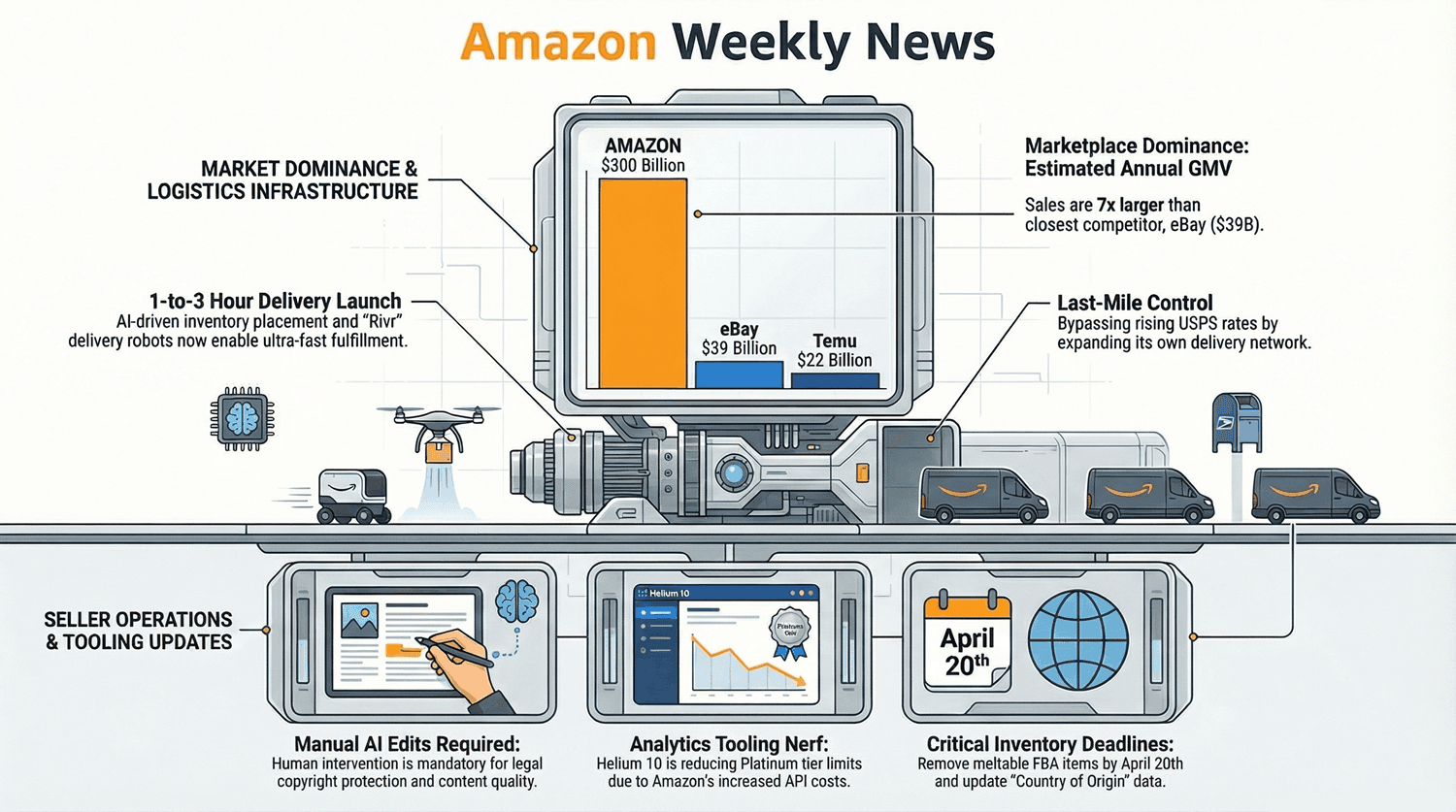
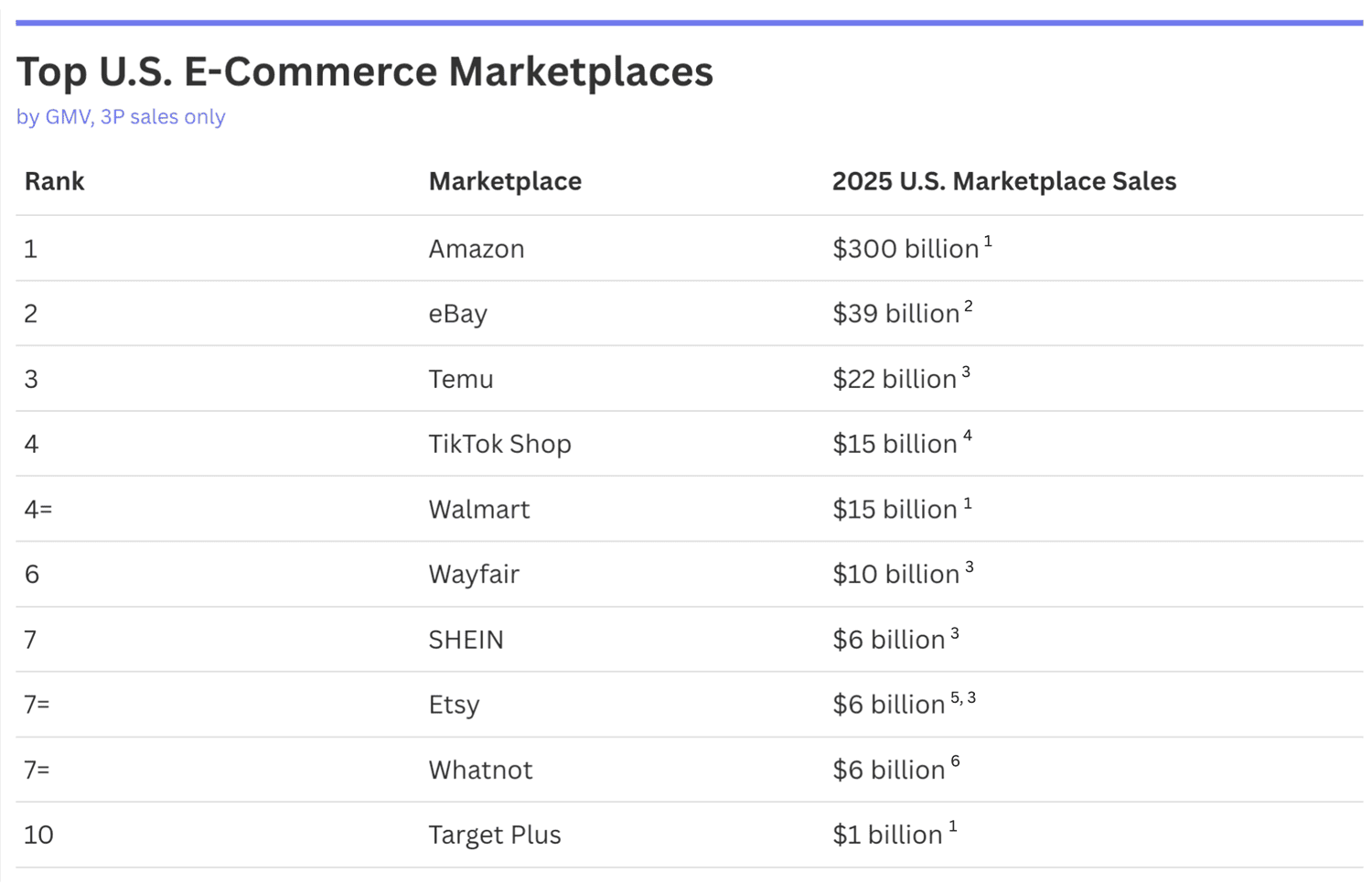
According to analysts, Amazon remains the largest U.S. marketplace with approximately $300 billion in third-party sales (GMV, gross merchandise volume) — more than seven times larger than eBay at $39 billion.
Temu follows with $22 billion, while TikTok Shop and Walmart Marketplace operate at around $15 billion each. The ranking also includes Wayfair, SHEIN, Etsy, Whatnot, and Target Plus.
Notably, Amazon’s internal project Haul already operates at a scale comparable to some companies on the list. Shopify is intentionally excluded, as it is not a marketplace but infrastructure for independent online stores — though its aggregated GMV would place it second.Why it matters
Growth is no longer driven by a single model. Temu scales through pricing and supply chain localization, TikTok Shop through content-driven commerce, and Walmart Marketplace through offline integration, seller expansion, and retail media (on-platform advertising). eBay maintains its position through collectibles and the secondary market.
What it means for Amazon sellers
Amazon Marketplace remains the primary platform for scaling sales. At the same time, the market structure is expanding: other platforms increasingly capture niche demand, internal traffic, or content-driven sales. Amazon continues to act as the core conversion engine, while additional channels serve as incremental growth.
News #2. Amazon expands 1–3 hour delivery and strengthens last-mile control
What happened
Amazon reported growth in same-day delivery, with 1–3 hour delivery now available in select cities. This is driven by placing inventory closer to customers and optimizing stock distribution using AI.
The company also acquired Rivr, a startup developing autonomous delivery robots for short-distance, doorstep delivery — particularly relevant for fast local fulfillment.
At the same time, uncertainty remains around cooperation with USPS. The postal service, under financial pressure, is raising prices and reducing discounts, while Amazon aims to keep last-mile delivery costs low to maintain conversion efficiency.Why it matters
All developments converge around one goal — faster delivery and operational control. Speed directly impacts conversion rates in Amazon Marketplace, especially in everyday categories.
Last-mile delivery remains the most expensive part of logistics. As reliance on external partners becomes less predictable, Amazon continues to expand its own infrastructure, including experimental solutions like robotics.What it means for Amazon sellers
Delivery speed is becoming a core sales factor. Products with sufficient inventory placed within Amazon’s network are positioned closer to customers and benefit from faster delivery.
More broadly, Amazon is strengthening control over logistics within Marketplace. This improves system stability but increases seller dependence on inventory planning and placement requirements.News #3. Experts recommend manual revision of AI-generated listing content
AI is widely used to create Amazon listings, but recent developments suggest that publishing such content without manual edits creates legal and operational risks.
What happened
Seller Labs highlights that AI-generated listing content requires mandatory human revision. This conclusion is supported by several developments.
A U.S. Supreme Court decision upheld that content created without human creative input may not be protected by copyright. The Perplexity case showed that automated actions on Amazon can be restricted even with user consent. Additionally, an internal Amazon incident involving an AI coding tool led to stricter oversight of AI-assisted changes.Why it matters
These cases span copyright, platform access, and internal systems, but point in the same direction: decisions made without human involvement introduce additional risks.
For Amazon Marketplace, this increases attention to content origin, automation control, and validation processes.What it means for Amazon sellers
AI-generated titles, bullet points, and A+ Content should not be published without edits. In practice, AI serves as a drafting tool, while final content requires manual revision.
Human input reduces risks of duplication, claims, and content quality issues.News #4. Helium 10 reduces functionality of the Platinum plan
What happened
Helium 10 announced phased reductions in Platinum plan capabilities. Starting April 2026, keyword research tools (Cerebro and Magnet) are limited to 100 searches per month, and AI listing optimization is capped at five uses.
From May, Alerts will monitor only up to five ASINs. From June, access to Helium 10 Ads will be removed, although campaigns themselves will continue running without automated optimization.
These changes are linked to Amazon’s introduction of paid access to API data, which underpins third-party analytics tools.Why it matters
Amazon Marketplace data is becoming a paid resource, directly affecting the business model of external tools. Analytics and automation are shifting from standard features to premium infrastructure.
This increases dependence on Amazon’s policies regarding data access and automation.What it means for Amazon sellers
The cost of full-scale analytics and advertising management is rising. Entry-level plans are becoming limited in functionality.
In practice, sellers will either upgrade to higher-tier tools or combine multiple services. Core data and demand management remain centered within Amazon Marketplace.Other Amazon News
Country of origin updates
Amazon is asking sellers to update country-of-origin information in listings. This can be done individually or in bulk via reports and is tied to import compliance.
Removal of meltable FBA inventory
By April 20, 2026, sellers must remove heat-sensitive products (e.g., chocolate, gummies) from FBA warehouses. Remaining inventory may be disposed of for a fee.
Amazon is updating payment reports to include deferred transactions and align data by transaction date. This simplifies financial reconciliation and API-based integrations.
Book a call now…
Book a call now…
Up to 45-min duration video-call
Topics we'll discuss:
| The next steps — there are two options
|